
MSG blocked off for Swift and Kelce wedding; NYC hits 97 degrees and crowds stay small
How a secret Madison Square Garden wedding became a high-heat, high-security spectacle with more press than Swifties.
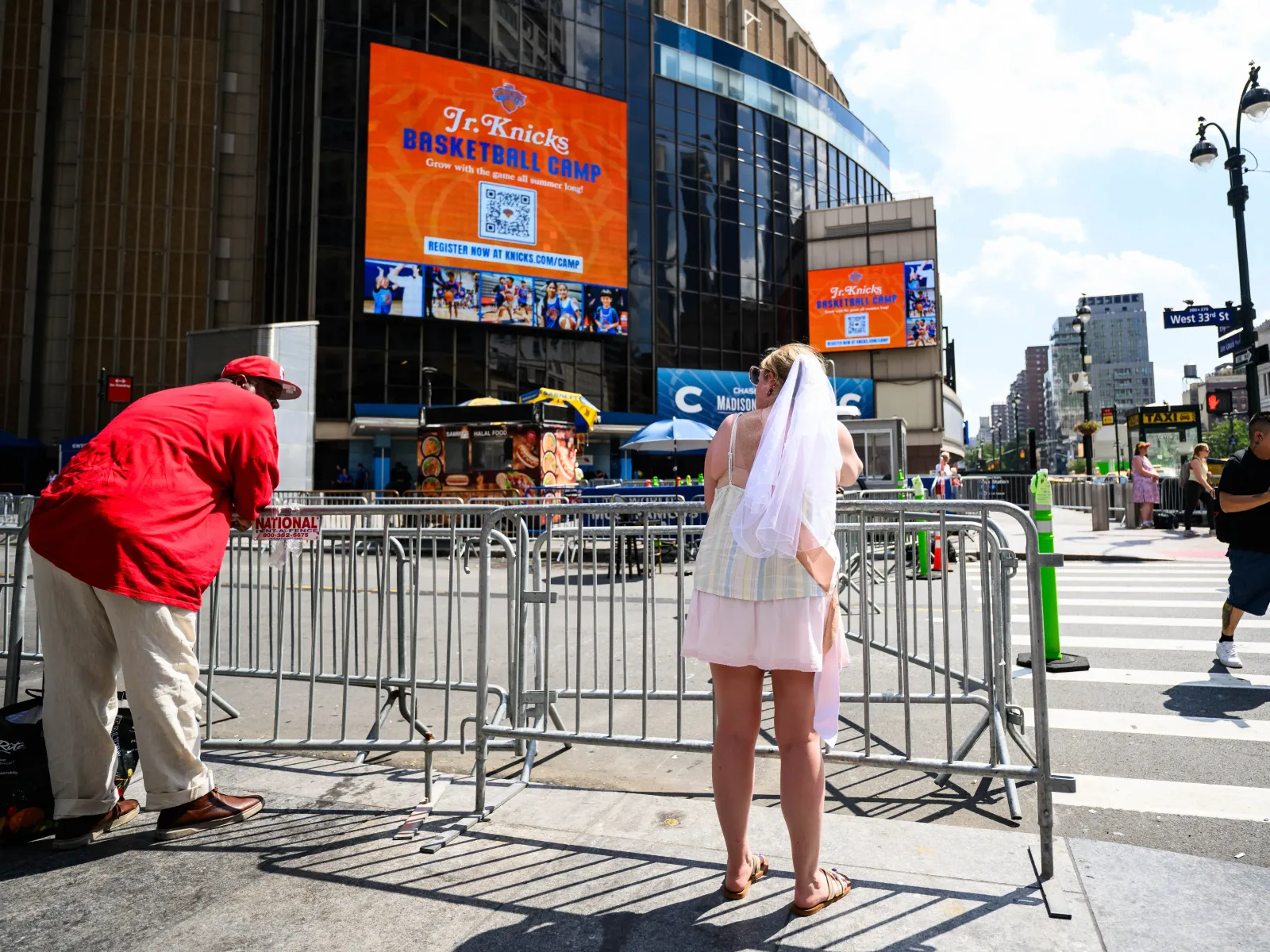
Taylor Swift and Travis Kelce hosted a reported wedding celebration at Madison Square Garden, starting July 2 with a small gathering inside the venue and continuing July 3 with a larger ceremony. For executives watching brand, media, and logistics, the scene is a live case study in crowd control, heat risk, and operational signaling.
Temperatures at Madison Square Garden hit 97 degrees Friday afternoon, and even with cops and barricades, it looked like the wedding was drawing mostly press, not massive street crowds. Reports said Taylor Swift and Travis Kelce were throwing a wedding celebration inside the arena, but outside, business as usual gave way to the more familiar reality of celebrity security: controlled access, limited visibility, and a media scrum that could barely be outmatched by fans.
The key detail is that the scale outside did not match the scale of the moment inside. A handful of people gathered outside as temperatures hit 97 degrees, and they appeared vastly outnumbered by journalists looking for an interview or a celebrity sighting. Emma Rasco, a 19-year-old with a summer internship in New York City, told Business Insider she expected to see more of her fellow Swifties but was unsure where they were. “Not sure where they are yet,” she said. “Even if there's not much energy, I'm here to support my gal through thick or thin, behind closed doors or out in the open,” Rasco said.
This is the kind of event that looks like pure pop culture theater, but it is also an operations problem and an incentives problem. The wedding celebration between Swift and Kelce, described as perhaps America’s biggest pop star and her Super Bowl champion fiancé, reportedly started July 2 with a small gathering of about 100 people at a theater inside the venue. Then, according to the New York Times, which cited an internal police memo, a ceremony with some 1,000 guests was scheduled inside the arena on July 3. Festivities were set to wrap up around 2 a.m., per the same report.
Outside, the visible crowd dynamics turned into a security and information dynamic. Streets surrounding the storied arena were closed, and it was a sea of police officers rather than a sea of fans. On Seventh Avenue, dozens of people hung around around 4:30 p.m., mostly waving, and one person shouted obscenities at black SUVs with tinted windows that crept down the street ahead of the reported 5:30 p.m. ceremony. The person, who declined to give a name, said they were protesting billionaires. Meanwhile, others in the area wore soccer jerseys, appearing to be World Cup fans.
That detail matters because it links celebrity events to larger, already-active audience flows. Friday wasn’t just any day in New York. Several World Cup matches were scheduled across the US, and while none were in New York, hundreds of bars and other businesses across New York have tried to draw audiences for the games. The world soccer federation FIFA estimated that tourists would spend $7.5 billion across the US, Canada, and Mexico for the games. When you stack a global entertainment brand moment against ongoing sports tourism and broadcast hype, the “who is in the street?” question stops being trivial. It becomes competition for attention, foot traffic, and even local comms.
Then there’s the heat and infrastructure angle, which is increasingly relevant for anyone planning events, operations, or venue strategy. Photos on social media showed crowds at Penn Station, the rail hub across the street from the arena. New Jersey Transit said a disabled train on the busy Northeast Corridor would delay trips by up to 90 minutes. It also said trains may roll more slowly because of the heat, which can cause power lines to sag and rails to buckle. In other words, even if the wedding plan is tightly choreographed inside, the surrounding transportation network can be forced into a slower tempo by physical conditions.
Second-order implications show up in exactly the places boards and operators care about: predictability, contingency planning, and brand signaling under constraints. For example, the reporting also referenced weeks of anonymously sourced reports about elaborate sets leaking from inside the arena, and some trucks being unloaded labeled “Garden Party.” That is a small clue with big meaning. When logistics vendors, staging areas, and unloading schedules are involved, even controlled environments can leak details through labeling, movement, and timing. That can be useful as marketing fuel, but it also creates security and expectation management challenges.
There were also attendance and entertainment signals feeding the public storyline. The New York Post reported that Stevie Nicks and Tim McGraw are expected to attend and perform. Whether or not every detail is confirmed at the street level, these names shape how people interpret the event, how media covers it, and how venue staff manage external expectations.
Finally, zoom out: this is an example of how mega-brands can trigger real-world friction even when the event is “behind closed doors.” Cecily Hall, a fan, said she initially thought Swift and Kelce might get married at a home Swift has in Rhode Island, but at MSG, “you have sports and music combined into one venue,” making it a fitting place for a singer and the Kansas City Chiefs' tight end to tie the knot. That sentence is more than fan commentary. It is the logic operators can recognize: the venue itself becomes a product. MSG is not just a building; it is the stage that merges industries, audiences, and infrastructure.
So what should executives in adjacent worlds take from this? Whether you are running a venue, managing event operations, advising a media company, or overseeing risk for brand activations, the lesson is clear. The headline moment can be contained, but the environment around it is not. Heat at 97 degrees, a delayed train by up to 90 minutes, police closures, and mixed crowds from soccer interest all interact in ways that either make the day run smoothly or turn it into a logistics tax.
This story's Key Insights and Take-aways are locked.
Create a free account to unlock Executive Actions for one credit.
Register to UnlockAlways free for Executives Club members. Join the Club
More in Entertainment

Russell Brand's accuser 'bewildered and confused' as he denies 7 sex charges
The criminal case against the comedian is a live test of how media companies manage talent risk when serious allegations go public.

'It's a Magic Trick': Ballet Experts Say Rosalía's SNL Pose Is Impossible
Three ballet experts tell Rolling Stone Rosalía's gravity-defying SNL stillness shouldn't be possible - and why the debate is now part of the show.

Activision CMO: GTA 6 Will Boost Call of Duty, Not Bury It
Activision's top marketer says Rockstar's blockbuster will drive players back to consoles and into Modern Warfare 4, even as the company admits its recent strategy failed.