
NASA adds “America 250” to Artemis 2’s SLS rocket, unveiled Dec. 2
A semiquincentennial paint job comes with real spacecraft details, plus a playbook for how NASA sells big missions.
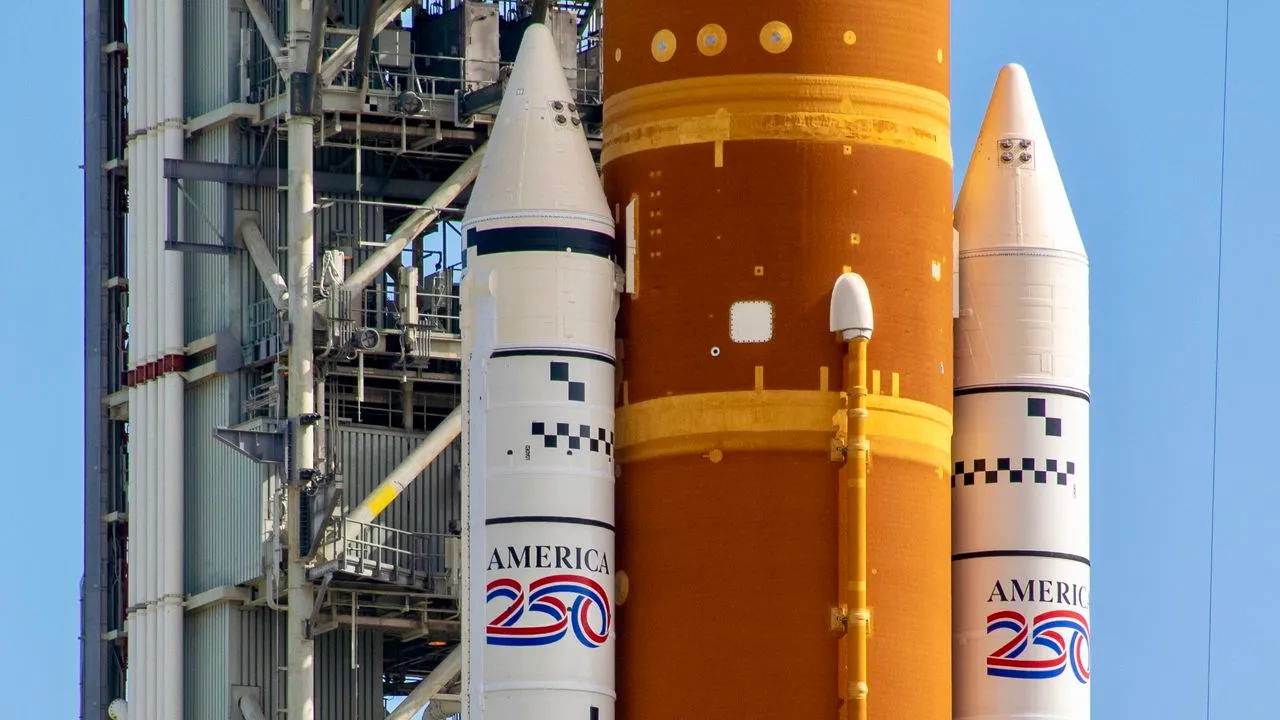
NASA painted two giant “America 250” logos on the Space Launch System (SLS) rocket that launched the Artemis 2 astronauts on April 1. For decision-makers, it is a reminder that branding, public signaling, and technical messaging are now part of mission delivery.
NASA made its Artemis 2 moon mission visibly official for America’s 250th birthday by adding two giant “America 250” logos to the Space Launch System (SLS) rocket. The “America 250” reveal happened on Dec. 2, after the rocket had already been completed and fully stacked earlier, in time for its spring launch on April 1.
That timing matters because Artemis 2 is not a test payload floating in PR space. On April 1, SLS lifted off with the Orion spacecraft on a 10-day mission around the moon and back to Earth. The crew included NASA astronauts Reid Wiseman, Victor Glover, and Christina Koch, plus the Canadian Space Agency’s Jeremy Hansen. The mission started with the roaring ignition of SLS’s four RS-25 engines and its two massive solid rocket boosters (SRBs), stacking together enough force for liftoff: 8.8 million pounds (4 million kilograms).
If you are wondering why a pair of birthday logos on a rocket even belongs in an executive briefing, here is the direct answer: NASA is using pageantry to make a technically complex mission legible to the public. Rockets are already complicated enough, with multiple stages and systems working in concert. Spaceflight is also expensive, regulated, and politically sensitive in ways most industries never have to manage. “America 250” is a cultural hook, yes, but it is also a communication device, a way to keep attention locked on the mission when the details might otherwise be too abstract for non-specialists.
The physical setup on Artemis 2 underlines that complexity. Each SRB is integrated into a sectioned stack that stands 177 feet (54 meters) tall on either side of the core SLS booster. That core booster sits between the SRBs, supported by the structure connecting them. With the SRBs securely clamped to the launch pad, SLS is held in the center largely by the strength of interstage bolts at the connection points. At liftoff, the thrust forces act opposite to the bolt loads, essentially turning those joints into the structural springboard for escape velocity.
There is also a straightforward engineering logic to the launch sequence that makes the public narrative easier to sell. NASA notes that SLS’s four RS-25 engines are not powerful enough to carry the rocket through its initial phase of flight, so the SRBs supply the extra force needed to lift SLS off the launch pad. That is a simple story with a real consequence: without the boosters doing their job at the beginning, the whole stack would never get rolling. In other words, the rocket’s “why it works” has a clear beginning, and that is the kind of storyline that branding can amplify.
The “America 250” also did not stay confined to paint. A special patch worn by the Artemis 2 astronauts honors America’s 250th anniversary. On their flight suits, each astronaut wore a red-outlined patch featuring SLS blasting off toward the moon and Mars above a United States flag and the phrase “THE ROCKET’S RED GLARE,” quoting lyrics from the U.S. national anthem. NASA said the patches first made an appearance in January, during the first Artemis 2 SLS rollout from the Vehicle Assembly Building (VAB), and that they were worn by the crew before, during, and after their mission.
This is where the “second-order” part comes in for executives watching public-sector programs, major capex, or any organization dependent on sustained legitimacy. Branding is not just decoration when your mission depends on public attention, stakeholder confidence, and ongoing political support. NASA is explicitly tying discovery to national identity: after the “America 250” SRB reveal last year, the space agency said in a statement, “America’s spirit of discovery is alive, and Artemis is carrying it to the moon and beyond.” That is not a technical claim. It is a positioning claim. And in government-backed megaprojects, positioning often decides how consistently funding and attention show up.
The Artemis 2 rocket itself also had its own logistics arc that explains how NASA could add the “America 250” later without breaking the program rhythm. The Artemis 2 SLS spent much of 2025 under assembly inside NASA’s Vehicle Assembly Building at Kennedy Space Center in Florida. The rocket was completed and fully stacked by October last year, but the “America 250” was added later and unveiled on Dec. 2. So the creative work had a window after the major stack readiness, which suggests a broader lesson: in complex programs, the final-mile visual and narrative layers can be staged without disrupting core readiness milestones, as long as the schedule is engineered for it.
For peers, the strategic stake is simple. If you lead a capital project, a regulated product rollout, or any endeavor that needs public buy-in over months or years, Artemis 2 shows how NASA pairs technical milestones with cultural timing. The mission is measured in engines and forces, but it is also measured in whether people stay watching. In the summer, NASA is celebrating America in other ways as well and points readers to an “America 250” website for a full list of events. The meta-takeaway: when the mission is hard to comprehend on first glance, the organization that controls the story has an easier time keeping trust while the hardware does the work.
This story's Key Insights and Take-aways are locked.
Create a free account to unlock Executive Actions for one credit.
Register to UnlockAlways free for Executives Club members. Join the Club
More in Science

Alaska's 1,580-foot tsunami had warning signs. Scientists just found them.
Rapid glacier retreat, heavy rainfall, and thousands of tiny tremors preceded Alaska's 1,580-foot tsunami, a warning for every coastal community in a warming world.

The rare mutation that lets high-risk brains dodge Alzheimer's
Scientists found a natural defense against protein buildup, opening a new path to preventive treatments.

3,000 steps a day may halve Alzheimer's decline, study finds
New research links a modest daily walk to less tau buildup and nearly half the cognitive and functional decline, even for those with early signs.