
NASA awards nearly $600M for four Moon landings, targeting late 2028
The agency bundles shared science payloads for dust, navigation, and radiation mapping to support a permanent lunar base.
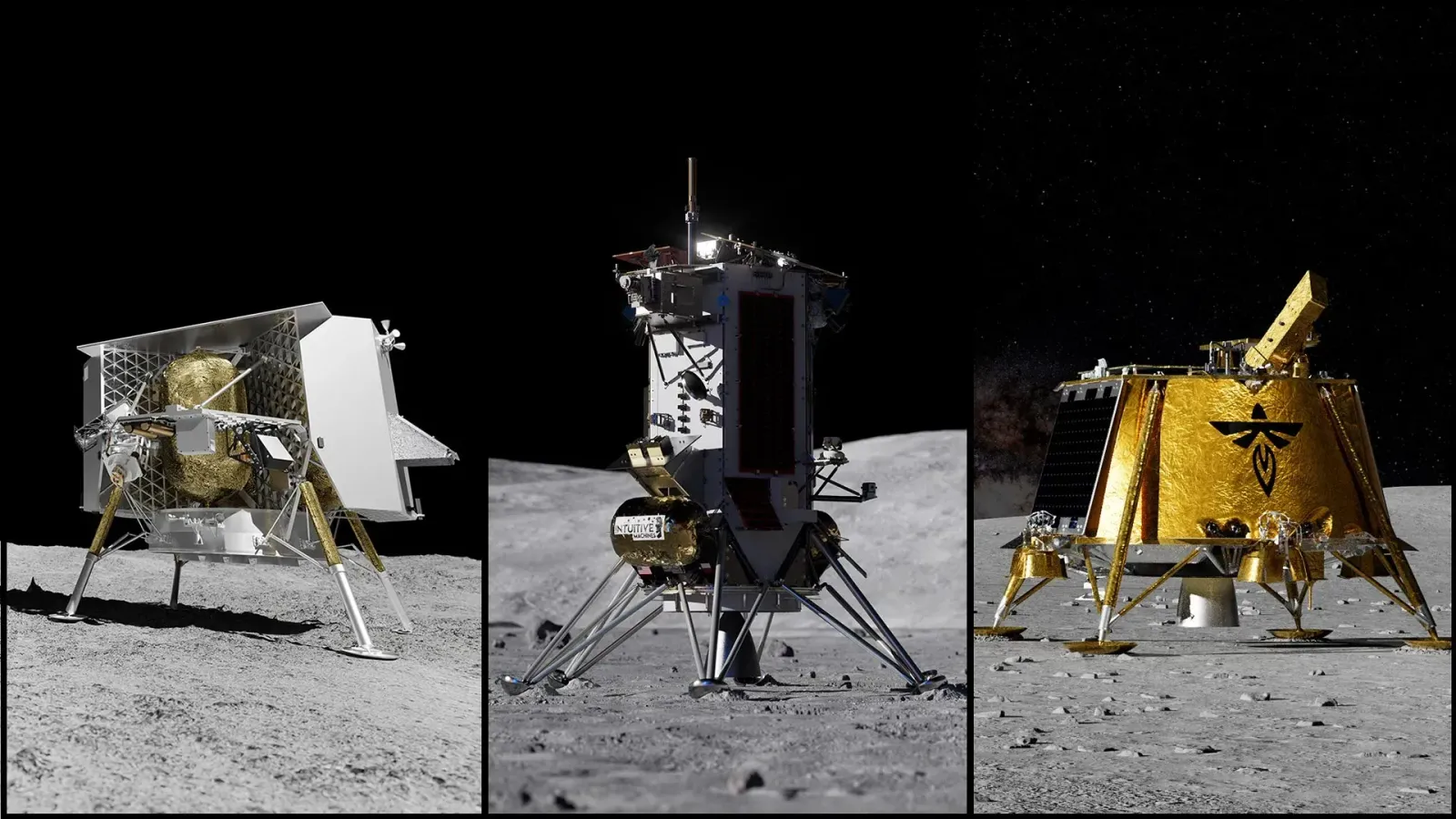
NASA selected four new commercial Moon landing missions, awarding nearly $600 million with plans for late 2028 launches. Each mission will carry the same trio of instruments to advance lunar navigation, dust risk understanding, and radiation environment mapping.
NASA just pushed its permanent Moon base plan into the procurement era, awarding nearly $600 million for four new commercial Moon landing missions planned for late 2028. The headline number matters because it signals NASA is treating lunar infrastructure as something you buy and iterate on, not just something you demonstrate once.
The agency also made the missions operationally comparable by standardizing the science payload. Each landing will carry the same trio of instruments, aimed at improving lunar navigation, studying dangerous dust kicked up during landings, and mapping the Moon's radiation environment. If you are an executive tracking space business, that combination is the point: it is not only about getting to the Moon. It is about making landing repeatable, survivable, and measurable enough to support ongoing surface activity.
To understand why this procurement move matters, it helps to zoom out on how lunar missions typically work. Landing on the Moon is one of those “all risks at once” problems. You have guidance and navigation constraints, you have landing dynamics you have to model and test, and you have crewless hardware that still needs to function through the conditions it was built for. Dust is not a footnote. Lunar regolith is abrasive and can create cascading failures by interfering with mechanisms, sensors, and optics. The source explicitly calls out the study of dangerous dust kicked up during landings. That means NASA is funding the evidence-gathering that could turn dust from a guess into an engineering parameter.
The navigation and radiation pieces reinforce that same theme of operational maturity. Lunar navigation is not just about where you are today. It is about how accurately you can update your position as you approach, how you can correct in real time, and how you can do it across different mission profiles and hardware configurations. Meanwhile, the Moon's radiation environment affects electronics and materials, and it changes how you think about mission duration and reliability. NASA is mapping that radiation environment using the standardized instruments carried on each mission, which should reduce the amount of one-off “we learned something” variability and increase the amount of “we can compare across missions” clarity.
And NASA is not stopping at landers and instruments. The agency also revealed plans for new rovers, communication satellites, and additional cargo missions. That matters for commercial operators and suppliers because a permanent base is a system problem, not a single vehicle problem. A lander that can touch down is only one layer. You then need roving capability to move science and equipment around, communications that can handle the bandwidth and latency realities of lunar operations, and cargo missions that keep the base supplied. By bundling the lander-focused science with follow-on infrastructure plans, NASA is implicitly telling the market what it will optimize for next: repeatable surface operations, not just successful landing headlines.
There is also a subtle procurement incentive here. Standardized instrumentation can simplify evaluation and increase the value of the data returned. If all four missions carry the same trio of science instruments, NASA can compare results across missions more cleanly, which can tighten requirements for future rounds. For companies, this can mean less ambiguity about what performance NASA will consider mission success, while still allowing each commercial team to differentiate on landing execution. The nearly $600 million figure indicates NASA is serious about moving from exploratory engineering toward a cadence that could look more like program management than prototype science.
For boards, investors, and executives in adjacent space sectors, the second-order implication is straightforward: the market is being built around lunar operations infrastructure. Communication satellites and rovers create downstream demand for power systems, autonomy software, robotics, sensing, thermal management, and ruggedized electronics. Cargo missions, too, suggest logistics and integration will be a competitive arena. If your company sells into space missions, this kind of NASA roadmap tends to be the difference between “we won a demo” and “we are now part of a recurring supply chain.”
Ultimately, NASA is using these four missions to de-risk the foundation of a permanent Moon base. Late 2028 is not tomorrow, but it is soon enough that procurement timelines, supply chain commitments, and engineering cycles have to align now. The agency's approach, standardizing the science payload while also planning rovers, communication satellites, and additional cargo missions, is a signal to the entire ecosystem. The winners will be the teams that treat landing as the beginning of an operations loop, not the end of a launch story.
This story's Key Insights and Take-aways are locked.
Create a free account to unlock Executive Actions for one credit.
Register to UnlockAlways free for Executives Club members. Join the Club
More in Science

Alaska's 1,580-foot tsunami had warning signs. Scientists just found them.
Rapid glacier retreat, heavy rainfall, and thousands of tiny tremors preceded Alaska's 1,580-foot tsunami, a warning for every coastal community in a warming world.

The rare mutation that lets high-risk brains dodge Alzheimer's
Scientists found a natural defense against protein buildup, opening a new path to preventive treatments.

3,000 steps a day may halve Alzheimer's decline, study finds
New research links a modest daily walk to less tau buildup and nearly half the cognitive and functional decline, even for those with early signs.