

NASA gives July 14 launch and docking coverage window for Soyuz MS-29
Follow Anil Menon, Pyotr Dubrov, and Anna Kikina from liftoff to Prichal docking, hatches open on NASA+.
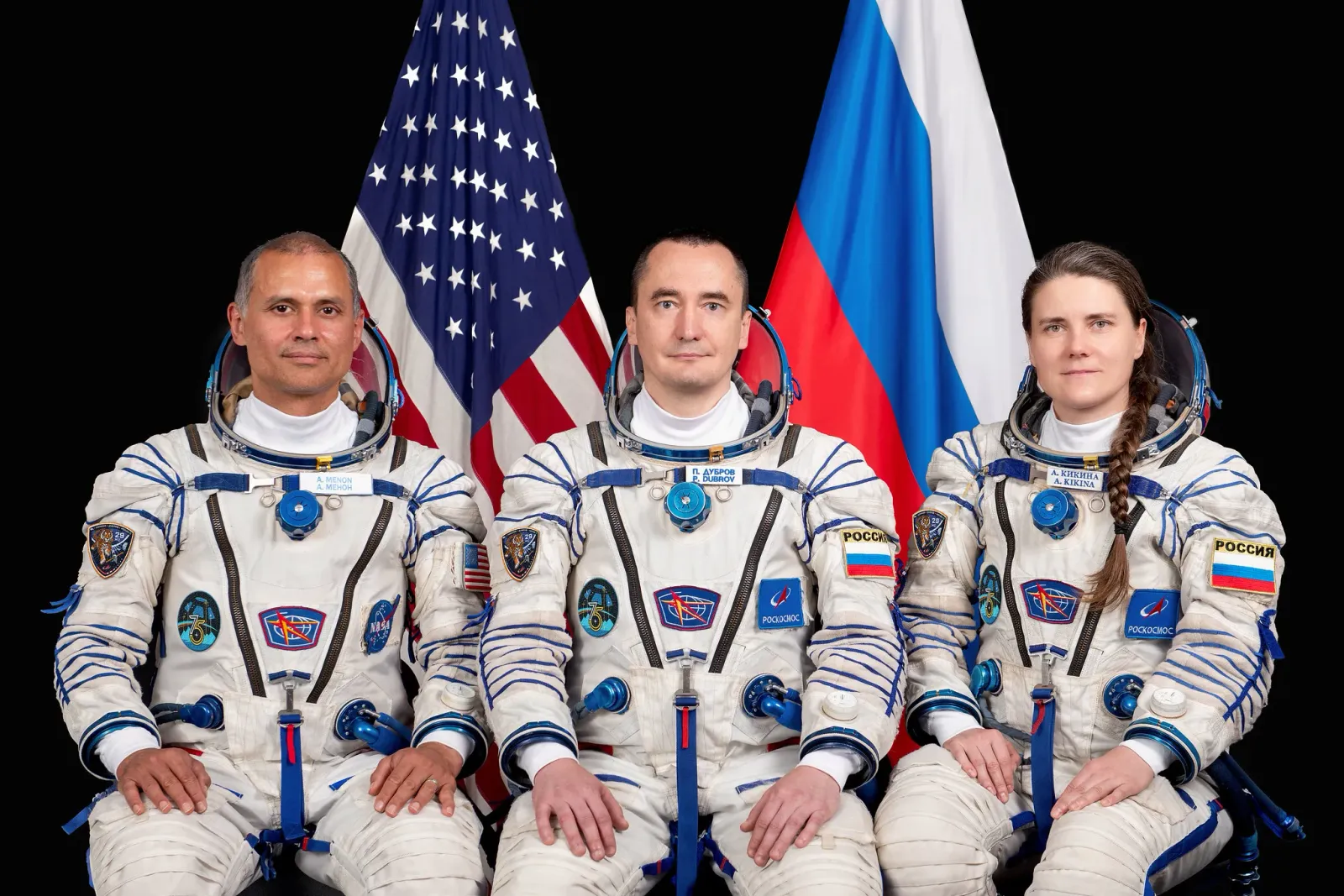
NASA announced coverage timing for astronaut Anil Menon’s July 14 launch aboard Roscosmos Soyuz MS-29 to the International Space Station with cosmonauts Pyotr Dubrov and Anna Kikina. The schedule matters for decision-makers and teams who need precise coordination around live mission milestones, research handoffs, and media planning.
NASA is setting the play clock for a key rendezvous-and-docking moment in low Earth orbit. On Tuesday, July 14, NASA astronaut Anil Menon will launch aboard the Roscosmos Soyuz MS-29 spacecraft at 10:47 a.m. EDT (7:47 p.m. Baikonur time), with coverage that starts earlier and tightens around docking and hatch opening.
Here are the specific milestones NASA says are covered (all times Eastern and subject to change based on real-time operations): Tuesday, July 14, 9:45 a.m. launch coverage begins on NASA+, Amazon Prime, and YouTube; 10:47 a.m. launch; 1:10 p.m. rendezvous and docking coverage begins; 1:56 p.m. docking at the Prichal module; 3:30 p.m. hatch opening and welcome coverage begins; and 3:55 p.m. hatch opening. After a two-orbit, three-hour trip, the spacecraft will automatically dock at 1:56 p.m. to the Prichal module, and “shortly afterward,” hatches will open between the Soyuz and the orbiting laboratory.
That schedule is not just viewer convenience. It is a real-world coordination signal for the people who run missions, manage research timelines, and synchronize the downstream flow of data and experiments. In a program where the International Space Station has supported more than 25 years of continuous habitation, minutes matter because crews rotate, experiments begin and end on time, and operational handoffs are planned around when visiting spacecraft arrive. The Soyuz docking and hatch opening windows are the hinge points.
Once aboard, Menon, Dubrov, and Kikina will join the Expedition 74 crew. Menon, Dubrov, and Kikina become part of Expedition 74/75 as they spend about eight months aboard the orbital complex, then return to Earth in April 2027. This will be Menon’s first spaceflight, and it will be the second for both Dubrov and Kikina, meaning the mission also blends first-time flight execution with experience from returning crew.
The mission’s scientific and technology workload also explains why NASA is emphasizing the handoff moments. During his stay, Menon will conduct research and technology demonstrations focused on advancing human space exploration and benefiting life on Earth. The list is packed with second-order “why this matters” items for executives and operators watching the long arc of space commercialization, life sciences, and high-performance computing.
First, Menon will continue research aimed at refining in-space production of semiconductor crystals. The goal is to enable large-scale manufacturing of components needed for high-performance computers, artificial intelligence, and improved medical devices. That is a pipeline story: getting better materials from space supports the downstream supply chain for hardware that touches terrestrial industries, especially the compute and healthcare categories that drive big budgets.
Second, Menon will perform ultrasound using augmented reality and artificial intelligence methods. NASA says these methods could eliminate the need for medical support from Earth on future space missions, which is a direct response to a constraint of distance and communications latency. Third, he will act as a test subject to help researchers understand how blood flow is affected in space to protect future astronauts. Fourth, Menon will test bioprinting vascular constructs in microgravity to improve understanding of the aging process and advance therapeutic developments. In other words, this is not “space novelty.” It is research designed to reduce medical risk for crews and to generate better biomedical understanding back on Earth.
For decision-makers tracking the ISS ecosystem, there is another layer: NASA frames the station as a platform for long-duration missions to the Moon and onward to Mars, as part of the Artemis program, while also expanding commercial opportunities in low Earth orbit and building the foundation for longer stays. That background matters because it shapes budgets, partnerships, and the regulatory posture around human spaceflight and research operations. The station helps NASA understand and overcome challenges of human spaceflight, and the arrival of a new crew is the operational prerequisite for keeping that momentum.
If you are a leader in a neighboring domain, the lesson is practical. Live coverage is the visible part; the real governance is the timing. Docking at 1:56 p.m. to the Prichal module, then hatch opening and welcome coverage starting at 3:30 p.m., and the subsequent joining of the crew are how research programs avoid idle time and keep experiment schedules aligned. NASA also directs viewers to learn how to watch across platforms, including social media, and notes that live launch and docking coverage is available on NASA+, Amazon Prime, and the agency’s YouTube channel.
Bottom line: on July 14, Menon’s Soyuz MS-29 mission will move from “launch” to “integrated station operations” on a clock NASA has publicly mapped. The tighter your mission, media, and research coordination, the more valuable a precise window like this becomes.
This story's Key Insights and Take-aways are locked.
Create a free account to unlock Executive Actions for one credit.
Register to UnlockAlways free for Executives Club members. Join the Club
More in Science

Alaska's 1,580-foot tsunami had warning signs. Scientists just found them.
Rapid glacier retreat, heavy rainfall, and thousands of tiny tremors preceded Alaska's 1,580-foot tsunami, a warning for every coastal community in a warming world.

The rare mutation that lets high-risk brains dodge Alzheimer's
Scientists found a natural defense against protein buildup, opening a new path to preventive treatments.

3,000 steps a day may halve Alzheimer's decline, study finds
New research links a modest daily walk to less tau buildup and nearly half the cognitive and functional decline, even for those with early signs.