
NASA's SPHEREx Telescope Launches to Reveal the Universe's Hidden History
The new infrared observatory will map the entire sky in 102 colors, probing cosmic inflation and the origins of water.
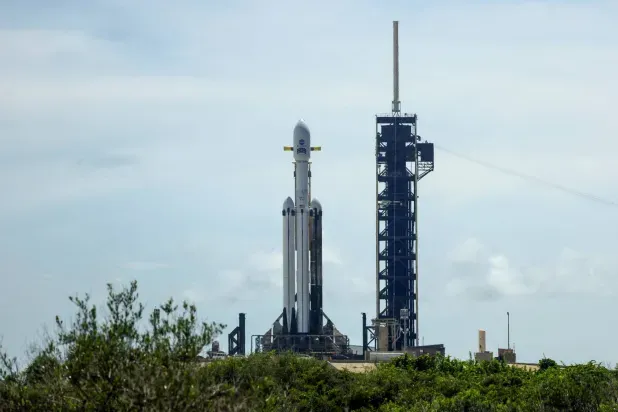
NASA's SPHEREx telescope launched on March 11, 2025, to survey the sky in infrared and uncover clues about the universe's earliest moments and the presence of water in star-forming regions. The mission will create a comprehensive map that could reshape our understanding of cosmic evolution and guide future observations by the James Webb Space Telescope.
On March 11, 2025, NASA's newest space telescope, SPHEREx, launched from Vandenberg Space Force Base aboard a SpaceX Falcon 9 rocket. The mission, officially named the Spectro-Photometer for the History of the Universe, Epoch of Recombination, and Ices Explorer, is designed to survey the entire sky in near-infrared light. Its goal: to explore the hidden universe, from the faint glow of the early cosmos to the icy ingredients of planetary systems. The launch also carried PUNCH, a solar observatory, as a rideshare payload, demonstrating NASA's efficient use of launch opportunities.
SPHEREx is a cone-shaped observatory about the size of a small car. It will map the sky in 102 infrared colors, far more than any previous all-sky survey. Over its two-year primary mission, it will create a three-dimensional map of hundreds of millions of galaxies. This map will help scientists understand how the universe expanded after the Big Bang and how galaxies formed and evolved over billions of years. The telescope's unique design allows it to sweep across the sky, capturing data in a way that no other mission has done before.
One of SPHEREx's key objectives is to probe cosmic inflation, the rapid expansion of the universe that occurred a fraction of a second after the Big Bang. By measuring the distribution of galaxies, scientists can test theories about the quantum fluctuations that seeded the large-scale structure we see today. The mission will also study the history of galaxy formation, looking at how light from stars and black holes influenced the intergalactic medium. These observations could provide critical constraints on the physics of the early universe, potentially revealing new phenomena beyond our current understanding.
Another major focus is the search for water and organic molecules in regions where stars and planets form. SPHEREx will detect frozen water, carbon dioxide, and other ices in molecular clouds, providing clues about how these essential ingredients are delivered to young planets. This data could help answer fundamental questions about the origins of life on Earth and the potential for life elsewhere. By mapping the distribution of these ices across the galaxy, the mission will offer a new perspective on the cosmic water cycle.
SPHEREx is designed to complement NASA's James Webb Space Telescope. While JWST zooms in on specific targets with incredible detail, SPHEREx provides a broad survey that can identify interesting objects for follow-up. The mission's all-sky map will be a public dataset, enabling astronomers worldwide to mine it for discoveries. This synergy between wide-field and deep-field observations is a new paradigm for space astronomy, maximizing the scientific return from both missions. The data will be released in stages, with early results expected within months.
The launch of SPHEREx marks a new chapter in our exploration of the cosmos. Its findings could reshape our understanding of the universe's earliest moments, the evolution of galaxies, and the cosmic distribution of water. For scientists and space enthusiasts alike, the mission promises a treasure trove of data that will fuel research for decades. As SPHEREx begins its survey, the hidden universe is about to come into focus, offering a clearer picture of our place in the cosmos and the forces that shaped it.
This story's Key Insights and Take-aways are locked.
Create a free account to unlock Executive Actions for one credit.
Register to UnlockAlways free for Executives Club members. Join the Club
More in Business

Tim Cook steps down as Apple CEO, stays on as chair with $45M equity
The 'Trump whisperer' keeps his White House and Beijing access as Apple navigates tariffs and a $4.6 trillion market cap.

Snowflake shares surge as AI data demand crushes estimates, lifting full-year forecast
Stocks jumped on stronger-than-expected guidance, signaling enterprise AI workloads are accelerating faster than Wall Street priced in.

Tim Cook's 15-year Apple CEO run ends: 3 lessons for any successor
After 15 years, Tim Cook hands Apple to John Ternus - here's how he turned a $350B company into a $4.6T juggernaut.