
NOAA traces June 30 X1.1 flare to R3 radio blackouts across North America
An X1.1 solar flare from AR4479 peaked at 4:50 p.m. EDT, briefly degrading high-frequency radio during daylight hours.
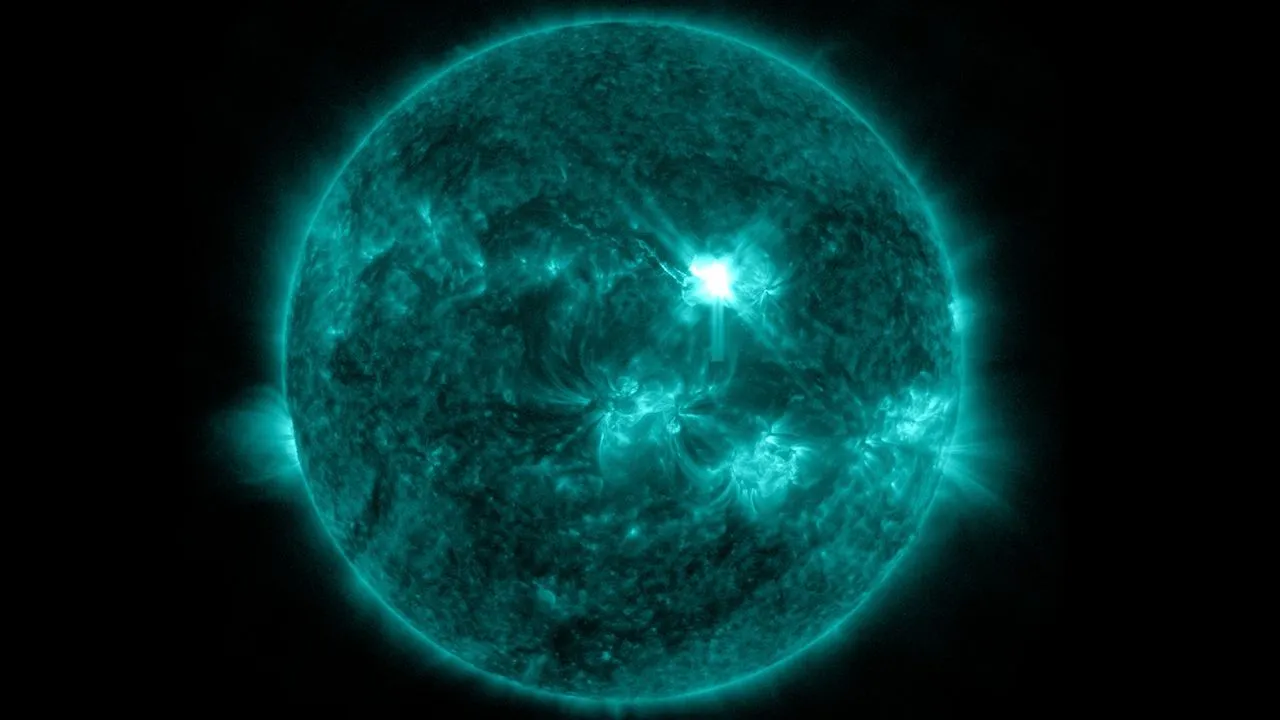
NOAA's Space Weather Prediction Center tracked a June 30 X1.1 solar flare from sunspot region AR4479 that peaked at 4:50 p.m. EDT (2050 GMT). The flare triggered strong (R3) radio blackouts across the daylight side of Earth and released a CME that appears to be mostly northward.
Earth got a very specific kind of headache on June 30. A restless Earth-facing sunspot, AR4479, unleashed an X-class solar flare that NOAA says peaked at 4:50 p.m. EDT (2050 GMT), and it didn’t just make space weather headlines. It triggered strong (R3) radio blackouts across the daylight side of Earth.
Here’s why decision-makers in communications, critical infrastructure, and operations should care. The X1.1 flare’s intense burst of X-rays reached Earth in just over 8 minutes, degrading high-frequency radio performance across parts of North America while the flare was at its strongest. If your organization relies on high-frequency radio for coordination, it can translate from “space weather” into “temporary signal degradation or brief communication outages” quickly, even when the risk horizon is short and the event is brief.
The flare itself matters because of how solar flares are categorized. Solar flares are sudden bursts of energy released when magnetic fields around sunspots become twisted and reconnect. NOAA’s Space Weather Prediction Center identified this eruption as an X-class flare, specifically X1.1, which is at the top end of the five-class system. The system is A, B, C, M, and X, with X representing the most powerful eruptions. In practice, that labeling is a shorthand for how big the radiation spike is likely to be when it hits Earth.
The next domino is the coronal mass ejection that came with the flare. The eruption launched a CME, a huge cloud of magnetized solar plasma hurled into space. CMEs behave differently from the flare radiation: unlike the light-speed rush of X-rays, these clouds of charged particles typically take one to three days to reach Earth. That time lag is operationally important. It gives forecasters and infrastructure operators a window to adjust plans for potential downstream effects like geomagnetic storms, which can disrupt power systems and add friction to communications, navigation, and other Earth-linked technologies.
Now for the part that changes the stake level. Early observations suggest this particular CME is traveling mostly northward, with only limited Earth-directed material. That reduces the likelihood of a major geomagnetic storm or widespread aurora display. Forecasters note we may experience a glancing blow around July 3, meaning the main impact could be more edge-case than full-on storm conditions. If that holds, the immediate “can we communicate?” pressure stays focused on the earlier radio blackout phase driven by the flare itself, rather than escalating into a longer, more systemic event.
Still, the near-term timing cannot be ignored. With the Fourth of July just days away, a more Earth-directed CME could have turned the sky into a different kind of fireworks display. Instead, the current expectation is “low chances of widespread northern lights” because significant geomagnetic storm conditions are unlikely to develop. But space weather is famously not a one-time event. AR4479 is still facing Earth, and the outlook could rapidly change if the sunspot unleashes another flare and a better-aimed CME over the next few days. That’s the operational punchline: even if this CME is likely mostly northward, the same region can produce another round.
For executives and boards thinking in risk terms, this is a reminder that space weather risk is not purely academic, even when it is short-lived. The flare’s fastest impact arrived in just over 8 minutes, and the radio blackout signal was labeled as strong (R3) across the daylight side of Earth, mainly affecting high-frequency radio users across parts of North America. The second-order implication is that “brief outages” can still create real business consequences when they collide with peak operational windows, especially in distributed systems where coordination depends on time-sensitive links.
The strategic stake for peers is simple: build processes that assume you can get hit quickly on the communications layer, then reassess as the slower CME story unfolds over the following 1 to 3 days. Even when early observations suggest a glancing blow around July 3 and forecasters say a significant geomagnetic storm or widespread aurora display is unlikely, the sun does not commit to a single outcome. Keeping a close eye on the region is not just for aurora chasers. It’s for anyone whose uptime depends on staying ahead of the next signal degradation window.
This story's Key Insights and Take-aways are locked.
Create a free account to unlock Executive Actions for one credit.
Register to UnlockAlways free for Executives Club members. Join the Club
More in Science

Alaska's 1,580-foot tsunami had warning signs. Scientists just found them.
Rapid glacier retreat, heavy rainfall, and thousands of tiny tremors preceded Alaska's 1,580-foot tsunami, a warning for every coastal community in a warming world.

The rare mutation that lets high-risk brains dodge Alzheimer's
Scientists found a natural defense against protein buildup, opening a new path to preventive treatments.

3,000 steps a day may halve Alzheimer's decline, study finds
New research links a modest daily walk to less tau buildup and nearly half the cognitive and functional decline, even for those with early signs.