
Notion shuts Notion Mail on Sep 22, citing AI agents replacing inbox work
The email product gets pulled in under 18 months, as Notion points to AI agent triage, replies, and scheduling.
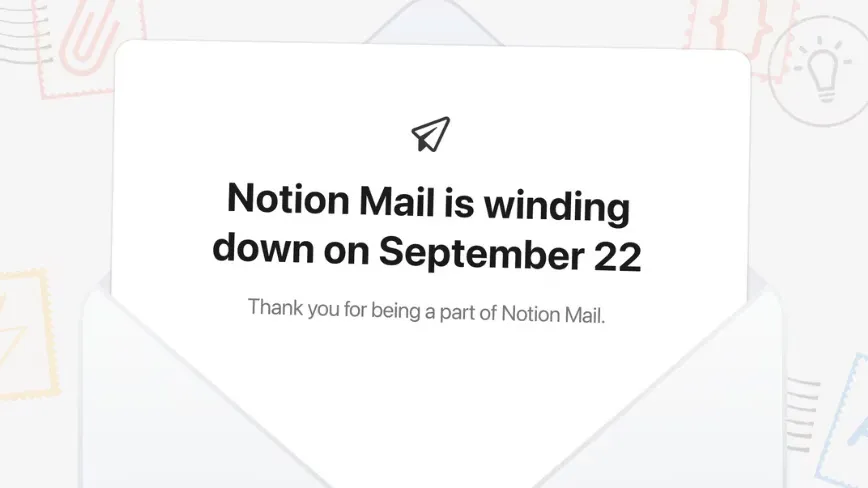
Notion is shutting down Notion Mail on September 22, less than 18 months after launching the email product. The company says AI agents are increasingly doing the inbox work, changing how people interact with email.
Notion is shutting down Notion Mail on September 22, less than 18 months after making the email product available to users. In plain terms: the company is walking away from a direct-to-inbox product fast, and it is explicitly telling users why, which matters because most startups quietly fade features and move on.
Notion’s rationale is that the job of email is being redefined by AI agents. The company argues that AI agents increasingly handle triage, responses, and scheduling, so users may not need to open an inbox at all. That is the strategic bet behind the shutdown, and it answers the real question behind the headline: Notion is not just ending an app. It is trying to align its product roadmap with a new workflow where the inbox is less central.
To understand why this move is worth attention beyond Notion’s user base, you have to zoom out to what email has always been in business software. Email is not just a messaging channel; it is an operating system for work. People use it to route decisions, request action, coordinate time, and capture commitments. Even when companies add calendars, CRMs, and chat tools, email remains a default because it is where external communication, internal escalation, and accountability converge.
So when Notion claims AI agents can cover “triage, responses, and scheduling” without forcing someone to open an inbox, it is saying something more consequential than “our app is smaller than it used to be.” It is effectively arguing that the value of the inbox can be redistributed: sorting can become automated, replies can become generated, and scheduling can become coordinated, all upstream of the user’s reading and writing. That is a second-order shift that impacts product design across the category, because the interface changes from inbox management to oversight of an automated workflow.
Notion is not alone in noticing this shift. Across the tech ecosystem, the strongest AI product narratives have been about reducing the number of manual steps required to complete work. If email is one of those “manual steps,” then an AI agent that can manage parts of email could reduce friction for users. But reducing friction also creates tough incentives for product teams. If users get value without relying on the specific surface area of an email client, maintaining the client becomes a cost center rather than a growth engine.
There is also an organizational angle here. Notion sells a single, coherent productivity platform, and it has to decide where new capabilities live: inside the core product, inside adjacent apps, or as agent-driven workflows that span multiple tools. Shutting down Notion Mail suggests Notion concluded that the email client itself was not the winning path, at least not within the time horizon it targeted. The company made the decision quickly enough that it had only been “less than 18 months” since Notion Mail became available, which signals speed and clarity in internal prioritization.
Regulation and compliance are part of the backdrop, even if the source does not go deep into it. Email is a highly regulated communication channel in many contexts, with expectations around data handling, recordkeeping, and user control. Any shift toward AI agents that generate responses and manage scheduling raises governance questions for enterprises and admins, because the system is no longer just storing messages. It is producing actions. That does not automatically mean agents are blocked or disallowed, but it does mean businesses will demand stronger controls, auditability, and predictable behavior. When an email client gets shut down, it often forces customers to re-evaluate how their communications are handled across tooling.
For executives and boards watching adjacent productivity software, the strategic stake is simple: AI is not only replacing tasks, it is replacing product surfaces. Notion is betting that AI agents will do enough of the “inbox work” to make an email client less necessary, and it is acting on that belief by ending Notion Mail on September 22. If you are leading a company with email-adjacent offerings, scheduling workflows, or message triage features, this is a signal that investments in user interfaces tied tightly to inbox behavior may face a faster-than-expected relevance cycle. The winners might not be the teams that build more inbox tooling. They may be the teams that build agent-driven workflows where inbox management becomes optional, not default.
This story's Key Insights and Take-aways are locked.
Create a free account to unlock Executive Actions for one credit.
Register to UnlockAlways free for Executives Club members. Join the Club
More in Technology

Nvidia's $89B data center quarter: the 9 companies cashing in
The AI buildout is minting fortunes beyond GPUs, and memory, cloud, and cooling suppliers are riding the same wave.

Google quietly links your phone number to every Android account on your SIM
Adding a SIM now ties your phone number to all Google accounts - and future accounts inherit it. Here's the security and privacy stakes.

Hijacker AI 'Skynet mode' runs 100,000 attack steps against exposed models
Symantec caught a criminal AI agent that borrows other models, steals data, and mines crypto; the only relief is no confirmed victims yet.