

NVIDIA’s ENPIRE lets AI coding agents autonomously run robot training overnight
Jim Fan says the NVIDIA GEAR lab self-improves with a new agent harness that loops tools, feedback, and memory.
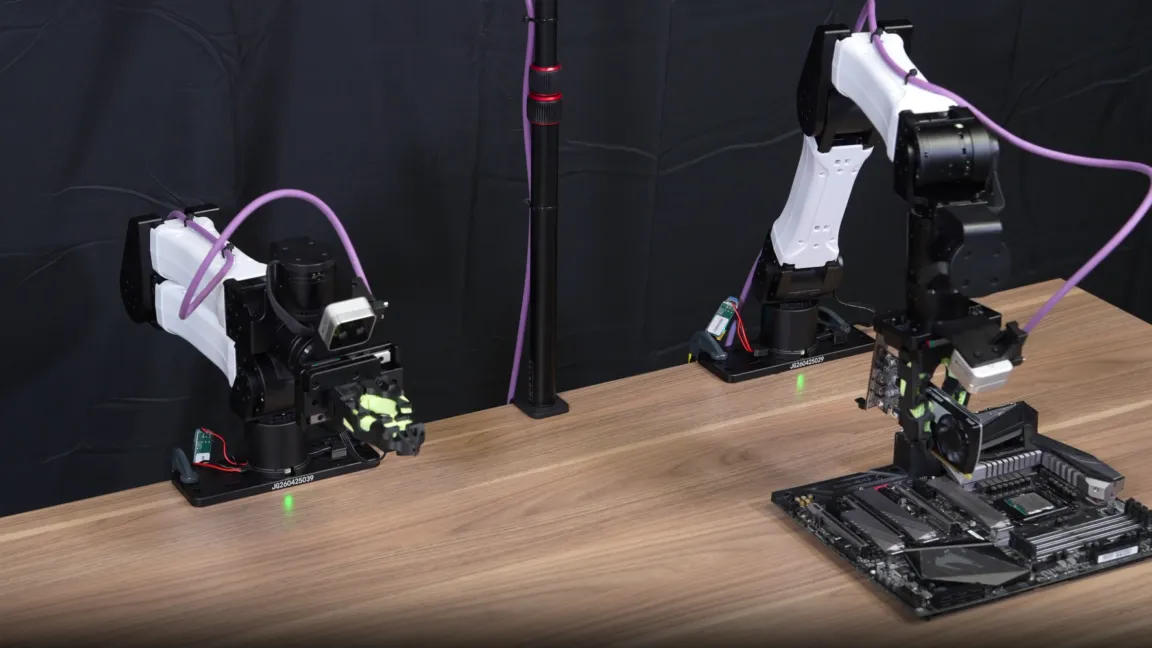
NVIDIA’s robotics researchers at the GEAR lab, with Carnegie Mellon and UC Berkeley collaborators, built ENPIRE, an agent harness framework for AI coding agents. In a LinkedIn post, Jim Fan, director of AI at NVIDIA, said a GEAR part now self-improves overnight by reading reports in the morning.
NVIDIA’s robotics lab just showed a path toward something that used to sound like sci-fi: AI coding agents autonomously directing robot training. The mechanism is ENPIRE, a “agent harness” framework that wraps around AI models so they can use tools while also handling memory, context, constraints, and feedback loops. In the example Ars Technica describes, agents can apparently generate and refine a training regimen that teaches robots to do real tasks like cutting zip ties and inserting GPUs into thin motherboard sockets.
This is the part Jim Fan pointed to. In a LinkedIn post, Fan, NVIDIA’s director of AI, wrote that “a part of our NVIDIA GEAR lab now self-improves tirelessly overnight,” and that the team “just read the reports in the morning.” The implication is not subtle. Instead of humans iterating on each step of training, the system can run an overnight cycle that outputs reports the researchers review, with the agent harness providing the scaffolding to keep the process constrained and feedback-driven.
To understand why ENPIRE matters to decision-makers, it helps to look at how robot training typically works. Training is rarely just “run an algorithm and wait.” Robots need tightly specified tasks, measurable success criteria, repeatable setups, and guardrails so the learning process does not wander into failure modes. In other words, the bottleneck is often not pure compute, but effective orchestration: which tools to use, what context matters, which constraints must be obeyed, and how the system gets feedback on what worked. Ars Technica’s description frames ENPIRE as exactly that orchestration layer, designed to wrap around AI models and connect them to tool use, memory, and looped feedback.
The article’s most telling detail is that the agents are treated like active engineering participants. Give them a lab full of robotic arms, some compute resources, and a “generous token budget” for teaching robots tasks, and they can figure out a training regimen. That regimen is not just a theoretical policy. Ars Technica reports it can translate into physical outcomes, including successfully cutting zip ties and inserting GPUs into thin sockets on motherboards. Those are not fluffy demos. They involve dexterous manipulation and precise positioning, which makes the result more credible as a step toward scalable automation.
There is also an incentives story lurking under the technical one. If a lab can run autonomous cycles overnight, the iteration rate changes. Humans can still review, but the “learning cadence” becomes much faster. Fan’s framing of “self-improves tirelessly overnight” is essentially a claim about throughput: the system does work when people are not watching. In lab and product settings alike, faster iteration can compress development timelines for tasks like manipulation, tool interaction, and eventually more general robotic behavior.
Still, this is not a regulator-shaped story in the article, and that matters because autonomous agents that touch the physical world raise questions beyond software. In many jurisdictions, organizations are moving toward clearer expectations around safety evaluation, auditability, and risk management for AI systems that affect the real world. ENPIRE’s emphasis on constraints and feedback loops is the kind of design detail that can support later governance conversations, because it suggests the system is not purely free-form. Instead, it is structured to operate within defined boundaries and to incorporate feedback.
Second-order implications for boards and executives: if agentic harness frameworks like ENPIRE become a standard way to connect AI models to tools and experimental loops, it could shift competitive advantage toward teams that can operationalize iteration, not just teams that can train models. Robotics programs often struggle to scale because each new task can require lots of manual engineering. An approach that automates parts of the training regimen design, with a system that can read reports in the morning, is a lever that could change cost curves and time-to-competence.
For peers building robotics, autonomous systems, or AI platforms, the strategic stake is straightforward. The path from “model can do X” to “system can reliably train robots to do X” is often where projects stall. ENPIRE, as described by Ars Technica and supported by NVIDIA’s GEAR lab activity as relayed by Jim Fan, is aimed at that exact gap. The question executives should ask is not whether agents can run. It is whether the harness architecture can keep the loops productive, constrained, and reviewable enough to scale from overnight demos to repeatable operations.
This story's Key Insights and Take-aways are locked.
Create a free account to unlock Executive Actions for one credit.
Register to UnlockAlways free for Executives Club members. Join the Club
More in Technology

Nvidia's $89B data center quarter: the 9 companies cashing in
The AI buildout is minting fortunes beyond GPUs, and memory, cloud, and cooling suppliers are riding the same wave.

A YouTuber dissected the iPhone Duo and thinks he found crackgate's cause
CuriousHagi's teardown of Apple's foldable reveals a gear-like hinge that may explain why screens crack in the same spot within hours.

Google quietly links your phone number to every Android account on your SIM
Adding a SIM now ties your phone number to all Google accounts - and future accounts inherit it. Here's the security and privacy stakes.