
Olivia Rodrigo launches Daisy Chain Fields with Bikini Kill, Chappell Roan, Stevie Nicks
A single-day, all-female lineup mixes rock legends and rising stars, testing how fast mainstream momentum can turn into events.
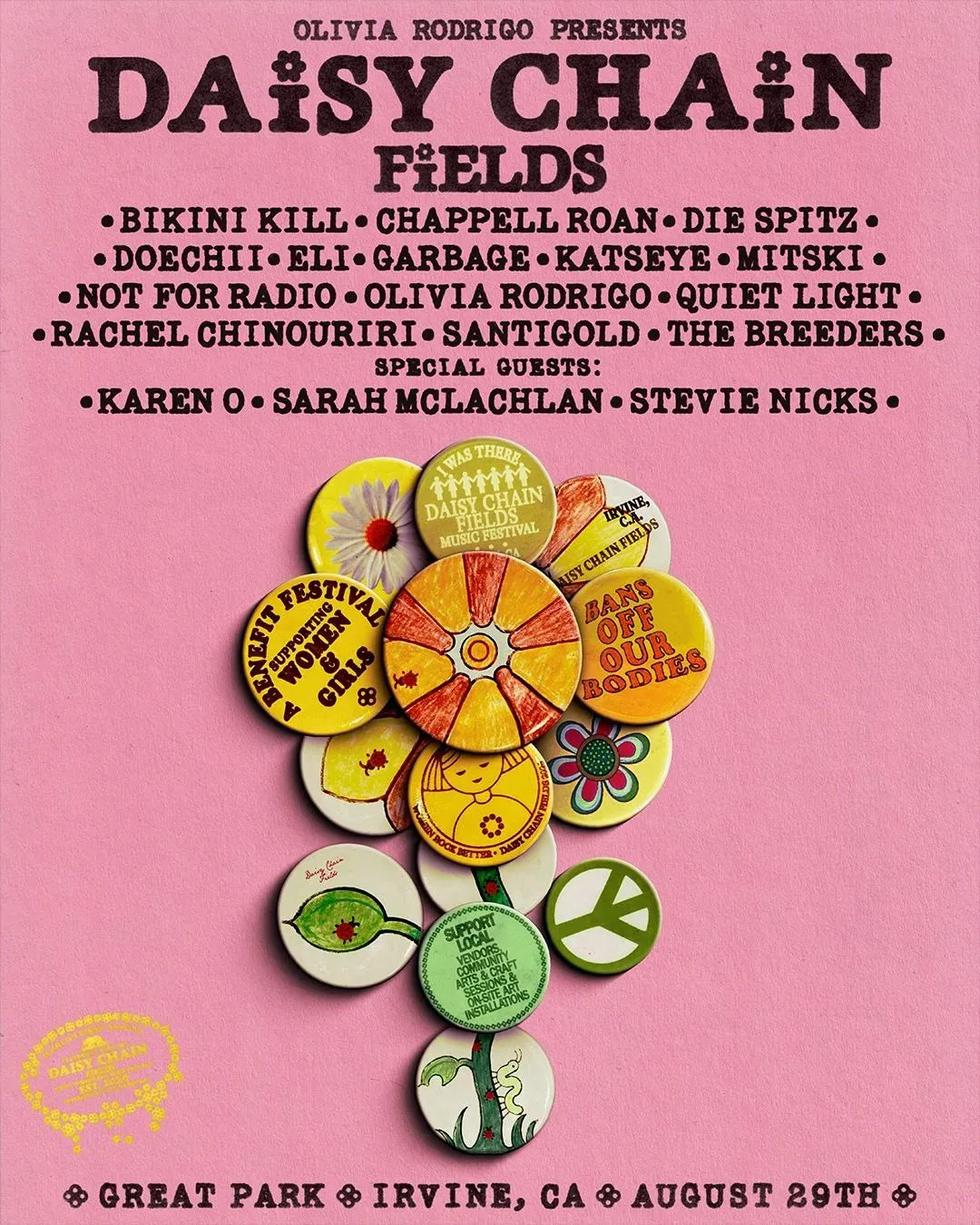
Olivia Rodrigo announced Daisy Chain Fields, a single-day festival with a cross-generational all-female lineup. The booking combines Bikini Kill, Chappell Roan, Stevie Nicks, and other artists, making the move a high-visibility test of Rodrigo's brand power beyond albums.
Olivia Rodrigo did the thing artists say they will do and then usually do not: she announced her own festival. Daisy Chain Fields is a single-day event with a cross-generational all-female lineup that spans serious rock royalty and current breakout momentum, including Bikini Kill, Chappell Roan, and Stevie Nicks, plus more acts.
This is not just “a cool announcement” for fans. Rodrigo released her third album, you seem pretty sad for a girl so in love, and now she is turning that mainstream spotlight into something with scheduling, production, and audience logistics built in. The headline act is the brand, but the product is the day: one day of music designed to feel bigger than a tour, and focused tightly enough that the lineup becomes the message.
To understand why decision-makers should care, zoom out to how the live business actually works. Festivals are expensive and operationally unforgiving. Promoters do not get the luxury of letting a bad single show ruin the day, because the day is the unit of value. You buy tickets for the promise of a complete experience, then you hope the roster delivers. A cross-generational lineup is one way to broaden the addressable market without changing the core identity. It invites different fan bases to the same table: listeners who came for legacy names and people who came for the newest reason to pay attention to pop.
And the roster is built to do exactly that. Bikini Kill brings the hardcore, riot-grrrl lineage that defined an era of punk activism. Stevie Nicks is a household name in rock history, with recognition that travels across age groups. Chappell Roan represents the current wave of breakout stardom, the kind that attracts an audience willing to show up quickly and loudly. Put together under one all-female umbrella, the lineup signals a theme before anyone sings. That matters because festivals are competing for attention in a crowded cultural calendar, and attention is the first step in revenue.
Rodrigo’s decision also sits at an interesting intersection of mainstream visibility and scene politics. All-female lineups are not new, but they still stand out because they are not the default in many large-scale rosters. For executives, that is a strategic choice, not a marketing slogan. The lineup becomes a statement about who belongs on the biggest stages, and it shapes how press, partnerships, and audience expectations form. If the event lands, it strengthens the case for more experiments in representation and programming. If it struggles, it can become a cautionary tale that people try to use to shut down future attempts.
There is also an implicit “brand extension” dynamic here. Albums build demand over time; festivals compress value into a deadline. When a high-profile artist announces a festival, the question is whether their fan base will behave like a consumer audience, not just a streaming audience. Festival promoters and venues are always watching for this conversion signal: do fans translate their attention into tickets, travel plans, and on-site spending. Rodrigo’s third album and Daisy Chain Fields function like a funnel, from recorded attention to lived participation.
From a risk perspective, there are the usual live-industry variables: scheduling, ticket sales velocity, the weather factor for outdoor events, production timelines, and the unforgiving reality that a lineup announcement is not a substitute for operational execution. While the source does not provide dates, venues, or pricing, the structure is still clear: it is single-day, all-female, and cross-generational. Those are three attributes that can simplify storytelling to audiences, but they do not remove the need to deliver a flawless day.
Second-order implications for peers in the same orbit are straightforward. If Daisy Chain Fields works, it strengthens the credibility of artist-led programming as a scalable strategy, not a one-off vanity project. If it surprises audiences in either direction, it will still influence how labels, management teams, and festival operators think about lineup curation and audience targeting. Either way, executives should read the move as a live-business stress test of modern pop stardom: can the artist ecosystem generate event-level demand, and can legacy credibility plus newcomer heat hold the center on one packed day?
This story's Key Insights and Take-aways are locked.
Create a free account to unlock Executive Actions for one credit.
Register to UnlockAlways free for Executives Club members. Join the Club
More in Entertainment

Russell Brand's accuser 'bewildered and confused' as he denies 7 sex charges
The criminal case against the comedian is a live test of how media companies manage talent risk when serious allegations go public.

'It's a Magic Trick': Ballet Experts Say Rosalía's SNL Pose Is Impossible
Three ballet experts tell Rolling Stone Rosalía's gravity-defying SNL stillness shouldn't be possible - and why the debate is now part of the show.

Activision CMO: GTA 6 Will Boost Call of Duty, Not Bury It
Activision's top marketer says Rockstar's blockbuster will drive players back to consoles and into Modern Warfare 4, even as the company admits its recent strategy failed.