
OpenAI engineer arrested for hiding $14 recorder in executive conference room
A $14 hobbyist board allegedly taped behind an executive conference room TV has cost an OpenAI engineer his job and his freedom, and it is a wake-up call for every AI company.
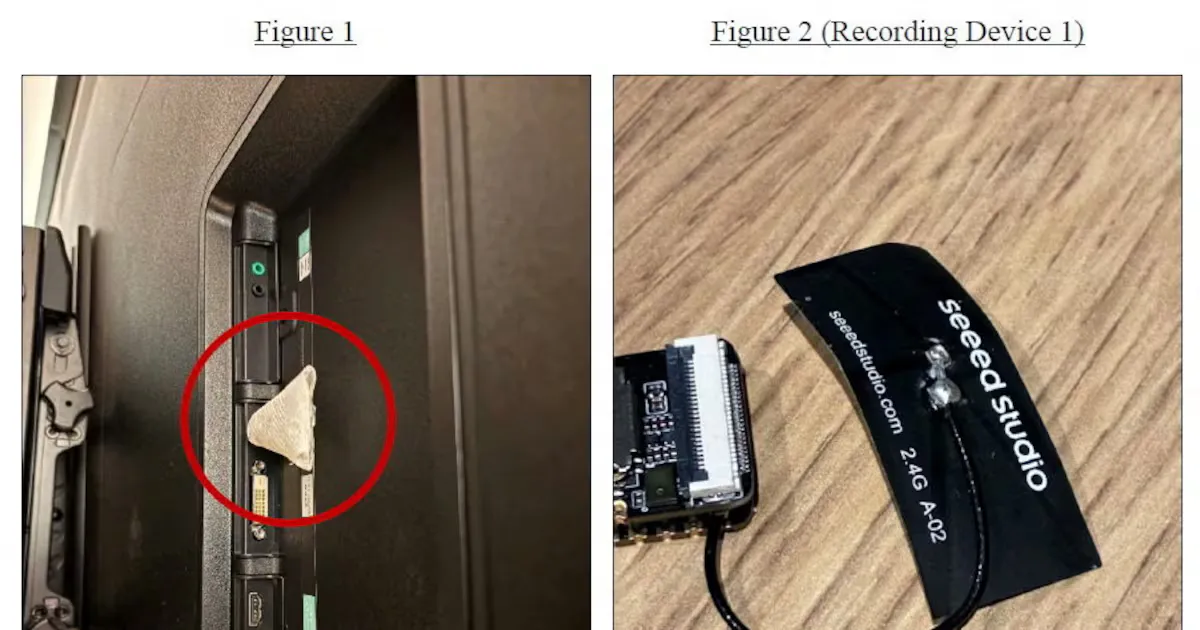
OpenAI fired and the US Justice Department arrested Abdulrahman Alfozan, a Saudi citizen and product team engineer, after a hidden recording device was found in a San Francisco executive conference room. The case underscores how cheap, off-the-shelf hardware can breach corporate secrecy, and it will push boards to re-examine physical security and insider risk at AI labs.
OpenAI has fired Abdulrahman Alfozan, a Saudi citizen and product team engineer, after the US Justice Department charged him with using a hidden recording device in a San Francisco office. According to the FBI's criminal complaint, the device was a Seeed Xiao ESP32-S3 Sense, a thumb-sized development board with a detachable camera sensor, digital microphone and microSD storage, listed for $14 on the manufacturer's website. OpenAI security staff found it on September 30, plugged into a USB port in the back of a television in an executive conference room and covered with toilet paper to disguise it. The company determined it had been planted around September 28.
Alfozan was arrested on October 9, more than a week after the discovery, and appeared in court in San Francisco on Tuesday, according to the Justice Department. He had started at OpenAI in July last year and worked on the product team; he was fired the same day as his arrest. The criminal complaint, which refers to an unnamed AI company with offices in San Francisco, says Alfozan did not have approval to access the conference room, a space that typically hosted meetings involving highly confidential technical, commercial and strategic information. OpenAI said it has alerted the FBI and the investigation is continuing.
The case is a stark reminder that corporate espionage no longer requires sophisticated spy gear. Security expert Lennart Koopmann, founder of cybersecurity firm Nzyme, said the device Alfozan allegedly used appears to be built on a hobbyist circuit board. It has a microphone, can save recordings to a memory card, and can send audio wirelessly over short distances via Wi-Fi. 'That makes it cheap and easy to hide, and catching one takes either equipment that watches the airwaves for unfamiliar devices or, if its wireless is switched off, someone physically searching the rooms,' Koopmann said.
OpenAI said its own AI models helped investigators understand the device and identify who placed it. The company also uncovered evidence that Alfozan had planned to use other recording devices to secretly record meetings in other parts of the office. Early this month, according to the Justice Department, OpenAI security employees found a similar recording device in a bag he had left inside one of its corporate buildings. The company said it has no indications that Alfozan inappropriately accessed or exfiltrated model weights, source code, or customer data, a critical distinction for an AI lab whose crown jewels are its models.
Alfozan's background makes the incident more unsettling. According to a LinkedIn profile connected to him, he worked as an engineering lead at OpenAI on AI agent software. He has worked part-time as a partner at Saudi Arabia-based venture capital firm Raed Ventures since 2025, and previously as a senior systems engineer at Meta Platforms. He studied computer science and engineering at MIT from 2011 to 2016, and earned a master's degree in data science from UC Berkeley between 2023 and 2025. In other words, this was not a random visitor; it was an employee with technical expertise and access.
The incident is poised to heighten concerns about security at top technology companies at a moment when nations are competing aggressively to develop more powerful AI systems. OpenAI's response, using its own AI to investigate, is a sign of how the industry is turning its core technology inward for security. But the incident also exposes a vulnerability that no software patch can fix: physical spaces where executives discuss confidential strategy. A $14 device hidden behind a TV can capture conversations that no amount of cyber defense can protect.
For boards and security leaders, the lesson is concrete. Insider threat programs should include physical security sweeps of executive meeting rooms, access controls that track who enters sensitive spaces, and monitoring for unusual behavior such as leaving bags or devices behind. The FBI's criminal complaint describes the device as a thumb-sized development board with a detachable camera sensor, digital microphone and microSD storage, and it was for sale for $14 from seeedstudio.com as of Tuesday. That price point means the barrier to entry for this kind of espionage is almost zero.
Alfozan is scheduled to appear before Magistrate Judge Alex G. Tse in federal court in San Francisco on October 19. The investigation is continuing, and OpenAI has alerted the FBI. For every company racing to build the next generation of AI, the case is a warning: the most valuable secrets are often discussed in rooms, not just in servers, and the person listening may be someone you hired.
This story's Key Insights and Take-aways are locked.
Create a free account to unlock Executive Actions for one credit.
Register to UnlockAlways free for Executives Club members. Join the Club
More in Technology

Cop fired after sharing Flock login with ICE husband: 983 searches
A Savannah officer's shared credential let an ICE agent run hundreds of plate searches on Hispanic drivers, exposing a surveillance backdoor.

Elizabeth Holmes doc 'You Can See Everything' posts second-biggest doc debut ever
The true-crime draw shows fraud narratives still sell - a signal for media execs and a caution for founders.
She blocked an Uber delivery robot to save jobs. Police arrested her.
Carolyn Marvin's disorderly conduct arrest turns a sidewalk standoff into a test case for how cities police the automation-versus-workforce debate.