

Planet born from a dying star: Hubble data reveals a second-generation world
A second-generation planet, born from a white dwarf, found in decades-old Hubble data, is rewriting the rules of star death.
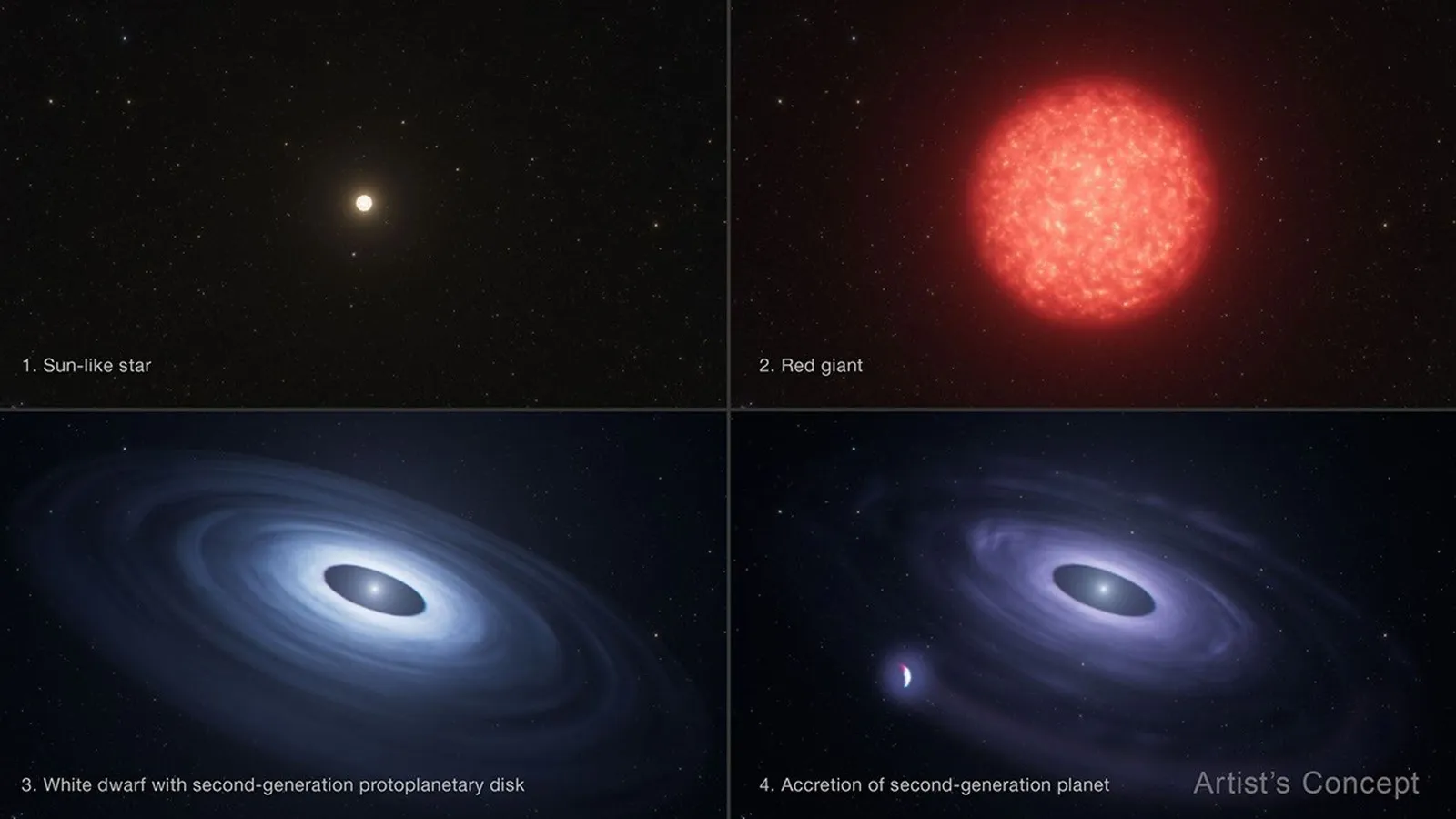
A team of scientists, using decades-old Hubble data, found evidence of a planet born from a white dwarf. The discovery forces a rethink of planetary system lifecycles and highlights the untapped value of archival data.
A team of scientists has found evidence of a planet born from a white dwarf, the dense remnant of a dying star, using decades-old data from the Hubble Space Telescope. The discovery, which emerged from re-analyzing archival observations, marks a rare and significant find: a second-generation planet that formed after its parent star's death, not alongside it. This is the payoff of the headline: the data has been sitting in Hubble's archive for years, and only now has it yielded proof that planets can rise from the ashes of a star's demise.
For the uninitiated, a white dwarf is what remains after a star like our Sun exhausts its nuclear fuel. The star sheds its outer layers, leaving behind a hot, compact core that can be surrounded by a disk of gas and dust. Over time, that debris can coalesce into new worlds. This is exactly what the team found evidence of: a planet born from the material ejected during the star's death throes. The finding directly challenges the long-held assumption that planets are inevitably destroyed when their star dies, suggesting instead that the end of a star can be the beginning of a new planetary system.
The implications stretch far beyond this single object. If planets can form after a star's death, then the lifecycle of a planetary system is not a one-way street. It suggests a kind of cosmic recycling, where the material from a dying star can seed a new generation of worlds. For our own solar system, the Sun will eventually become a white dwarf in the distant future. While Earth will likely be engulfed, this discovery hints that some of the remaining debris could one day form new planets, a possibility that reshapes how we think about the ultimate fate of our cosmic neighborhood.
The fact that this evidence was found in decades-old Hubble data is a story in itself. Hubble has been in orbit since 1990, and its archives are a treasure trove of observations. The team used new analytical techniques to extract signals that were previously missed, demonstrating that the value of data can compound over time as tools and methods improve. This is a powerful reminder that the raw material for breakthrough discoveries often already exists, waiting for a fresh perspective to unlock it.
For executives and decision-makers, the lesson is clear: the data you already have may hold answers you haven't yet found. In an era of rapid technological change, the ability to revisit old datasets with fresh eyes can yield breakthroughs that were invisible at the time of collection. This is true in astronomy, but it applies equally to business, finance, and technology, where historical data often contains patterns that only become visible with new analytical frameworks. The team behind this finding didn't need a new telescope; they needed a new perspective on old data.
The discovery also has implications for the search for exoplanets and the broader understanding of planetary formation. If second-generation planets are common, then the number of planets in the universe could be higher than previously estimated. This could affect models of habitability and the odds of finding life elsewhere. While the team's findings are specific to this one system, they open a new avenue of research that could reshape our understanding of how planetary systems evolve over cosmic timescales.
For peers in research and development, the takeaway is to invest in data infrastructure and archival analysis. The raw material for the next big discovery may already be sitting in your servers. The team behind this finding didn't need a new telescope; they needed a new perspective on old data. That is a strategic insight for any organization sitting on a mountain of historical information: the past is not just a record, it's a resource.
Ultimately, this discovery is a reminder that the universe is more dynamic and resilient than we often assume. Stars die, but their material lives on. Planets can be born from the remnants of their predecessors. And sometimes, the evidence has been there all along, waiting for someone to look again. For those who pay attention, the past is not just a record; it's a resource.
This story's Key Insights and Take-aways are locked.
Create a free account to unlock Executive Actions for one credit.
Register to UnlockAlways free for Executives Club members. Join the Club
More in Technology

A Chinese rocket deorbited over Minnesota and landed in a farmer's cornfield
Experts tied the fragment to LandSpace's Zhuque-2E, which launched on September 15 and shed debris over the American Midwest after deploying 10 satellites.

JPMorgan Chase deploys first $5B into defense tech and hypersonic missiles
The bank is moving off its balance sheet to back robot factories, hypersonic missiles, and supply chains, signaling a new era of bank-backed military innovation.

Cop fired after sharing Flock login with ICE husband: 983 searches
A Savannah officer's shared credential let an ICE agent run hundreds of plate searches on Hispanic drivers, exposing a surveillance backdoor.