

Quick-commerce AI can predict storms, but who trains it to choose worker safety?
As monsoons intensify, delivery platforms use weather models for speed. The brief unpacks how incentives shift physical risk to workers.
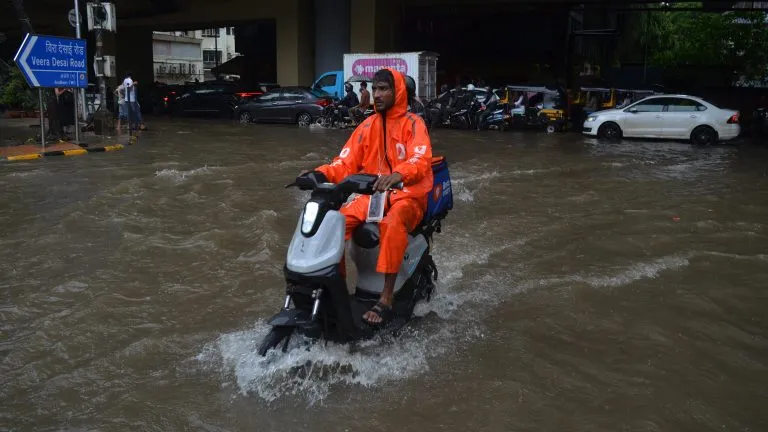
Quick-commerce delivery platforms are using advanced weather algorithms to capture surging customer demand during monsoon flooding around Mumbai. For executives, the consequence is simple: the same systems that optimize service speed can also redistribute physical risk onto workers trapped by pay incentives.
As July monsoon rains flood the Mumbai streets around the narrator's home, quick-commerce platforms are using advanced weather algorithms to capture surging customer demand. The twist is that these systems do not just help customers get deliveries faster. They also help companies profit from storm demand while shifting the physical risk onto workers who are out in the weather, doing the deliveries.
This is the real question behind the story's title: can you train AI to choose safety over speed when the business incentives reward speed first? In other words, the algorithm might “see” the storm coming and adjust operations, but the optimization target is not automatically safety. If the payoff structure is tied to rapid delivery and throughput, the model will learn whatever behavior best serves that goal, even when conditions become more dangerous for the people who have to show up.
To understand why this is happening, you have to look at how delivery economics work in a high-urgency model like quick commerce. When demand spikes during weather events, companies can capture more orders and monetization opportunities. But the operational reality does not scale neatly. Trucks and warehouses do not magically move workers out of harm’s way. Instead, the people tasked with last-mile work are the ones who experience the friction: flooded roads, reduced visibility, higher accident risk, and the immediate physical strain of navigating unsafe conditions.
This is where weather algorithms become more than “cool tech.” Advanced forecasting models can estimate how conditions will change and how demand might behave. From a platform perspective, that is valuable because it supports scheduling, routing, inventory allocation, and staffing decisions. From a worker perspective, it means that dangerous periods may be treated as operational inputs that drive labor deployment, rather than as a trigger to reduce exposure.
The story frames the core dilemma as a choice about what the AI is trained to optimize. Training an AI system is not just about giving it data from storms and traffic. It is also about defining the objective function, meaning what the model is rewarded for. If performance metrics reward the platform for speed and customer satisfaction, and if workers are paid in ways that effectively intensify their pressure to keep delivering, the system will tend to replicate the incentive structure. That can create a feedback loop: weather models anticipate more orders, the platform moves faster to capture them, and worker pay incentives maintain delivery momentum even when safety conditions deteriorate.
Regulatory background matters here, because safety responsibilities do not live solely inside tech departments. While the source does not name specific regulators or cite particular statutes, it clearly points to the larger structural tension between profit optimization and worker protection. In many markets, regulators and labor authorities generally expect employers and platforms to manage workplace hazards. But algorithmic systems complicate accountability. When “an algorithm decided it was worth it,” executives still remain responsible for what the business trained that algorithm to do. If safety is not an explicit target, the system will usually learn speed as the path of least resistance.
Second-order implications follow quickly for anyone running logistics, marketplaces, or on-demand platforms. If customers receive faster service during storms while workers assume the physical cost, the company may see near-term growth and stronger retention. But the reputational and regulatory risks are not optional. A platform that becomes synonymous with worker harm during predictable weather events invites scrutiny. It also risks internal blowback: workers may reduce participation, regulators may demand operational changes, and boards may face hard questions about governance over automated decision-making.
The most strategic stake for peers in similar roles is governance of optimization. You can deploy weather models and still choose safety as a measurable priority, but it requires explicit safety criteria, monitoring, and incentives that do not punish workers for refusing dangerous conditions. The story’s central challenge is that AI training reflects human priorities. So the decision for executives is not whether the AI can predict storms. It is whether the business is willing to redesign what “winning” looks like, before the next monsoon turns optimization into harm.
This story's Key Insights and Take-aways are locked.
Create a free account to unlock Executive Actions for one credit.
Register to UnlockAlways free for Executives Club members. Join the Club
More in Business

Anthropic’s Levant Alpöge cracks the Jacobian conjecture after 87 years
A Harvard valedictorian used Claude to hit a 1939 breakthrough, but the missing “why” is the real problem.

Uber buys Delivery Hero for nearly $15B, vaulting to top food delivery outside China
The deal doubles Uber's dual-services footprint and pushes a ride-and-eats bundling play into 50 more markets.

Epic and Google drop settlement bid, forcing rival Android app stores by July 22
Google told the court it is ready to carry third-party app stores starting Wednesday, July 22.