
Razer CEO's 20-year wait for everyone to be a gamer ends with AI
Razer CEO Min-Liang Tan is betting AI companions, camera headsets, and game-testing tools will turn gaming into a trillion-dollar industry.
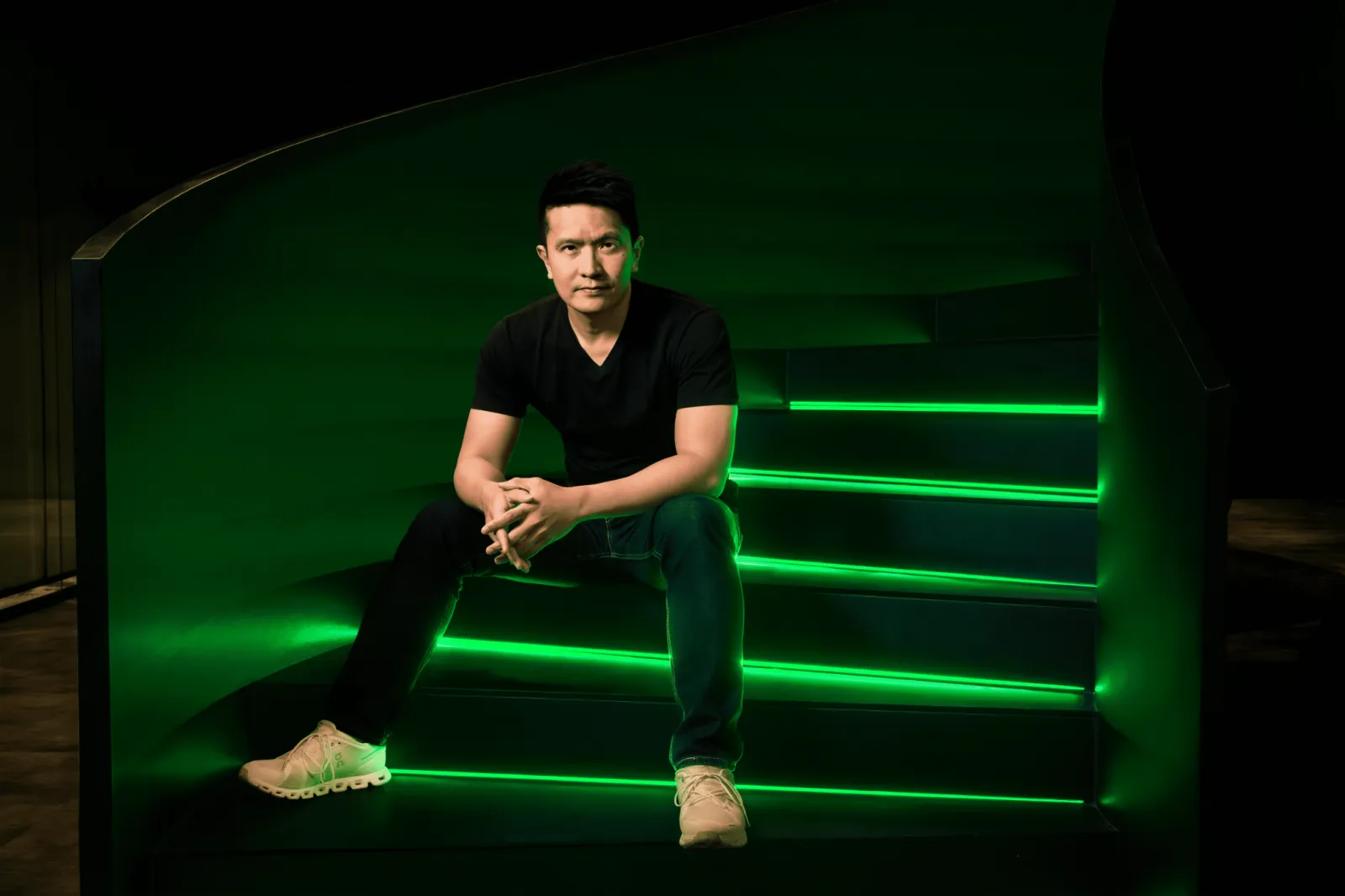
Razer co-founder and CEO Min-Liang Tan, who took the gaming hardware maker private with CVC in 2022, is now betting on AI companions, camera-equipped headsets, and AI game-testing tools to make everyone a gamer. For decision-makers, the bet signals that AI is reshaping gaming hardware, content creation, and quality control, with implications for how AI-driven products and platforms capture the next wave of consumer engagement.
Min-Liang Tan has spent two decades telling anyone who would listen that everyone would eventually become a gamer. Now, the Razer co-founder and CEO says AI is the force that finally makes it happen, and he is betting the company he took private in 2022 with CVC Capital Partners on that conviction.
In an interview with Fortune at Razer's Singapore office, Tan showed off Sumi, a 5.5-inch-tall AI hologram with black-and-green hair, and her male counterpart Niko, virtual personalities on Razer AVA, a desktop AI companion powered by xAI's Grok. Sumi is an illustrator from Tokyo with a calico cat who enjoys 'cozy gaming,' while Niko is a freelance engineer and skater in downtown Los Angeles. The avatars are part of a broader AI lineup that includes the Barracuda AI headset with built-in computer vision and compatibility with ChatGPT and Google's Gemini, plus an AI game-testing tool called Razer QA Co-AI.
Tan's conviction is grounded in a market that already looks like the future he predicted. 'AI is going to bring a new renaissance to all of gaming,' he says. The gaming industry generated roughly $188.8 billion in revenue last year, serving over 3.5 billion players worldwide, and Tan believes AI will push it to a trillion-dollar industry. He notes the demographic shift: gaming was once a predominantly male subculture of 12-to-25-year-olds 'living in our parents' basement,' but is now a 50-50 split between men and women.
Tan's route into the industry was sideways. A lawyer by training, he grew up playing fantasy role-playing games like Ultima, and in 1999 teamed with American businessman Robert Krakoff, whom he met gaming online, to build a gaming mouse named the Boomslang. They established Razer in 2005. The company now employs over 1,500 people with dual headquarters in Irvine, Calif., and Singapore's Queenstown district; about half its business is in the U.S., 30% in Europe, and less than 1% in Singapore, by Tan's account.
Going private in 2022 ended Razer's five-year run on Hong Kong's stock market, where it traded under the ticker 1337, or 'leet' in gamer slang. Tan says the company was already working on what he calls 'cognitive gaming,' and the private structure let him think without the 'quarterly commitments of a publicly listed company.' He now predicts Razer will be 'one of the largest AI hardware companies on the planet.'
The hardware side includes the Barracuda AI headset, unveiled on Sept. 28, with integrated cameras for computer vision, smart audio processing, and compatibility with AI models like ChatGPT and Google's Gemini. Tan says Razer is taking a 'privacy-first' approach to wearables, adding, 'It's definitely not down the route of where Meta is going.' Razer AVA, the AI companion with Sumi and Niko, has not been publicly released but is expected to ship in the second half of 2026, according to its website.
Tan also sees AI as a game-development accelerant. On Oct. 7, Google and Unity launched Playground, an AI game creation platform that lets users create video games with a simple prompt. 'Now, everyone can create games with just their imagination, even without technical skills,' Tan says, adding that AI will enable much larger games with virtual worlds 'that can mimic or transcend the size of our world.' But the same ease of creation is flooding storefronts with shovelware: one in five games released on Steam last year disclosed generative AI use, an eightfold increase in a year, according to a study of the storefront's catalog. In a single week this June, 120 of the roughly 300 games released on Steam carried an AI disclosure, according to a survey from PC Gamer. A separate study of 53,000 titles found AI-made games account for up to 90% of the growth in monthly releases, with almost none making money.
That is where Razer QA Co-AI comes in. Launched last year, the AI-powered game testing tool is designed to catch performance issues and review AI-generated bug drafts. 'We don't like AI slop,' Tan says. 'When you get a huge glut of content created, which is not very good, we can then help them make it better.' Tan is unmoved by the debate over whether AI is moving too fast: 'AI is going to be inevitable, and the genie is already out of the bottle. What we can do is to see how we can effectively harness it.' For executives watching Razer's pivot, the strategic stakes are clear: a hardware company with a cult following is repositioning itself as an AI infrastructure and quality-control player, betting that the same technology that floods the market with content will also create demand for tools that filter, test, and personalize it. Whether or not gaming becomes a trillion-dollar industry, Razer's move shows how AI is forcing even established consumer brands to rethink their product roadmaps, their capital structure, and their definition of who their customer is.
This story's Key Insights and Take-aways are locked.
Create a free account to unlock Executive Actions for one credit.
Register to UnlockAlways free for Executives Club members. Join the Club
More in Business

Elon Musk unveils a flying car, and SpaceX helped build it
The Tesla CEO's showcase at a SpaceX facility signals a future where road and rocket engineering converge.

Apple's $2,000 iPhone Duo opens preorders, taking on Samsung and Google
Apple's first foldable hits the market at a premium price, reshaping a category Samsung and Google have led.

Pope Leo XIV, first American pope, diagnosed with lung cancer
The 71-year-old Chicago-born pontiff underwent successful surgery on his right lung, and his diagnosis raises new questions about his AI-focused papacy and the Vatican's future.