
Riz Ahmed pitches a James Bond spy thriller built from being brown in London
In BAIT, the spy template becomes a mirror for identity, surveillance, and double meaning.
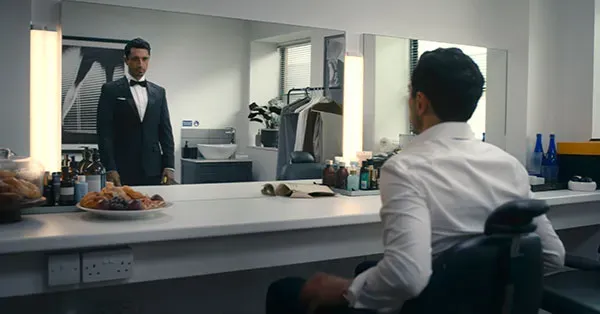
Academy Award-nominee Riz Ahmed discusses BAIT with Awards Tour Podcast host Jacqueline Coley, including his James Bond pitch to producer Barbara Broccoli. He connects the show’s spy thriller structure to how it can feel to be brown in London, and he explains how Jordan Peele influenced the genre framing.
Riz Ahmed is not subtle about why BAIT works: it takes the James Bond template and turns it into a pressure cooker for identity. In a conversation on the Awards Tour Podcast with host Jacqueline Coley, Ahmed breaks down the spy-thriller mechanics at the center of the limited series, which he describes as being about whether an actor can “pull it off” when up for the role of James Bond. And behind that pitch sits a personal thesis: “Being Brown in the West sometimes feels like you're stuck in a spy thriller.”
That is the core of the episode’s answer to the big question lurking behind BAIT’s premise. Ahmed says he wanted to use spy thriller conventions because they naturally map onto lived experience. Spy thrillers, he explains, hinge on double identity, torn loyalties, being looked at but not seen, surveillance, and not knowing who you can trust. The result is not just a fun genre mashup. It is a story engine that makes the emotional logic of surveillance feel legible, and it makes the audition for Bond feel like something bigger than casting.
Zoom out from the plot for a second, because this is also a business and brand lesson for the entertainment industry. BAIT is streaming now on Amazon Prime, and that matters because streaming platforms thrive on distinctive positioning. A show that is merely “a spy thriller” can be substituted. A show that is “a spy thriller told through a specific identity experience” becomes harder to replicate, easier to market with clarity, and more likely to earn repeat viewing because it offers layered meaning rather than only adrenaline. Ahmed’s framing supplies that differentiation in plain terms: the spy genre already contains the language of misrecognition and monitoring.
The podcast conversation also spotlights how creative development actually gets shaped, not just what ends up on screen. Ahmed talks about the James Bond pitch he gave to producer Barbara Broccoli, placing him in the rare position of taking a globally recognizable property template and asking, “What if the thriller structure is the experience?” Broccoli is a producer associated with the Bond universe, and an interaction at that level signals how ideas are vetted: you need both familiarity and a reason to remix it. BAIT, as described by Ahmed, uses the template while changing the lens.
Ahmed’s route to that lens runs through another creator: Jordan Peele. He says Peele, after Get Out, discussed how being Black in America sometimes feels like you are in a horror movie, and Ahmed credits that as inspiration for his own thesis. He describes Peele’s influence as shaping the genre logic, not the surface story. The second-order implication is important for executives and boards: socially resonant genre storytelling is not limited to one demographic or one franchise. It is a replicable creative strategy when it is grounded in specific lived experience and translated into universal tension.
There is also a craft component Ahmed calls out directly: homage. He discusses paying homage to the Bollywood soap operas he grew up watching. That detail signals that BAIT’s identity is not a token layer placed on top of spy fiction. It is a composite, built from how audiences learn melodrama, stakes, and performance habits in earlier viewing life. For producers, that is the difference between “inspired by” and “constructed from.” For investors and platform strategists, it is the difference between content that feels decorative and content that feels inevitable.
Finally, Ahmed gives the show its central emotional payload by anchoring the spy-thriller genre in the double bind of representation. In his words, spy thrillers revolve around being looked at but not seen, and not knowing who you can trust. Put that next to the basic premise Jacqueline Coley lays out on the show: BAIT is about an actor being up for the role of James Bond, and the overarching story is a thriller about whether he can pull it off. When you merge those ideas, the “casting” plot becomes a metaphor for social legibility and institutional scrutiny. That is why the series feels timely and why it lands beyond genre fans.
For decision-makers watching BAIT’s momentum on Amazon Prime, the strategic stake is clear: audiences increasingly reward stories that use familiar frameworks while delivering a new interpretive key. Ahmed’s approach shows how a platform can differentiate without inventing a whole new universe, by retooling an existing template so the tension feels freshly earned. If you are an executive deciding what gets funded, commissioned, or championed, the question becomes whether your slate has enough work that can carry a thesis this specific, and still play as widely as a spy thriller should. BAIT, as described in this episode, is a case study in turning identity into plot, not garnish.
This story's Key Insights and Take-aways are locked.
Create a free account to unlock Executive Actions for one credit.
Register to UnlockAlways free for Executives Club members. Join the Club
More in Entertainment

Entertainer Russell Brand denies 7 sex charges amid accuser's 'couldn't breathe' claim
The alleged victim's account sharpens the reputational and legal stakes for Brand, his platforms, and any business tied to a public figure under criminal scrutiny.

Russell Brand's accuser 'bewildered and confused' as he denies 7 sex charges
The criminal case against the comedian is a live test of how media companies manage talent risk when serious allegations go public.

'It's a Magic Trick': Ballet Experts Say Rosalía's SNL Pose Is Impossible
Three ballet experts tell Rolling Stone Rosalía's gravity-defying SNL stillness shouldn't be possible - and why the debate is now part of the show.