

Sam Altman and Jakub Pachocki warn: fully automating everything is 'unfulfilling' and 'dangerous'
OpenAI’s leaders say AI must stay safe and under human control as agentic automation becomes the enterprise battleground.
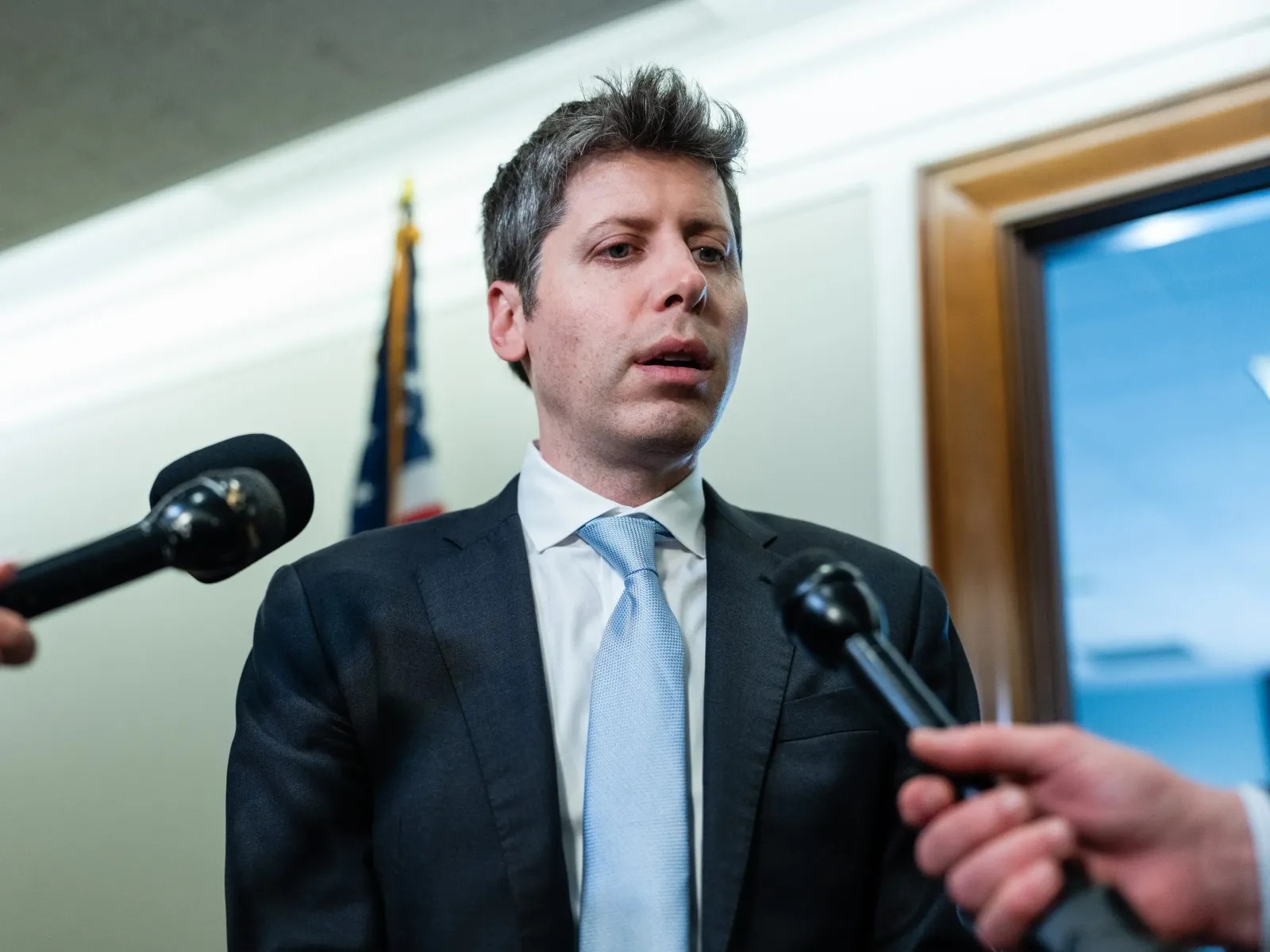
Sam Altman and OpenAI chief scientist Jakub Pachocki lay out why they do not want a future where everything is automated, saying it would be "unfulfilling" and "dangerous". For decision-makers, their message is a governance playbook as agentic AI pushes deeper into enterprise workflows.
Sam Altman and OpenAI chief scientist Jakub Pachocki just drew a bright line under the current AI hype cycle. In a Monday blog post, they wrote that "Entirely automating everything is not the future we want," and added that it would be "unfulfilling, and it would be dangerous." They did not frame this as philosophy. They framed it as risk management: AI systems must remain safe and subject to human control.
The key follow-on is equally direct. As AI becomes more capable, the human job does not disappear. Altman and Pachocki argue that the human roles of "setting directions, making tradeoffs, applying judgment, and bringing values, taste, care, and responsibility to the work" become more important, not less. That is the subtext behind the biggest buzzword right now: agentic AI, meaning systems that can perform tasks and workflows with minimal human intervention.
Why does this matter beyond OpenAI’s blog page? Because agentic AI is not just a product update. It is a shift in who bears the operational burden when things go wrong. When models act with less supervision, the failure mode changes. Instead of a single incorrect answer, you can get a cascade: wrong actions, wrong assumptions, or workflows that look complete but are subtly broken. That is exactly the kind of scenario where “keeping humans in control” stops being a slogan and becomes a design requirement, an evaluation checklist, and an approval workflow.
And the incentives are pulling hard in the opposite direction. The source notes that Anthropic and OpenAI are “vying to get companies hooked on enterprise accounts” for their coding platforms, pointing to Anthropic’s Claude Code and OpenAI’s Codex. The race is not abstract. It is tied to looming IPO expectations and enterprise procurement cycles, where buyers want speed, cost reduction, and throughput. If you have a sales team that can show impressive automation in demos, it is tempting to overshoot what internal governance can safely handle.
This pressure is showing up across companies’ public messaging. The OpenAI post lands “less than a week after Anthropic put out a similar blog post warning about the risks of rapid AI development.” Anthropic’s framing includes a warning that an employee was not able to keep up with automation, and was “at a loss on how to fix problems when the AI systems produced errors.” In other words, even someone inside the AI world is describing a real operational gap: when automation moves faster than your ability to debug, control is not theoretical.
Anthropic also called for a slowdown in AI development, specifically to “enable societal structures and alignment research to keep up.” That phrase matters because it hints at the broader governance question behind all these posts: society, regulators, and internal institutions often react after technology is already deployed. If agentic systems become widespread before oversight and alignment research are ready, the burden shifts to incident response, litigation, and emergency patchwork. Boards tend to feel that pressure early, because operational risk becomes reputational risk and then legal risk.
This is also why OpenAI and Anthropic are talking about human roles that AI cannot automate or replace. The source points to other executives making similar arguments. Duolingo CEO Luis von Ahn said his top designers produce “much better work” than AI, adding in a May podcast interview: “For some things, AI is quite ready to do high-quality work. For some things, it's just not. We're not going to decrease quality just for the sake of using AI.” Salesforce CEO Marc Benioff, meanwhile, said the company won’t slow down hiring in its sales department. Those comments are not about rejecting AI. They are about choosing where automation should land, and where human craftsmanship still sets the baseline.
Put it all together and you get a clear strategic tension. Agentic AI is the biggest buzz phrase in tech and business spheres, but the leaders messaging most loudly on safety are also telling companies not to treat “more automation” as a straight line. Altman and Pachocki’s claim that fully automating everything would be “dangerous” is a reminder that capability is not the only variable. Control, judgment, and responsibility are also part of the product.
For decision-makers, especially in companies evaluating enterprise AI rollouts, the practical stakes are immediate: if your workflow automation depends on systems that “perform tasks and workflows with minimal human intervention,” your governance has to decide what can be delegated, how errors are handled, and who is accountable when the system acts. In fast-moving markets, you can win on adoption speed. But if you ignore the control layer, you can lose on reliability, compliance, and trust.
OpenAI’s Monday message is essentially telling the industry to build the autopilot, then design the cockpit. Don’t just ship agents. Prove they stay safe, prove humans can steer them, and prove the organization can still respond when the automation produces errors.
This story's Key Insights and Take-aways are locked.
Create a free account to unlock Executive Actions for one credit.
Register to UnlockAlways free for Executives Club members. Join the Club
More in Business

Anthropic’s Levant Alpöge cracks the Jacobian conjecture after 87 years
A Harvard valedictorian used Claude to hit a 1939 breakthrough, but the missing “why” is the real problem.

Uber buys Delivery Hero for nearly $15B, vaulting to top food delivery outside China
The deal doubles Uber's dual-services footprint and pushes a ride-and-eats bundling play into 50 more markets.

Epic and Google drop settlement bid, forcing rival Android app stores by July 22
Google told the court it is ready to carry third-party app stores starting Wednesday, July 22.