
Sean Hannity says Trump and Zohran Mamdani get along only as an “act”
The Fox host challenges the friendly vibe between Trump and NYC’s mayor, citing their policy differences and a staged dynamic.
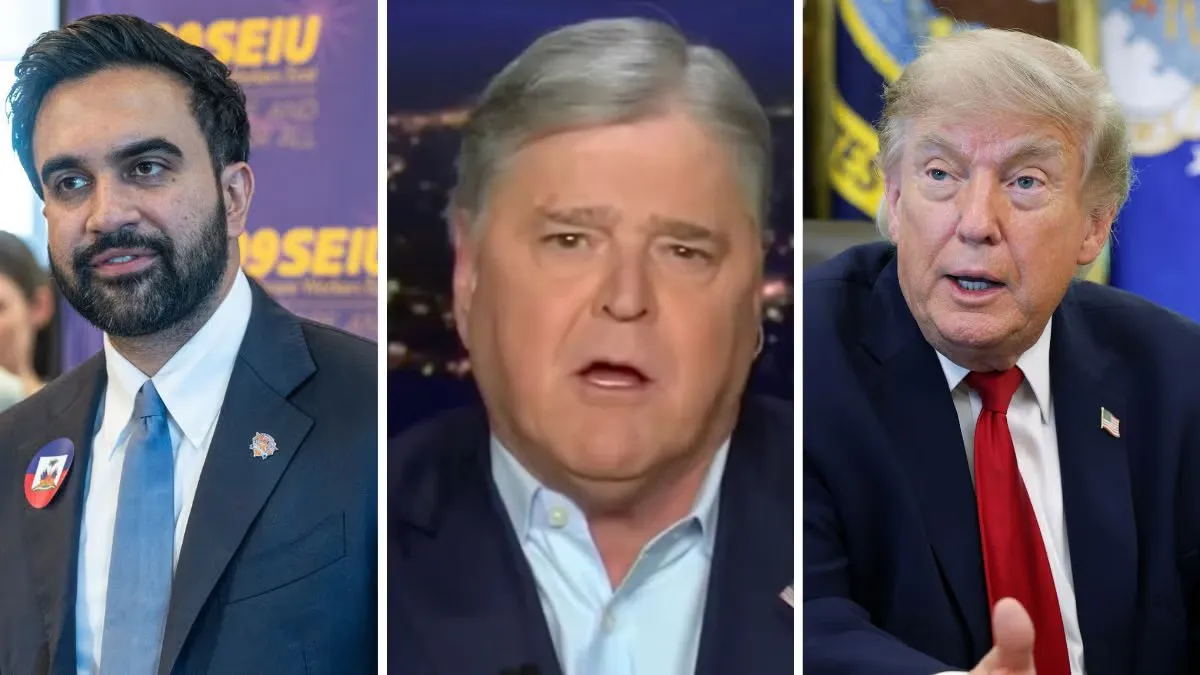
Sean Hannity told Bill de Blasio on Fox News that Donald Trump does not truly like Zohran Mamdani, calling their rapport “all an act.” The dispute matters because it spotlights how political incentives and messaging can diverge sharply from policy realities.
Sean Hannity made it awkward on Fox News. During a Wednesday appearance on “Hannity,” the host argued that Donald Trump’s friendly signals toward NYC mayor Zohran Mamdani are not sincere, insisting, “They don’t get along. That’s all an act. I don’t believe it.”
The exchange happened while Hannity and former Mayor Bill de Blasio discussed the Democratic Party’s shift toward “Democratic Socialism” candidates. De Blasio pointed to Mamdani as evidence Democrats can find common ground with the president, saying, “Look at Mamdani, this is why Trump gets along with Mamdani,” and then starting to explain that Mamdani “talked about the rent” before Hannity cut him off. De Blasio followed up by arguing Trump saw Mamdani “was on to something,” specifically referencing Mamdani’s focus on people being able to pay rent, afford getting on a bus, and afford childcare.
Zoom out: this is less about personalities than about narrative strategy. Hannity’s core claim is a separation between optics and substance. He frames the relationship as transactional theater, while de Blasio frames it as proof that certain economic issues can cut across ideological lines. Both can be true in practice, because political messaging is often engineered for audiences with different incentives. Viewers at home want a clear story. Campaign strategists want controllable headlines. The president wants loyalty and attention, while local officials want deliverables and national leverage.
Hannity, meanwhile, did not just challenge the Mamdani-Trump rapport. He also advanced the argument that “new Democrats” are taking a platform with dangerous consequences, saying that if independents vote for policies like “the borders are open” and “we’ll have no police,” plus plans that would “take away private property,” it is not a winning formula. That broader framing is important because it sets up why he doubts the “friendly dynamic” with Mamdani. If Hannity believes the ideological distance is real, then any warm compliment from the top of the ticket becomes suspect.
De Blasio’s pushback underscores the opposite logic: if Mamdani’s emphasis is on practical affordability, then a president who prioritizes housing and economic stability might be able to align with the substance even if other parts of the agenda clash. De Blasio said Mamdani has “done some real things on those things already,” and then argued the point is what Democrats will run on. He added that if Democrats have “any sense,” they will not stay “the party of the status quo,” but instead become the party that argues for “real economic change and what people need at the kitchen table.” In that frame, the Mamdani relationship is a symptom of a broader political realignment toward cost-of-living issues that resonate widely.
Hannity’s skepticism also gains traction from the specificity of Trump’s prior praise. The article notes that Hannity’s commentary contradicts Trump’s own words, because the president has recently praised Mamdani as “a charming guy, a good looking guy.” It also highlights that this is not the first round of compliments, since Trump previously admitted to speaking with Mamdani “a lot.” That matters because public praise is not costless. Even if a president wants to appear bipartisan, compliments can strengthen an opponent’s narrative that they have genuine common ground with power. That can shape campaign tone, fundraising conversations, and how the press frames conflict.
The source also includes Mamdani’s earlier response on X: “I had a productive meeting with President Trump this afternoon. I’m looking forward to building more housing in New York City.” Separately, Trump was quoted in February as saying, “Bad policy, but nice guy.” Together, these remarks create the exact ambiguity Hannity is calling out. The president can simultaneously criticize policy while praising personal rapport. Mamdani can present engagement as productive while still maintaining ideological identity. Hannity reads that as an “act,” while de Blasio reads it as selective overlap: rent, affordability, and day-to-day constraints.
For executives, boards, and anyone building strategy around public institutions, the second-order implication is simple: messaging alignment is not the same as policy alignment, and policy alignment is not the same as political branding. When leaders meet, the outcome is often packaged for different audiences. Compliments, optics, and “productive meetings” can coexist with disagreement on the hard parts. That means risk is not just what a policy might do, but how political narratives can reshape expectations, staffing decisions, regulatory focus, and stakeholder perception.
If you run a business that depends on government decision-making, you have seen this movie before. A friendly photo can sit next to tough enforcement. A local agenda can intersect with national rhetoric and then get reinterpreted in the next news cycle. The Hannity-de Blasio clash is a reminder that in politics, relationships are frequently leveraged. The “act vs. real” debate is not just TV drama, it is a signal about how quickly interpretive battles can flip public understanding of what is actually happening.
This story's Key Insights and Take-aways are locked.
Create a free account to unlock Executive Actions for one credit.
Register to UnlockAlways free for Executives Club members. Join the Club
More in Entertainment

Russell Brand's accuser 'bewildered and confused' as he denies 7 sex charges
The criminal case against the comedian is a live test of how media companies manage talent risk when serious allegations go public.

'It's a Magic Trick': Ballet Experts Say Rosalía's SNL Pose Is Impossible
Three ballet experts tell Rolling Stone Rosalía's gravity-defying SNL stillness shouldn't be possible - and why the debate is now part of the show.

Activision CMO: GTA 6 Will Boost Call of Duty, Not Bury It
Activision's top marketer says Rockstar's blockbuster will drive players back to consoles and into Modern Warfare 4, even as the company admits its recent strategy failed.