

Serbia signs Artemis Accords July 16, making NASA’s Moon rules instantly multinational
The 69th country to join a peace-and-safety framework, Serbia adds Apollo-era credibility and new payload possibilities.
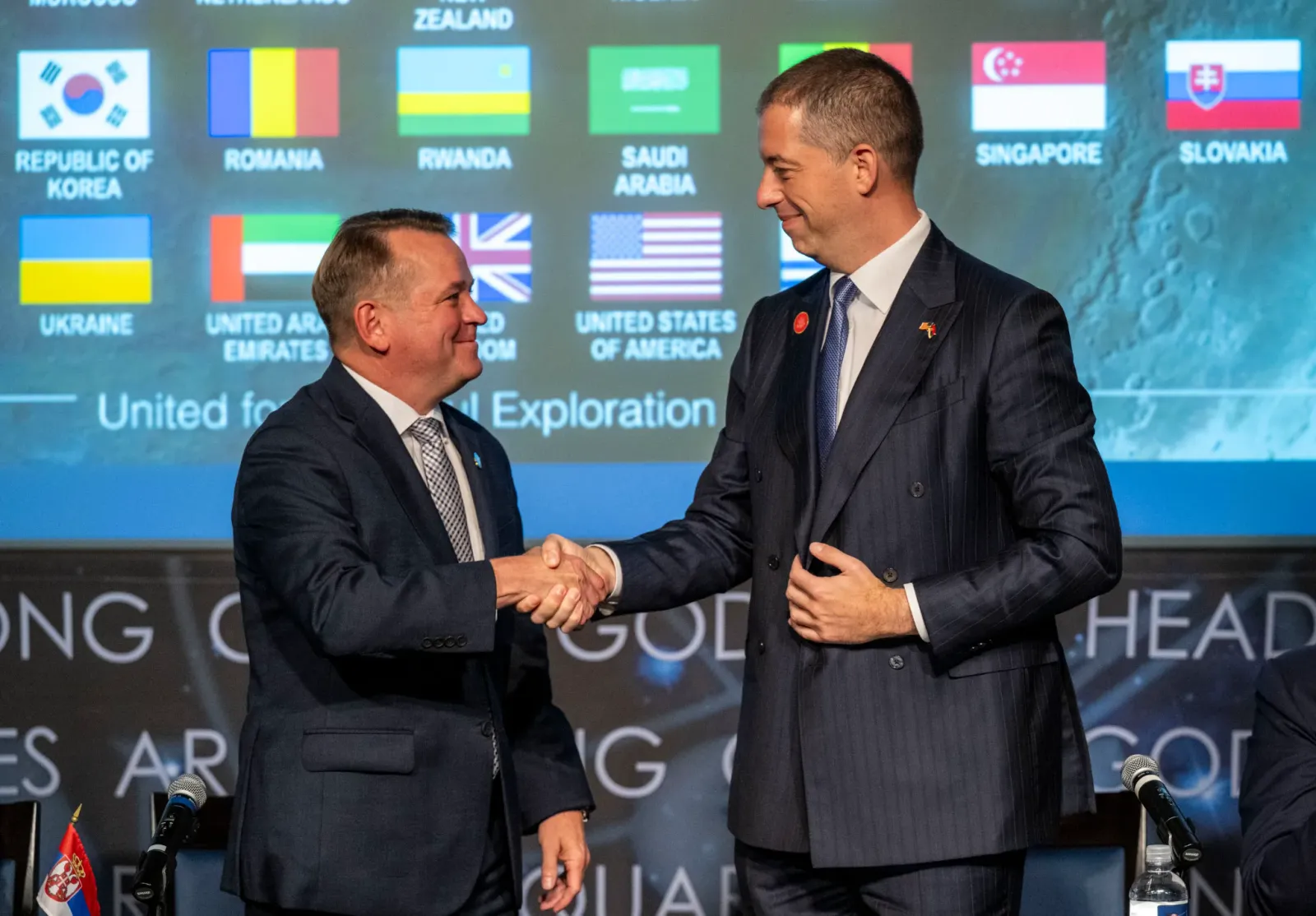
On July 16, the Republic of Serbia signed the Artemis Accords during a NASA-hosted ceremony at NASA Headquarters in Washington. Serbia became the 69th nation to join the framework aimed at peaceful, transparent, and responsible exploration, with Apollo ties spanning decades of engineering contributions.
On July 16, the Republic of Serbia signed the Artemis Accords at NASA Headquarters in Washington during a ceremony hosted by NASA. That move makes Serbia the 69th nation to join a growing community of like-minded governments building rules for how countries explore the Moon.
The signing mattered beyond ceremony vibes. Serbia’s Minister of Foreign Affairs Marko Đurić signed the Artemis Accords on behalf of the country, and NASA used the occasion to connect the present framework to the past work of Serbian engineers during the Apollo era. NASA Deputy Administrator Matt Anderson tied Serbia’s NASA relationship back to Apollo, including Milojko "Mike" Vučelić, who received the Presidential Medal of Freedom for bringing the Apollo 13 crew safely home. For executives watching space policy, this is the signal: Artemis is not only about rockets and landing sites. It is also about legitimacy, coordination, and shared expectations that start with signed principles.
Here is the practical background. In 2020, NASA and the Department of State joined with seven founding nations to establish the Artemis Accords. The Accords responded to growing interest in lunar activities from both governments and private companies. They introduced the first set of practical principles designed to improve safety and coordination between nations as they explore the Moon, Mars, and beyond. The commitments are specific, even if they read like philosophy: nations should explore peaceably and transparently; render aid to those in need; enable access to scientific data; ensure activities do not interfere with those of others; and preserve historically significant sites and artifacts by developing best practices.
Now fast-forward to why a new signatory is a big deal for decision-makers. The Artemis Accords are meant to shape behavior before missions collide, data is withheld, or cultural sites get treated like disposable real estate. By signing, Serbia joins the pool of countries expected to share in opportunities for future lunar exploration with NASA. The source explicitly mentions potential involvement such as providing science and technology payloads for the U.S.-led Moon Base and CubeSats for upcoming Artemis missions.
That matters because the path to lunar infrastructure is partly political and regulatory, not just technical. NASA also points to a policy trigger that ratcheted the urgency: five years after the Accords were formed, President Donald J. Trump’s National Space Policy directed NASA to establish a sustained lunar outpost. With this Moon Base, NASA is putting the principles of the Artemis Accords into practice and “inviting every signatory to take part in the endeavor.” In other words, the Accords are not only a checklist for diplomacy. They are designed to become the operating environment for hardware, payload agreements, and mission scheduling.
The Serbia ceremony also included several stakeholders that underline how international space agreements get implemented. Ambassador of the Republic of Serbia to the United States Dragan Šutanovac participated, along with State Secretary for Serbia’s Ministry of Science, Technological Development and Innovation Marija Gnjatović and U.S. Department of State Assistant Secretary for Oceans and International Environmental and Scientific Affairs Wesley Brooks. That lineup is a reminder that these Accords live at the intersection of space agencies, foreign ministries, and science and environmental policy offices. When the U.S. brings those players together, it usually means the next wave of collaboration will involve more than just engineering contracts.
NASA’s message leaned into the “Serbia helped make Apollo possible” thread, and it did so with concrete scope. The source notes that Serbian American engineers played key roles during the Apollo era across systems engineering, propulsion, power systems, spacecraft docking, electronics reliability, and mission coordination. Their expertise supported critical functions ranging from lunar landing analysis to safe spacecraft docking. That historical credibility is more than a feel-good footnote. It strengthens the narrative that Serbia is not entering Artemis as a tourist. It is entering as a country with long institutional memory about complex, safety-critical space systems.
And Đurić’s remarks added cultural and historical framing, including references to Nikola Tesla and Milutin Milanković, plus David Vujic, one of the pioneers of the Apollo missions and a member of the “Serbian Seven,” an engineers and technicians group whose contributions helped make the Moon landing possible. While that part is rhetorical, it also signals something executives should notice: governments that sign Artemis are making a public commitment to align their national science and engineering priorities with the rules NASA is trying to standardize.
So what should peers in similar roles take from this? More signatories are expected “in the months and years ahead.” That expectation alone creates second-order pressure for any organization that wants payload opportunities, data access, or participation in a sustained lunar outpost. The more countries join, the more Artemis becomes an international coordination problem where the winning strategy is being the partner who is already aligned with the Accords. Serbia’s signature is one more confirmation that the Moon’s future is being negotiated in advance, not improvised at launch.
This story's Key Insights and Take-aways are locked.
Create a free account to unlock Executive Actions for one credit.
Register to UnlockAlways free for Executives Club members. Join the Club
More in Science

Alaska's 1,580-foot tsunami had warning signs. Scientists just found them.
Rapid glacier retreat, heavy rainfall, and thousands of tiny tremors preceded Alaska's 1,580-foot tsunami, a warning for every coastal community in a warming world.

The rare mutation that lets high-risk brains dodge Alzheimer's
Scientists found a natural defense against protein buildup, opening a new path to preventive treatments.

3,000 steps a day may halve Alzheimer's decline, study finds
New research links a modest daily walk to less tau buildup and nearly half the cognitive and functional decline, even for those with early signs.