
Slate Auto starts its electric pickup at $24,950, undercutting rivals in one bold move
A mid-$20k EV pickup aims to prove price can still beat features in a market that forgot basics.
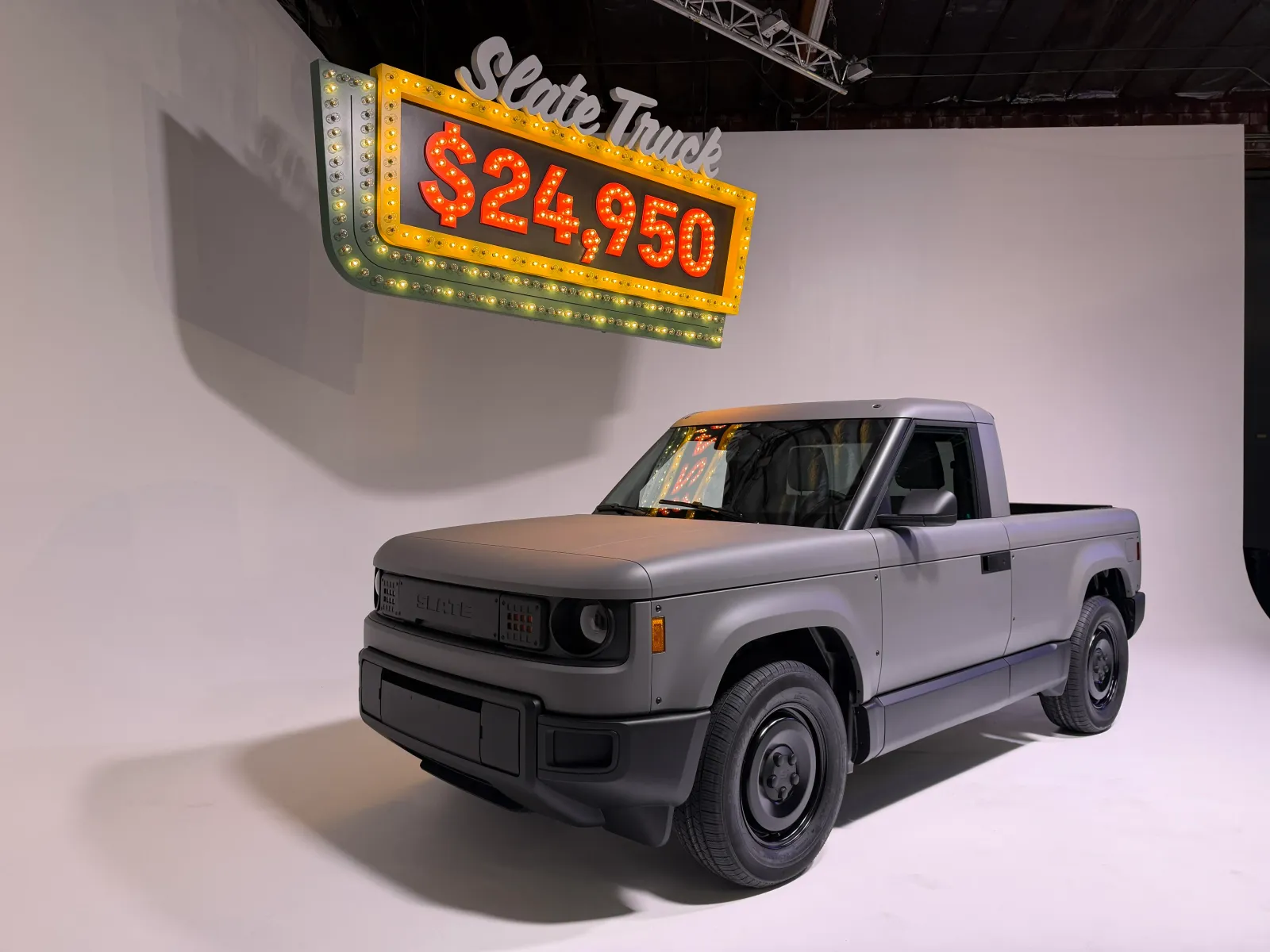
Slate Auto announced its American-made electric pickup will start at $24,950, positioning it in the mid-$20,000 range it originally promised. For decision-makers, the move raises a sharp question: can a truly “basic” EV compete when the average new vehicle costs nearly twice as much?
Slate Auto just put a stake in the ground with its new electric pickup: the truck will start at $24,950. The company says that number is intentional, and it is not a rounding error. At that price, Slate frames its pickup as the least expensive pickup truck and EV available today, and also lands squarely in the mid-$20,000 range it had originally promised. For anyone tracking the EV market, this is a rare kind of marketing promise. It is not “more tech.” It is “less stuff,” for the explicit goal of keeping the total price down.
That $24,950 launch matters because it directly targets a reality most automakers have been racing away from. The article notes that the average new vehicle costs nearly twice that amount. In other words, Slate is betting that there is still demand for a new vehicle that looks straightforward on day one, not a rolling tech demo. And to reach that price point, the company “stripped away features many drivers now take for granted,” making the truck genuinely basic in both design intent and product configuration. This is not EV minimalism as lifestyle branding. It is EV minimalism as a cost and margin strategy.
To understand why this is such a live wire for executives, zoom out to what has happened to vehicle economics and consumer expectations over the last decade. Features that used to feel optional have become defaults: extra driver-assist systems, more infotainment content, premium interior materials, and a general shift toward loaded trims. Even when those features are “good,” they create a compounding effect: higher sticker prices, higher financing costs, and a widening gap between what buyers can afford and what manufacturers are willing to offer in the base model.
Slate’s pitch is basically the opposite direction. If the company can deliver an electric pickup in the mid-$20,000 range, it can pull buyers who are priced out of mainstream new vehicles into the EV tent without requiring them to wait years for prices to normalize. That also changes the sales conversation for dealers, fleet managers, and anyone doing vehicle allocation for teams. When a product’s competitive advantage is price, the objection set shifts. Instead of “Why is this $X more than gas?” the question becomes “Is this good enough, given the missing features?” That is a harder customer decision in some ways, but it is also a clearer one.
There is a regulatory and policy subtext hiding underneath the surface. Electric vehicles do not just compete on consumer preference, they compete within a web of government incentives, emissions standards, and compliance pressures. In many markets, EV adoption is accelerated by policy support, but those policies do not automatically solve affordability. An EV can be “eligible” and still be too expensive for mass uptake. That is why a base price like $24,950 is not just a branding detail; it is a lever for how quickly EVs can move from early adopters to broader mainstream buyers.
For boards and investors, the second-order implication is about what this forces competitors to consider. If Slate is truly positioning itself as the least expensive pickup truck and EV available today, then it is setting a new reference point that others cannot ignore. Even if rivals do not match the price immediately, they now face questions about lineup strategy: do they need a cheaper entry model, or do they defend higher trims with better margins and stronger feature stacks? Either path involves trade-offs, and trade-offs show up in how management teams talk about volumes, production planning, and inventory risk.
Finally, there is the strategic stake that matters most to executives: pricing power versus feature power. Slate is explicitly trying to prove that price can be the centerpiece of an EV product, not an afterthought to technology. The market has been trending toward loaded vehicles because it is often easier to defend margins that way. But if demand exists for a basic new EV, the winners may not be the most feature-saturated brands. They may be the ones that can reliably produce and sell a vehicle that meets buyers where they are, financially. Slate’s $24,950 starting price, and the feature stripping required to get there, is the clearest signal yet that at least one company thinks the middle of the affordability curve is still up for grabs.
This story's Key Insights and Take-aways are locked.
Create a free account to unlock Executive Actions for one credit.
Register to UnlockAlways free for Executives Club members. Join the Club
More in Business

SpaceX sells $25B in debt under two weeks after IPO, despite $90B in orders
The satellite and rocket company’s quick $25 billion borrowing move signals how it plans to finance scale after going public.

Accenture’s $4.18bn play fails as AI fears spark a 20% worst-ever stock plunge
On Thursday, Accenture hit its biggest one-day drop on record after forecasting worries that AI could hollow out consulting.

SpaceX stock jumps 3% after it overtakes Amazon’s market cap
CNBC says SpaceX’s shares surge following its IPO Friday, forcing investors to reprice what “space” and “AI” are worth.