

Snap’s Specs cost $2,195 and crushed Evan Spiegel’s ears in the “highly wearable” demo
Specs are all-in-one AR glasses with 7-millisecond latency, but the battery and investor reaction raise eyebrows fast.
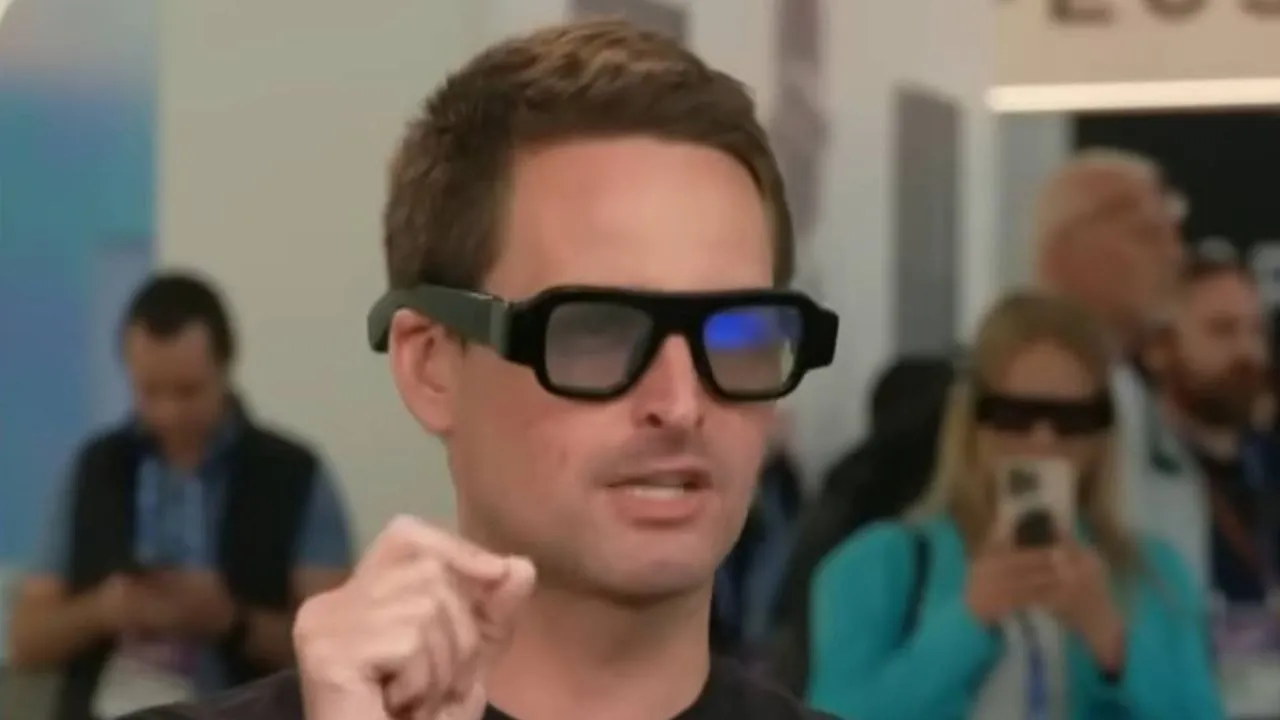
Snap, led by CEO Evan Spiegel, unveiled its AR glasses called Specs in a CNBC clip. The company pitches the frames as capable and “highly wearable,” while the chunky design visibly crushes Spiegel’s earlobes and Specs launch with a $2,195 price tag.
Snap CEO Evan Spiegel called Specs “highly wearable” in a CNBC clip showing him trying on Snap’s new AR glasses, and the frames’ chunky build visibly presses into his ears. Specs are not cheap either. Snap says a pair costs $2,195, and the company is positioning the glasses as a wearable way to reduce constant phone screen time while delivering real-time augmented visuals.
That is the key tension the demo accidentally spotlights: Specs may be engineered for performance, but the physical reality of “wearable” is hard to square with frames that look like they were designed to house a small computer. Snap describes the lenses as feeling like “a 24-inch desktop monitor when you're working” and “a 115-inch home cinema screen placed about 10 feet away when you're watching a movie.” In other words, the pitch is immersive on the content side. The video, meanwhile, underlines how much hardware Snap has stuffed into the wearable form factor.
Under the hood, Snap is going after the classic AR problem: latency and tracking have to be excellent or the experience feels glued-on rather than anchored in the real world. Snap says Specs uses two Snapdragon processors. One is dedicated to computer vision, and the other runs Lenses. Snap’s claim is specific about what that enables, including fast hand tracking, low latency, and responsive interactions that make digital content feel anchored. The company also states Specs delivers 7-millisecond motion-to-photon latency, verified through “advanced robotic measurement systems.” Even for executives who do not live in the weeds of AR engineering, the strategic meaning is clear. If you want developers and consumers to believe AR is usable, latency is one of the few metrics that can make or break perception.
Snap also leans hard into the all-in-one design. The company frames Specs as “with no puck and no tether,” contrasting it with other major players’ AR glasses projects the source references. That is a real product decision with second-order consequences. Tethering and external compute can reduce the heat and bulk in the glasses themselves, but it adds friction in real life. By going all-in-one, Snap is betting it can trade off chunkier frames for a smoother user experience, even though that tradeoff is precisely what makes Spiegel’s “wearable” line look at best optimistic and at worst tone-deaf.
Battery life is the other obvious constraint. Snap says you should expect four hours of mixed use, including audio and video playback, Lenses, AI assistance, Bluetooth notifications, and more. The included charging case can offer four additional charges, for a total of 20 hours of battery life. For decision-makers thinking about adoption, this is not a small detail. When a wearable is the product, battery is the clock that governs how often people will wear it, not just how long it runs. A consumer who needs to treat glasses like a daily charge-cycle device is going to compare the inconvenience directly to a phone they already carry and charge on their schedule.
Then there is the capital markets layer, and it is where the spectacle meets the ledger. The original unveiling took place on June 16, and the source notes a decline into today, capping off six straight sessions of losses, according to Seeking Alpha. In other words, Specs may be a bold hardware bet for Snap, but investors were not waiting for the “highly wearable” moment to judge the economics. Even if hardware ambitions are strategically rational, the market tends to demand proof of traction, not just ambition. The source is explicit that the share-price reaction is perhaps less laughable than the demo itself.
So what does this mean for executives across tech and adjacent industries? AR glasses are one of those categories where physical design, performance metrics, and distribution all have to land at once. Snap is publicly committing to an all-in-one approach, stuffing two Snapdragon processors into the frame, and making quantified claims about motion-to-photon latency. It is also setting a premium price point of $2,195. That combination creates a tightrope walk. You need credibility that performance is real and experiences are stable, while customers need comfort, battery life that fits daily routines, and a compelling reason to wear glasses instead of pulling out a phone.
For boards and leadership teams watching from the sidelines, Specs is a reminder that “hardware grunt inside a wearable” is not automatically solved by ambition. It is solved by tradeoffs. The second-order risk is that if those tradeoffs show up as awkward discomfort or limited run-time in early user reality, the narrative can shift quickly from engineering marvel to pricey gadget. Snap can absolutely be right about the technical stack and wrong about the user experience timing. The stakes are big because the AR market is crowded with visions, and the next phase will reward the teams that make performance claims match daily life.
This story's Key Insights and Take-aways are locked.
Create a free account to unlock Executive Actions for one credit.
Register to UnlockAlways free for Executives Club members. Join the Club
More in Technology

Nvidia's $89B data center quarter: the 9 companies cashing in
The AI buildout is minting fortunes beyond GPUs, and memory, cloud, and cooling suppliers are riding the same wave.

Google quietly links your phone number to every Android account on your SIM
Adding a SIM now ties your phone number to all Google accounts - and future accounts inherit it. Here's the security and privacy stakes.

Hijacker AI 'Skynet mode' runs 100,000 attack steps against exposed models
Symantec caught a criminal AI agent that borrows other models, steals data, and mines crypto; the only relief is no confirmed victims yet.