

Sotheby's July 14 T. rex Gus auction targets up to $30M as collectors outbid museums
Private buyers are grabbing fossils like luxury assets, and scientists say auction hype is accelerating the loss to study.
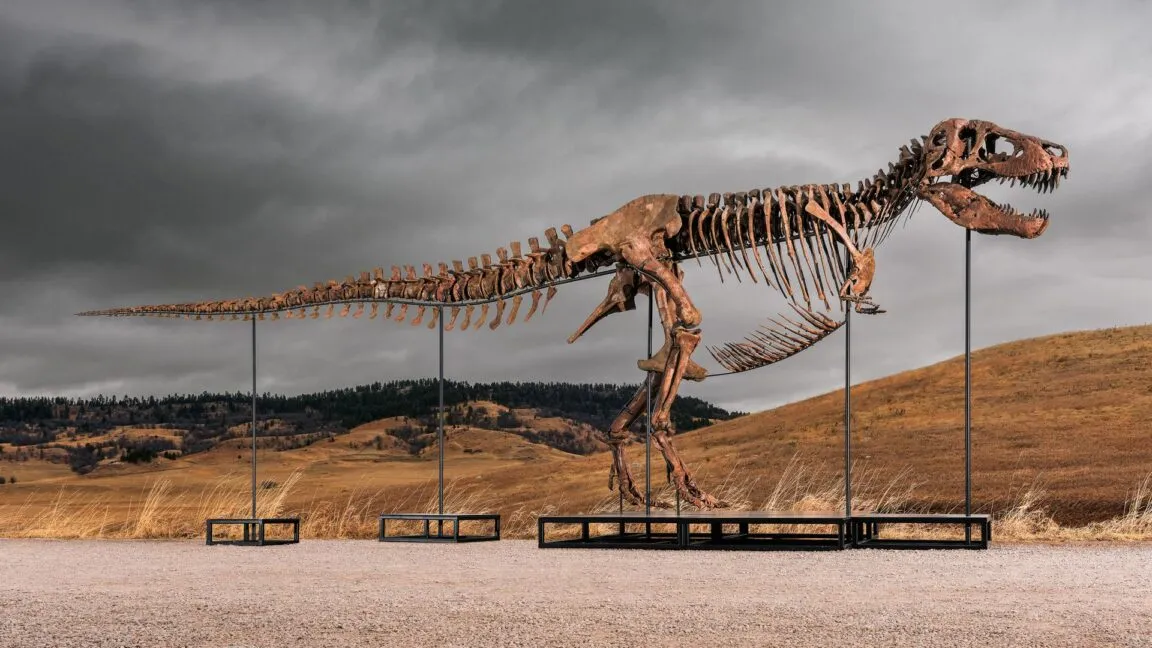
Sotheby's opened live bidding on fossils July 14, with lot 20, the 67-million-year-old Tyrannosaurus rex skeleton “Gus,” expected to fetch up to $30 million. Paleontologists warn that as private buyers outbid museums at auction, important specimens increasingly become unavailable for science.
On July 14, Sotheby's opened live bidding on assorted fossils, and the centerpiece is lot 20: a rare 67-million-year-old Tyrannosaurus rex skeleton called “Gus.” Sotheby's expects Gus to fetch up to $30 million, positioning it as one of the largest and most complete T. rexes ever found. Whether Gus ends up behind a public museum door or in a private collection, one thing changes either way: the specimen is leaving the mainstream scientific pipeline in a hurry, replaced by market and spectacle.
Sotheby's describes Gus as a big science-adjacent deal on paper: discovered on a ranch in South Dakota, the skeleton is billed as comprising “an incredible 183 fossil bone elements” and “approximately 61% complete by bone count.” It is mounted in a custom steel armature, with replicas of missing bones, arranged in a dramatic pose with replicas’ dagger teeth ready to tear into prey. That blend of completeness, reconstruction, and theatrical presentation is part of what makes this auction work as a wealth event. But it is also exactly what paleontologists worry is distorting incentives.
The core concern is not that private collectors exist. It is that private collectors increasingly outbid museums for fossils, and auction houses may be helping drive the trend by building hype. When fossils are purchased as “luxury assets,” those pieces of history can become effectively lost to science. That is a second-order implication that board members and investors often underestimate: even if a specimen gets preserved, access for study is different from ownership. Science needs repeatable access, standardized documentation, and collaboration. A private buyer can keep all of that out of reach, turning scientific potential into something more like a high-value display object.
For decision-makers, the auction model matters. Sotheby's is not just moving an artifact. It is running a market designed around rarity, competition, and urgency, and it is doing so with a global audience that includes both museums and private collectors. Sotheby's says Gus will go to the highest bidder, “whether public museum or private collector.” That framing sounds neutral, but the incentives are not. Museums are often constrained by acquisition budgets, funding cycles, and governance. Private buyers can move faster, pay for prestige, and treat the fossil as an asset class. As those dynamics shift, the auction becomes less of a discovery transfer and more of a wealth allocation battle.
The market backdrop helps explain why the stakes are rising now. Paleontologists interviewed for the piece note that private buyers have played an increasingly prominent role in buying fossils, with auction houses contributing to the trend by building hype. This is where the story stops being about one dinosaur and starts being about how culture funds knowledge. Fossil discovery is rare. Fieldwork is slow. If the most complete specimens repeatedly land with collectors, the datasets that scientists rely on get smaller and more fragmented over time.
There is also a regulatory and compliance layer that tends to get less attention than the hammer price. Fossils do not float in a vacuum. Where they are sourced, how ownership is established, and what documentation exists can determine whether museums can acquire them cleanly and whether private buyers are even allowed to import or trade them. Even when an acquisition is legal, science can still lose. The regulatory goal is preventing illegal trafficking, not guaranteeing that specimens will be available for research. So executives who think about compliance should also think about operational accessibility: what happens after the transaction, not just before it.
Second-order effects show up in brand, talent, and partnerships. When museums buy fewer key specimens, research agendas can tilt away from building new collections and toward working with what remains available, potentially slowing some lines of study. Researchers may also spend more time navigating restricted materials or missing comparative context. Meanwhile, auction narratives that emphasize reconstruction, completeness by bone count, and dramatic mounting can train buyers to reward spectacle over provenance and scientific readiness.
So what does this mean if you are an investor, an operator, or a museum-adjacent executive watching the market? Gus is a single lot in a single sale. But the structure behind it is bigger than one dinosaur. A fossil that is “approximately 61% complete by bone count,” offered with replicas for missing elements and promoted as one of the largest and most complete T. rexes ever found, is exactly the kind of object that wealth and hype can pull toward private hands. If the highest-bidder path increasingly favors collectors, the ecosystem that turns fossils into publishable knowledge gets weaker. And that is the real risk: not just that science loses an individual specimen, but that the market trains everyone, buyers and sellers alike, to treat history as something to own rather than something to study.
This story's Key Insights and Take-aways are locked.
Create a free account to unlock Executive Actions for one credit.
Register to UnlockAlways free for Executives Club members. Join the Club
More in Science

Beta Pictoris d is 100x fainter than b, hiding for over a decade in VLT data
Astronomers finally confirm the faint planet by reanalyzing ESO’s VLT archive, turning 10-year noise into a headline.
UK Met Office: 20th century climate is gone, and cold mountain areas are disappearing
A new UK climate report from the Met Office warns the UK has moved past its last century’s baseline.
Biodiversity only pays hardest in extreme drought for drier grasslands, global synthesis finds
A Nature Ecology & Evolution review of 75 biodiversity experiments shows drought makes biodiversity benefits context-dependent.