

Soyuz MS-28 brings Chris Williams home July 26, with NASA webcast timing everyone should know
Undocking at 3:02 a.m. EDT and landing at 6:26 a.m. EDT close a critical ISS transition.
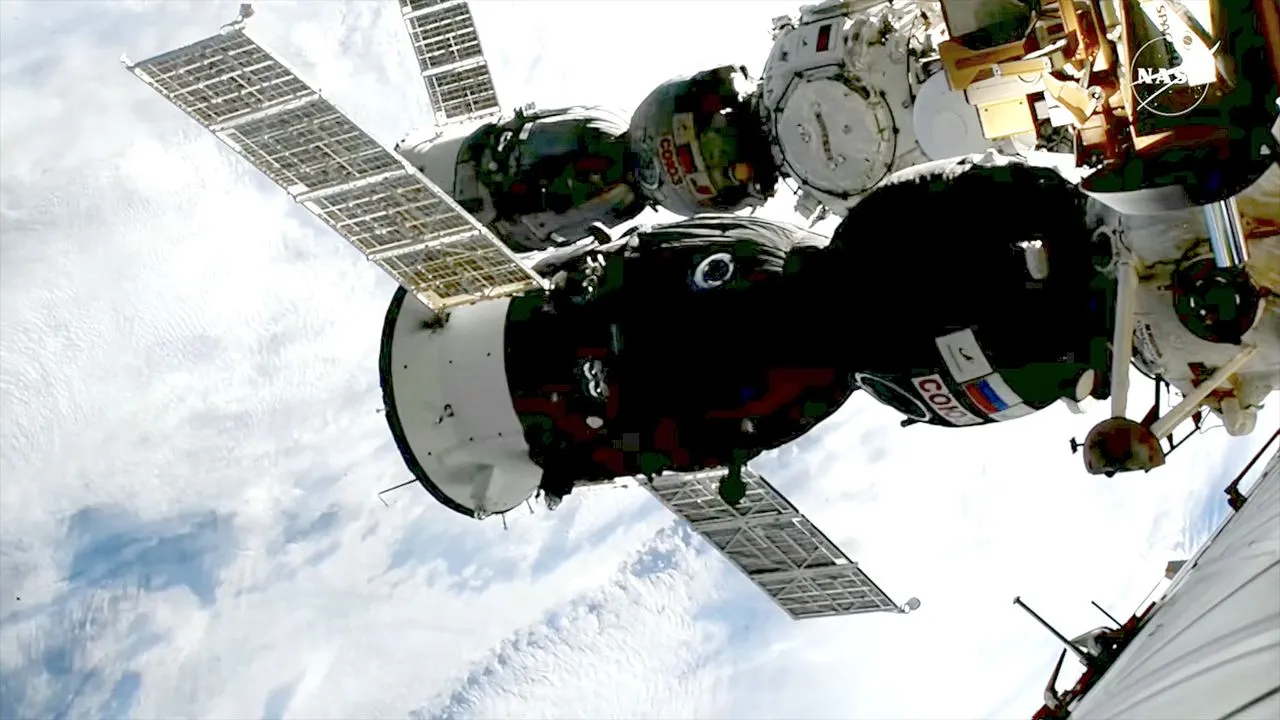
NASA astronaut Chris Williams returns to Earth on July 26 on the Soyuz MS-28 mission, landing in Kazakhstan with two Roscosmos cosmonauts. For decision-makers, the webcast schedule and transition milestones show how tightly ISS operations are managed across U.S. and Russia.
Early Sunday morning (July 26), NASA astronaut Chris Williams will leave the International Space Station for the final leg home, alongside two Russian cosmonauts on the Soyuz MS-28 spacecraft. The key operational moments are booked to the minute: the Soyuz is scheduled to undock from the ISS at 3:02 a.m. EDT (0702 GMT), and it will land on Kazakhstan's steppe about 3.5 hours later at 6:26 a.m. EDT (1026 GMT). If you care about how global space operations actually run, this is the part where everything either clicks into place or goes sideways, and NASA has a live feed to track the milestones.
The Soyuz crew set to come down consists of Williams and two Roscosmos cosmonauts, Sergey Kud-Sverchkov and Sergei Mikaev. The spacecraft, known as MS-28, is set to undock Sunday at 3:02 a.m. EDT, after which deorbit and landing activities take over on the webcast. NASA’s coverage schedule is also spelled out: NASA resumes its webcast tonight (July 25) at 11:10 p.m. EDT (0310 GMT on July 26) to cover crew farewells and the closing of the hatches between the ISS and Soyuz MS-28, expected at 11:30 p.m. EDT (0330 GMT). Undocking coverage begins at 2:30 a.m. EDT on Sunday, and the stream picks up again at 5:15 a.m. EDT (0915 GMT) for deorbit and landing activities.
Why so much attention on timing? Because the ISS is a continuous, multinational machine that runs on choreography, not vibes. In this case, the July 26 landing is tightly linked to a change-of-command ceremony aboard the station. On July 25, coverage starts at 9:40 a.m. EDT (1340 GMT) ahead of that ceremony. During the transition, Kud-Sverchkov will hand over the reins of the orbiting lab to NASA astronaut Jessica Meir. The handoff matters operationally because it lines up with the official Expedition transition: the Expedition 74 to Expedition 75 change officially begins when Soyuz MS-28 undocks.
The flight context underscores that this is not a short hop. Soyuz MS-28 launched to the ISS on Nov. 27, which was Thanksgiving Day. That liftoff kicked off the first space mission for Williams and Mikaev, and the second for Kud-Sverchkov. When the current mission ends, the trio will have spent 241 days in space. They will have orbited Earth 3,856 times and traveled more than 102 million miles (164 million kilometers). In other words, the undocking and landing are the visible end of a long runway of work that had to be executed precisely since launch.
And there is a second-order reality check after touchdown: recovery logistics. NASA says touchdown will occur southeast of the Kazakh city of Dzhezkazgan. After landing, the three spaceflyers “will fly by helicopter to Karaganda, Kazakhstan, where recovery teams are based,” according to NASA. Williams then will return to NASA’s Johnson Space Center in Houston, while Kud-Sverchkov and Mikaev head back to their training base in Star City, Russia. For executives watching global programs, that last mile is where plans meet weather, ground infrastructure, and cross-border coordination, long after the technical story ends.
Finally, this mission sits at the intersection of international partnership and institutional continuity. The ISS transition is moving from Expedition 74 to Expedition 75, with NASA and Roscosmos personnel embedded in the same operational timeline. The source even notes how the crew will be transitioning across the live webcast moments: farewells, hatch closures, undocking, deorbit, and landing. For other operators, integrators, and boards overseeing mission-critical programs, the lesson is blunt: the risk is rarely in the headline event. It is in the handoffs, the scheduled closures, and the exact minutes when one system must stop and another must start.
If you are the kind of decision-maker who has to allocate attention, budget, and risk across complex, multinational programs, the July 26 return offers a clean reminder of what “execution” means in practice. Soyuz MS-28 undocks at 3:02 a.m. EDT, lands at 6:26 a.m. EDT, and Expedition 75 officially begins with that undocking. Everything else is supporting detail. But the detail is there because that is what prevents the whole machine from unraveling.
This story's Key Insights and Take-aways are locked.
Create a free account to unlock Executive Actions for one credit.
Register to UnlockAlways free for Executives Club members. Join the Club
More in Business

Anthropic’s Levant Alpöge cracks the Jacobian conjecture after 87 years
A Harvard valedictorian used Claude to hit a 1939 breakthrough, but the missing “why” is the real problem.

Uber buys Delivery Hero for nearly $15B, vaulting to top food delivery outside China
The deal doubles Uber's dual-services footprint and pushes a ride-and-eats bundling play into 50 more markets.

Epic and Google drop settlement bid, forcing rival Android app stores by July 22
Google told the court it is ready to carry third-party app stores starting Wednesday, July 22.