
SpaceX’s $2T debut minted Elon Musk as first trillionaire, shares jump 18% Friday
A Nasdaq opening bell, a $75bn sell-off, and a valuation near $2T immediately reshuffle the IPO power rankings.
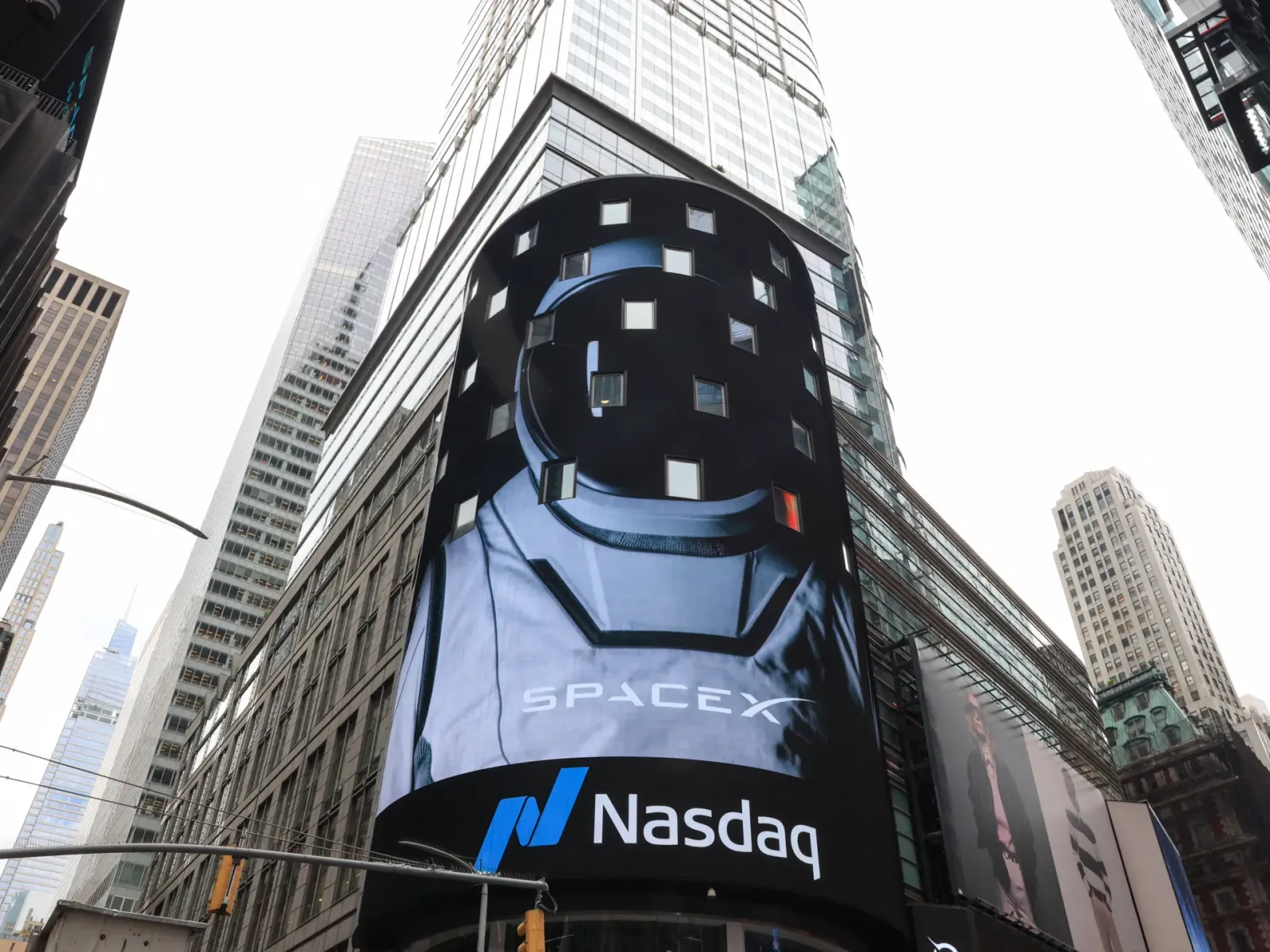
SpaceX debuted on US markets with a valuation above $2 trillion on Friday, turning CEO Elon Musk into the world’s first trillionaire. For decision-makers, the oversubscribed, quickly rising listing signals how much risk appetite is returning to mega-cap IPOs.
SpaceX hit public markets on Friday with a valuation above $2 trillion, immediately minting CEO Elon Musk as the world’s first trillionaire. Shares opened at $150, up 11 percent from the IPO price of $135, valuing the company at $1.96 trillion and putting it on track to become the sixth-largest US company by market value. By the end of the trading day, the stock surged 18 percent to $159 per share, up from the $135 IPO price.
That opening move was not just a headline for space fans. The company sold $75bn in shares, and that pricing placed the initial valuation at $1.77 trillion right after the sale. The IPO was oversubscribed four times higher than was otherwise expected, according to Reuters. In plain English, investors were lined up hard enough that the market arguably had to “clear the runway” by letting pricing land where demand demanded, not where timid expectations would have set it.
The day’s market tape also mattered. US markets ticked higher more broadly amid a possible interim peace deal between the United States and Iran that could open the Strait of Hormuz. As trading wrapped for the week, the Dow Jones Industrial Average was up 0.6 percent, the Nasdaq was up 0.2 percent, and the S&P 500 was up 0.35 percent. That backdrop matters for IPOs because sentiment can change quickly; a deal-driven energy and geopolitics narrative can soften volatility, which makes it easier for investors to step into big-ticket risk.
SpaceX’s debut itself came with operational friction, the kind public markets never fully forget. Shares did not trade until the middle of the trading day because the exchange collected buy and sell orders and underwriters delayed trading until supply and demand were balanced. That detail matters because investors and exchanges are watching for technical mishaps that marred Meta’s 2012 debut. This listing is widely viewed as a dress rehearsal for a new generation of mega-listings, and the market clearly wanted a cleaner opening than the last time giant-tech went public at scale.
The investor mix also hints at who is underwriting the valuation story. Of the institutional investors allocated, Bloomberg News reported that as much as 70 percent went to long-only investments, a strategy where holders buy with expectations that assets will rise over time. Bloomberg also noted that sovereign wealth funds participated, including those from Saudi Arabia and Kuwait. That is an important nuance for executives and boards: when long-only and sovereign money are prominent, the marginal buyer might be less focused on short-term pop-and-drop trades. It can support stability, at least in theory, and it can change how volatility plays out after the first day of headlines.
The IPO’s ceremony was literal and symbolic. SpaceX President Gwynne Shotwell and Chief Financial Officer Bret Johnsen rang the opening bell at Nasdaq MarketSite in New York City at 9:30am local time as US markets opened. But the excitement outside the building was sharper than the vibes inside. Protesters gathered outside MarketSite to protest the IPO amid continued allegations that Grok, part of xAI, a subsidiary of SpaceX, allowed users to create non-consensual deepfake sexualised images before the IPO debut. That juxtaposition is more than theater. For public companies, controversies do not just affect brand perception; they can influence investor sentiment, regulatory scrutiny, and how aggressively governance questions get asked in the months after listing.
Behind the valuation mechanics, SpaceX’s financial and business reality is doing a lot of the heavy lifting. The surge comes even though the firm posted a loss of nearly $5bn last year and generated only a fraction of the revenue brought in by similarly valued tech giants. The source ties that mismatch to growth driven by its Starlink subsidiary, which drives as much as 80 percent of its revenue. In other words, the market is leaning into an operating model where one business line carries most of the near-term economics, while the rest of the story, rockets and satellites, supports the longer-term thesis.
The IPO lands with timing that the next wave of AI and space-adjacent listings will not ignore. The source notes that market participants will be watching for signals on investor appetite in advance of forthcoming IPOs for AI heavyweights Anthropic and OpenAI. It is a reminder that IPOs are not isolated events; they are signals in sequence. When SpaceX trades up 18 percent after a four-times-oversubscribed process, boards and CFOs of other high-profile companies can read it as permission, or as a benchmark that their own deals will be compared against.
And SpaceX kept momentum off the trading floor too. On Friday, SpaceX launched its Falcon 9 rocket with 29 satellites into space from Cape Canaveral in Florida. For decision-makers, the strategic stake is clear: the world just watched a capital markets reset in real time. The question now is whether the same investors willing to value a space and Starlink-driven platform at $2 trillion will show up again when the next mega-IPO attempts to convert hype into durable ownership.
This story's Key Insights and Take-aways are locked.
Create a free account to unlock Executive Actions for one credit.
Register to UnlockAlways free for Executives Club members. Join the Club
More in Business

Mena construction CPMI slips 12% in April 2026, but execution momentum rebounds to 1.01
GlobalData’s April CPMI shows resilience masking pre-execution caution, with conflict risk surfacing unevenly by country and sector.
Naqi Water adds SAR 1.22M works, pushes Riyadh factory delivery to H1 2027
A contract addendum expands floor space and electrical capacity, but the schedule slips due to construction and supply issues.

FDA expands Sanofi’s type 1 diabetes injection for newly diagnosed 8 to 17-year-olds
The FDA’s approval widens use in a key pediatric group, reshaping market access timelines and future revenue forecasts.