
Spanish doctors chased metastatic cancer and found multiple brain lesions caused by worms
A 60-year-old headache case turned from oncology suspicion to parasitic reality, highlighting why diagnostic assumptions can mislead.
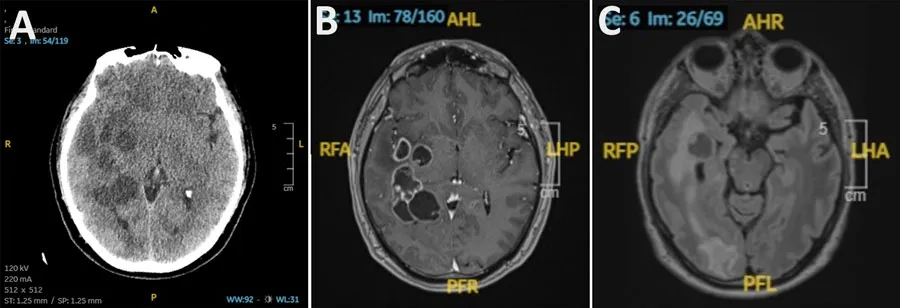
In Spain, doctors treating a 60-year-old man for a worsening headache suspected metastatic cancer after CT scans showed multiple brain lesions with swelling. Their Emerging Infectious Diseases case report traced the diagnostic path, emphasizing how immune signals like elevated IgE and missing risk factors change the odds for decision-makers and clinicians alike.
A 60-year-old man in Spain walked into the doctor with a headache that started two weeks earlier and kept getting worse, plus subtle behavioral changes. When clinicians ran a neurological exam, they found a mild delay in his movements but no other deficits. The blood work was also mostly normal, except for elevated IgE, a lab signal that can show up in allergic or autoimmune conditions but also in parasitic infections.
Then came the pivot moment: a computed tomography (CT) scan of his head revealed multiple lesions scattered throughout his brain, alongside swelling. In other words, this was not a vague symptom story. It was a pattern with consequences, and the doctors worked through likely causes in a case report published in Emerging Infectious Diseases. Their top suspicion was metastatic cancer, even though the man was not immunocompromised and had never traveled internationally.
For executives and operators, this is a reminder that the first “most likely” explanation is not always the right one, especially when the initial data points are loud but ambiguous. CT imaging showing multiple brain lesions with swelling pushes clinicians down a familiar road, because metastatic cancer is a high-stakes, common enough explanation that clinicians are trained to check it early. From an organizational standpoint, that is exactly how incentives are usually built: the fastest path is often the safest path, because missing cancer can have catastrophic outcomes.
But the case report adds the diagnostic friction that changes decision-making. Elevated IgE nudges the differential diagnosis, widening it beyond purely oncologic causes. IgE is often discussed in the context of allergies and autoimmune disease, yet it is also associated with parasitic infections. That one lab value, combined with the man not being immunocompromised, matters because it quietly removes a major branch of the diagnostic tree. If a patient is not immunocompromised and has no recent travel, the likelihood of certain infectious exposures can drop, which should make teams more careful about assumptions that rely on “usual suspect” exposure pathways.
This is where the “diagnostic workup” becomes more than clinical procedure. In case-based reasoning, every test is a decision with a direction. CT findings create urgency. Blood work narrows and broadens. Immune status and travel history act like constraints. When the top suspicion is metastatic cancer but the patient lacks key risk factors, the organization has to manage uncertainty actively, not passively. The doctors in the report explicitly noted they worked through possible conditions that could explain all the findings, starting from the oncology suspicion and then reconciling imaging, immune markers, and clinical context.
Regulatory and governance parallels exist even outside medicine. In highly regulated industries, boards and compliance teams are taught to avoid “single-factor certainty,” the mental shortcut where one dominant data point overrides everything else. This case is the clinical version of that lesson: a CT scan can scream one narrative, but the overall pattern has to be explained, not just described. Emerging Infectious Diseases case reports also underscore how important surveillance-style thinking is, because rare or non-obvious causes can present in ways that resemble mainstream diagnoses.
Second-order implications for leadership go beyond curiosity. First, diagnostic uncertainty has downstream cost and risk. If teams default to metastatic cancer without fully accounting for alternate explanations, they may trigger invasive confirmatory pathways, escalate urgent treatment decisions, and strain patient communication, all while potentially delaying the correct diagnosis. Second, the case highlights how teams should structure their “differential diagnosis” process so that exceptions are not treated as anomalies but as data. Elevated IgE plus non-immunocompromised status and no international travel are not trivial details. They are the clues that keep the search honest.
Finally, the stake is not just this one patient. For clinicians, it is the difference between the right therapy and the wrong one. For decision-makers in healthcare systems, it is about building processes that support thorough reasoning under pressure. The takeaway is simple and sharp: when imaging and symptoms point toward metastatic cancer, but the patient’s immune and exposure context does not fit, the diagnostic team has to keep asking, “What else could explain all the findings?” In this case, the answer was worms, not cancer.
This story's Key Insights and Take-aways are locked.
Create a free account to unlock Executive Actions for one credit.
Register to UnlockAlways free for Executives Club members. Join the Club
More in Technology

Nvidia's $89B data center quarter: the 9 companies cashing in
The AI buildout is minting fortunes beyond GPUs, and memory, cloud, and cooling suppliers are riding the same wave.

Google quietly links your phone number to every Android account on your SIM
Adding a SIM now ties your phone number to all Google accounts - and future accounts inherit it. Here's the security and privacy stakes.

Hijacker AI 'Skynet mode' runs 100,000 attack steps against exposed models
Symantec caught a criminal AI agent that borrows other models, steals data, and mines crypto; the only relief is no confirmed victims yet.