

Starlight Festival's Giza debut: 114 countries, one ancient stage
EXIT and Venture Lifestyle just pulled off the first multi-day electronic festival at the Pyramids. Here's what it signals for music tourism and Egypt's creative economy.
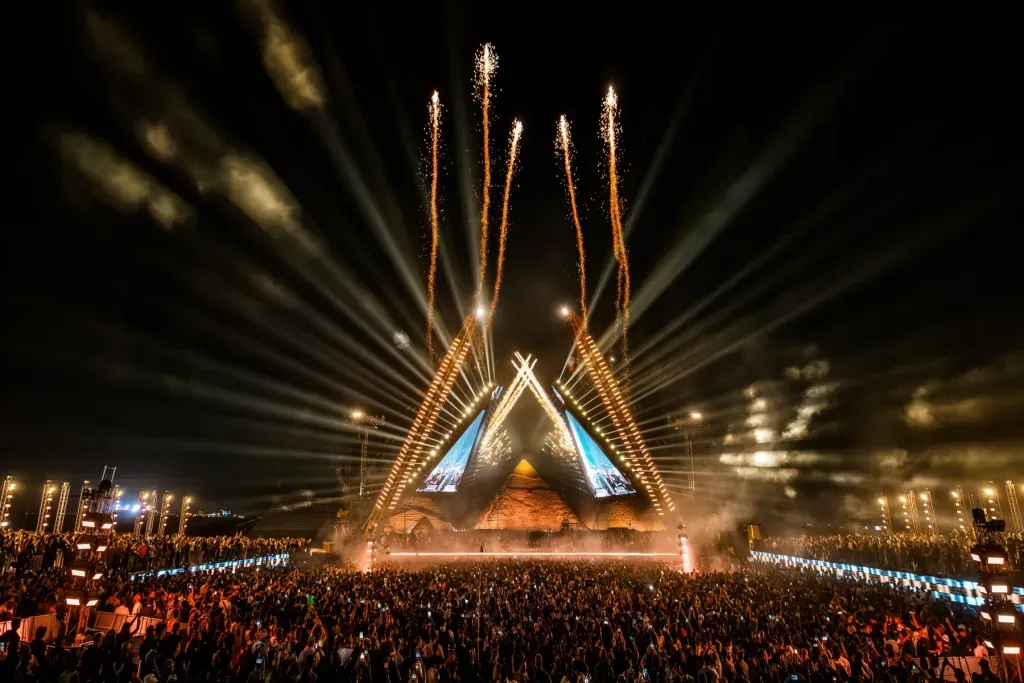
EXIT and Venture Lifestyle's P+US platform launched the inaugural Starlight Festival at the Great Pyramids of Giza, a sold-out, multi-stage electronic music event drawing fans from 114 countries. The debut positions Egypt as a serious international festival destination and signals the growing economic weight of music tourism.
The Great Pyramids of Giza just hosted something no one had pulled off before: a multi-day, multi-stage electronic music festival. Starlight Festival, the inaugural event from Serbia's EXIT and Venture Lifestyle's electronic music platform P+US, sold out on Oct. 9 and 10, drawing more than 60 international and regional artists and attendees from 114 countries. Organizers called it the largest electronic music event at the historic site since Jean-Michel Jarre's 1999 concert, and the first multi-day, multi-stage festival staged at Giza. For a region often seen as a tourism destination rather than a music destination, that is a statement with commercial weight behind it.
The lineup gave the debut immediate credibility in the global electronic scene. Belgian techno heavyweight Charlotte de Witte made her Egyptian debut, sharing the bill with Michael Bibi, Adriatique, Indira Paganotto, Enrico Sangiuliano, Vintage Culture, Pete Tong and WhoMadeWho. EXIT's No Sleep stage added Charlie Sparks, BIIA, Layla Benitez, Paolo Ferrara and Olympe, while Satori and Giolì & Assia delivered live sets. Multimedia studio Sila Sveta designed the visual production, using lighting and optical illusions to make the pyramids appear to float above the stage. The scale and production quality matter because they signal to international promoters, agents and brands that Egypt can handle events that compete on a global level, not just a regional one.
Starlight was also the final stop on EXIT's eight-event international tour, a tour born out of necessity. EXIT was forced to leave its longtime home in Serbia after publicly supporting student-led protests in the country. That context gives the festival's name an extra layer of meaning: in a year the festival could not gather at home, it gathered in front of the greatest wonder of the ancient world. EXIT founder and CEO Dušan Kovačević put it directly: "In the year we could not gather at home, we found ourselves bringing people together in front of the greatest wonder of the ancient world." The resilience story is not just sentimental. It shows how a festival brand can pivot its physical footprint when political conditions shift, a lesson for any live-events company whose home market becomes unstable.
The commercial logic behind Starlight extends beyond ticket sales. Music tourism has become a serious economic driver, with international audiences increasingly traveling specifically for experiences that combine music, culture and destination. Kovačević framed the philosophy clearly: "An extraordinary location should deepen the experience, rather than become a substitute for it." That distinction matters for every festival organizer weighing whether to chase spectacle or substance. The location is the hook, but the music and club culture remain the product. Starlight's identity, he said, would keep electronic music and club culture central, not relegate them to background ambience.
For Venture Lifestyle founder and CEO Rabih Mokbel, the partnership was an explicit bet on Egypt's potential as a festival market. "It shows that Egypt has the potential to host world-class festivals that can compete on an international level, not just because of the artists or production, but because of the destination itself," he said. That is a meaningful endorsement from a platform that could have chosen any number of established festival destinations. It also signals to regional governments and tourism authorities that international event organizers are watching, and that infrastructure and destination appeal can translate into high-spending international visitors.
Mokbel also emphasized the importance of placing regional artists alongside established international performers. "If we want the regional music industry to continue growing, we need to create more opportunities like this, where local talent can be part of the global conversation rather than watching it from the sidelines," he said. That is a direct answer to a common criticism of destination festivals: that they import international talent and leave local scenes untouched. Starlight's model, at least in its stated ambition, is designed to create a pipeline for Egyptian and regional artists to reach global audiences, and for local production professionals to build experience at world-class scale.
The organizers have already confirmed Starlight's return on Nov. 5 and 6, 2027, which signals confidence that the debut was not a one-off experiment. For Kovačević, the longer-term ambition is to build a recurring cultural event that creates lasting opportunities for Egypt's artists, production professionals and wider creative economy. "Becoming an annual gathering that people travel to Egypt specifically to experience, and that brings real value to the people hosting it, would be a success worth building on," he said. That is the difference between a festival and a franchise: the first sells tickets, the second builds an ecosystem.
For executives in live events, tourism, and regional economic development, Starlight's debut is a case study in how a destination can reposition itself in the global market. The combination of a world heritage site, international production standards, and a deliberate local talent pipeline is replicable, but only with the right partners and a long-term commitment. The festival's return in 2027 will be the real test of whether the model can sustain itself beyond the novelty of the pyramids. For now, the message is clear: Egypt is not just a place to visit, it is a place to build.
This story's Key Insights and Take-aways are locked.
Create a free account to unlock Executive Actions for one credit.
Register to UnlockAlways free for Executives Club members. Join the Club
More in Business

Elon Musk unveils a flying car, and SpaceX helped build it
The Tesla CEO's showcase at a SpaceX facility signals a future where road and rocket engineering converge.

Apple's $2,000 iPhone Duo opens preorders, taking on Samsung and Google
Apple's first foldable hits the market at a premium price, reshaping a category Samsung and Google have led.

Pope Leo XIV, first American pope, diagnosed with lung cancer
The 71-year-old Chicago-born pontiff underwent successful surgery on his right lung, and his diagnosis raises new questions about his AI-focused papacy and the Vatican's future.