

Switch seeks $50B+ valuation in talks to raise billions for data centers
The Las Vegas data-center developer is in talks for a mega-round that signals where capital is heading next.
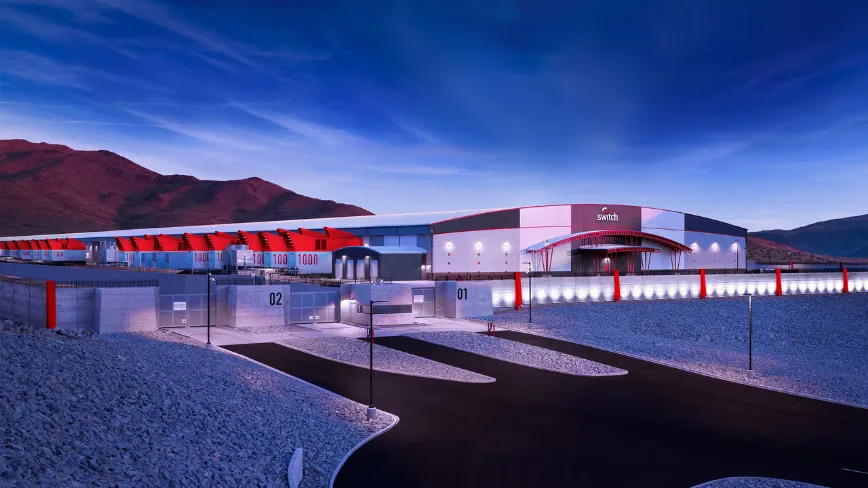
Switch, a Las Vegas data-centre developer, is in talks to raise billions of dollars at a valuation of at least $50bn, according to The Information. For decision-makers, the implied message is clear: data-center buildout demand is strong enough to pull institutional-scale financing again.
Switch, the Las Vegas data-centre developer, is in talks to raise billions of dollars at a valuation of at least $50bn, according to The Information. That $50bn-plus number is the kind of valuation that would have sounded implausible for a pure-play data-centre developer just a few years ago.
The reason this matters is not just the headline valuation. It is what that valuation tries to bankroll: Switch is positioning itself to capitalize on the demand for data-centre capacity, and it wants capital on terms that reflect how urgently the market is trying to solve the compute crunch. If you are a CFO or investor tracking where the next wave of “infrastructure meets AI” dollars will go, this is the clearest signal yet that data centers are again attracting funding at venture-style scale.
Zoom out a bit and the shift becomes easier to understand. Data-centre buildout sits at the intersection of three forces that have been colliding for years. First, cloud providers and enterprises keep buying more compute. Second, the infrastructure required to run that compute, in the physical world, takes time: land, power, construction, and then the operational lift to keep uptime high. Third, the demand curve can become lumpy, because capacity is constrained by electricity availability and by the cadence of permitting and construction.
That last point turns “demand” into a capital allocation problem. Data centers are not like software. You cannot just spin up more servers overnight and call it a day. You need grid connection, you need transformers and substations, you need crews, materials, and local approvals. Over the last few years, regulators and grid operators have become more central to timelines, because power is the real gating factor. In that context, a developer raising billions at a $50bn-plus valuation is effectively betting that the bottlenecks are surmountable, and that the market is willing to price the risk.
Why would investors pay up now? Because if the underlying demand persists, returns scale with scale. Once a developer builds out capacity that can meet contracted demand, the business can become a long-duration play rather than a short-term construction cycle. That is the “second-order” dynamic boards care about: valuation is not just about current cash flow, it is also about the expected path of revenue, occupancy, and the durability of demand. When capital markets are willing to underwrite that durability at high valuations, it changes negotiation leverage for developers in future rounds and potentially even for their ability to secure favorable financing structures.
There is also a governance and deal-structure angle. The source says Switch is in talks to raise billions and that the valuation is at least $50bn. That phrasing matters because it hints at a process that could be competitive or iterative. In capital raising, “in talks” often means the company is shopping terms across investors, balancing valuation expectations against other deal terms such as control, governance rights, and future fundraising flexibility. For a board, the key question is whether a high valuation accelerates progress without locking the company into inflexible expectations later.
For peers and counterparties, the ripple effect is straightforward: it raises the benchmark for what “infrastructure build” can be valued at. If Switch can approach a $50bn-plus valuation while pitching data-centre demand, other developers may feel pressure to justify their own growth plans more aggressively. It could also influence landlords, energy partners, and contractors, because large rounds tend to pull timelines forward and attract talent and procurement commitments.
The strategic stakes are even higher for anyone involved in buying compute capacity or funding the physical layer behind it. Data-centre developers are not only competing with each other for projects. They are competing with alternative uses of capital, and they are competing with the calendar. If more capital flows into projects at valuations that once seemed reserved for tech firms, the market may accelerate construction, which can ease future capacity constraints. On the other hand, if valuations outrun execution, the downside can land hardest on companies that cannot secure power and timelines.
In short, Switch’s $50bn-plus valuation talks, as reported by The Information, are a signal that data-centre development is once again treated as a mega-scale growth bet. For executive teams in adjacent roles, that signal should sharpen the questions: do your assumptions about capacity timelines and power constraints still hold, and are your strategic partnerships aligned with where the financing is headed now?
This story's Key Insights and Take-aways are locked.
Create a free account to unlock Executive Actions for one credit.
Register to UnlockAlways free for Executives Club members. Join the Club
More in Business

Anthropic’s Levant Alpöge cracks the Jacobian conjecture after 87 years
A Harvard valedictorian used Claude to hit a 1939 breakthrough, but the missing “why” is the real problem.

Uber buys Delivery Hero for nearly $15B, vaulting to top food delivery outside China
The deal doubles Uber's dual-services footprint and pushes a ride-and-eats bundling play into 50 more markets.

Epic and Google drop settlement bid, forcing rival Android app stores by July 22
Google told the court it is ready to carry third-party app stores starting Wednesday, July 22.