

Synthesia adds Cinder to stop AI videos before they exist
The London AI video company is tightening a screen-at-creation system that could shape how fast AI-generated media gets governed, approved, and shipped.
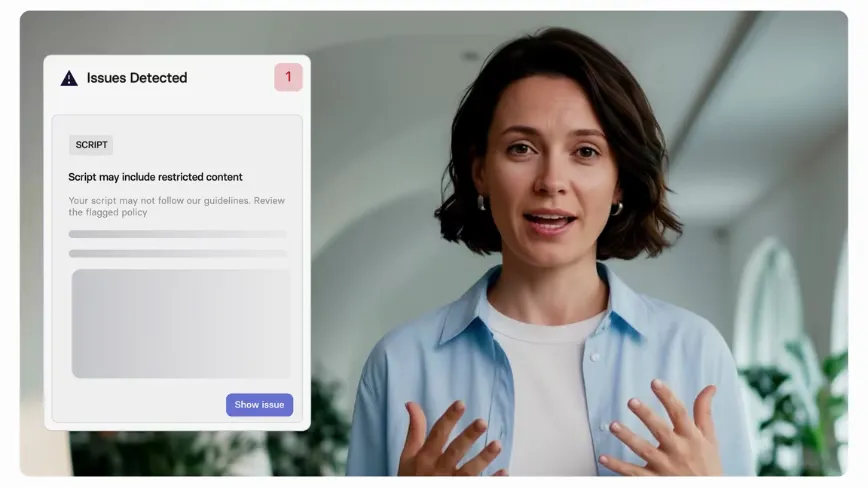
Synthesia, the London AI video company that generates avatar-led clips from a script, announced on 4 June that it is extending its moderation stack with Cinder, a company built for AI-generated content. The move reinforces Synthesia’s long-running model of deciding whether a video is allowed before it exists, which matters for any team shipping AI content at scale.
Synthesia is doubling down on a very specific idea: moderation should happen before a frame ever renders. On 4 June, the London AI video company said it is extending its moderation infrastructure with Cinder, a company built for AI-generated content. That means Synthesia, which lets users generate avatar-led clips from a script, is not just checking videos after the fact. It is screening them at creation time, before the content is even fully formed. In plain English, the company is trying to decide whether a video is allowed to exist at all, not merely whether it should be taken down later.
That approach is not new for Synthesia. The company says it has run a screen-at-creation model since 2017, which makes this latest move less of a pivot than a reinforcement. But it is still strategically interesting because AI video is moving into a world where speed, scale, and trust are colliding. The more content can be generated instantly, the more pressure there is to stop unsafe or disallowed material before it spreads. For a product like Synthesia, that creates a business question as much as a safety one: if your platform is built to let users generate video fast, how do you keep the workflow tight enough to catch the bad stuff without slowing the good stuff down?
The answer Synthesia is signaling is infrastructure. Rather than treat moderation as a bolt-on clean-up task, it is adding tooling designed for AI-generated content itself. That matters because moderation systems built for the old internet were often designed around static text, images, or uploaded videos. AI-generated video changes the job. The content is created on demand, often in huge volumes, and can vary with each prompt or script. If moderation waits until after rendering, the platform may already have spent compute, time, and product momentum on material it should never have made in the first place. A pre-generation model flips that order and tries to make the approval gate part of the product architecture.
For executives, the bigger point is that this kind of setup can become a competitive requirement, not just a compliance nice-to-have. Companies using generative video for marketing, training, customer support, or internal comms will increasingly care about whether the platform has controls baked in from the start. If your team is adopting AI content tools, the risk is no longer just what the model can create. It is also what your governance process lets through, what your legal team can live with, and how quickly your operations team can move without creating a moderation mess downstream. In that sense, Synthesia’s partnership with Cinder is a signal to buyers as much as a technical update: trust is part of the product.
It also fits a broader industry pattern. As generative AI becomes more embedded in everyday business workflows, the companies that win may be the ones that make safety feel invisible. Nobody wants a week-long approval queue every time someone needs an explainer video or training clip. But nobody wants a compliance incident either. So the pressure is to build systems that can screen early, move quickly, and scale with usage. That is especially true for AI video, where a single tool can be used to produce a huge amount of branded, external-facing content. The moderation layer becomes one of the hidden pieces of infrastructure that determines whether a platform can graduate from novelty to enterprise standard.
The source material does not say exactly how Synthesia is implementing the Cinder integration, or what categories of content it is screening for. Still, the strategic direction is clear enough. Synthesia is betting that the future of AI video will not be won by generation alone. It will also be won by the systems that sit in front of generation, decide what gets through, and help companies ship content without creating avoidable risk. For peers building or buying AI tools, that is the real takeaway: as creation gets cheaper and faster, moderation moves from the back office to the front door. And once that happens, the companies that can make governance feel seamless will have a serious edge.
This story's Key Insights and Take-aways are locked.
Create a free account to unlock Executive Actions for one credit.
Register to UnlockAlways free for Executives Club members. Join the Club
More in Technology

OpenAI says 10,000 agents cracked a 90-year math problem in 88 hours
The company's claim is audacious, but one mathematician is pushing back. Here's what it means for AI-driven discovery.
Meta still serves child sexual abuse ads on Instagram in India - BBC report
A new report following the BBC Eye investigation says the ads are still there - what it signals for every platform with a self-serve ad engine.

White House yanks 'Build the Wall' game after Tetris Company copyright warning
The administration's arcade game vanished in hours - and the takedown playbook every brand can learn from.