
Tade Oyerinde says AI turns learning into biannual gym reps for your career
Campus founder argues you need two to three hours weekly of continuous AI learning, not a one-time skill binge.
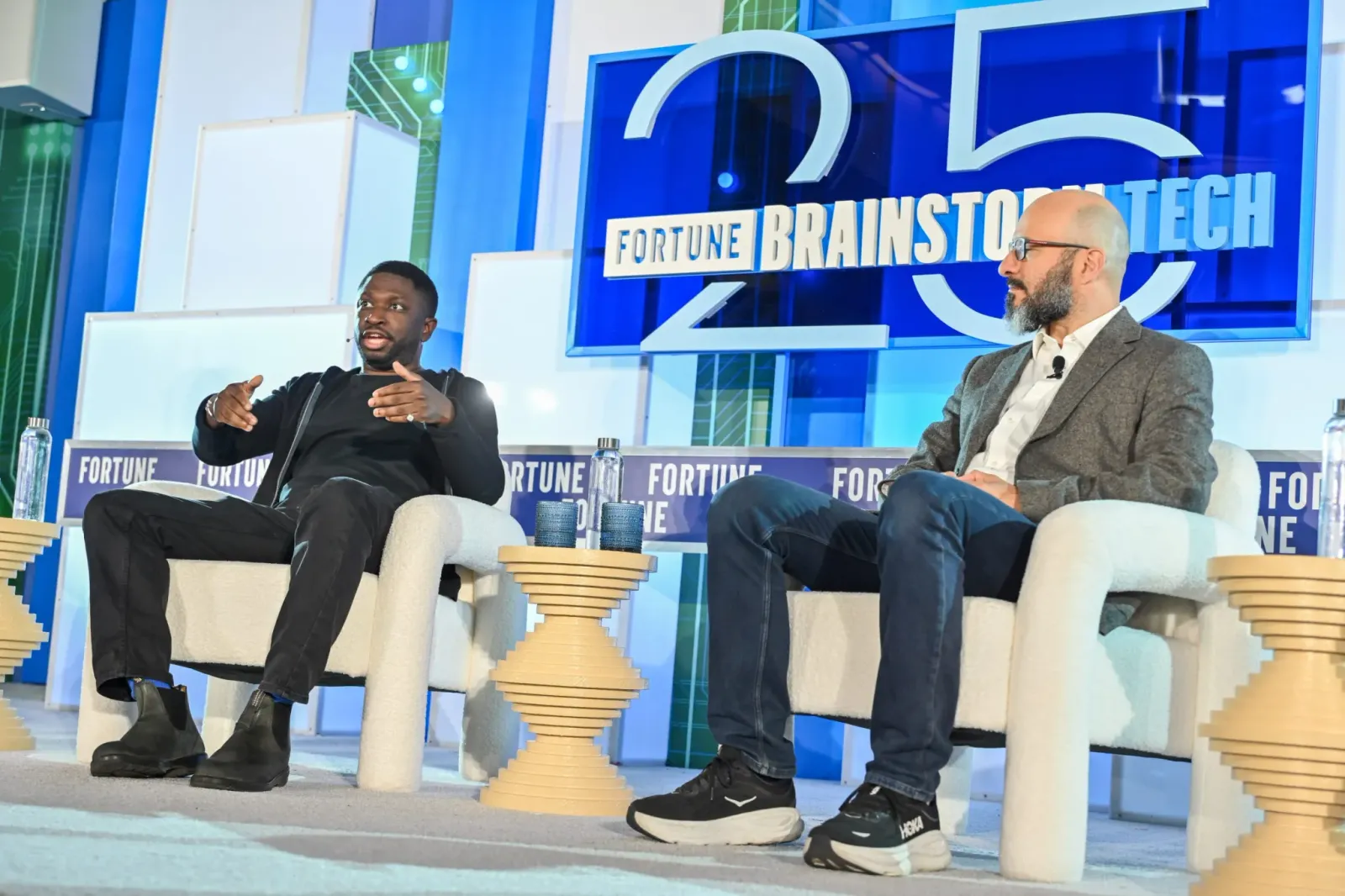
Campus founder and chancellor Tade Oyerinde told Fortune Brainstorm Tech that AI’s rapid improvement makes “learn once and done” obsolete. For decision-makers, it signals organizations will need permanent continuous-learning infrastructure, not ad hoc AI upskilling.
Tade Oyerinde, the Campus founder and chancellor, compared AI-era education to a New York gym membership: two to three hours a week, every week, for the rest of your career. Speaking on the first day of the 25th annual Fortune Brainstorm Tech conference in Aspen on Monday, he made the case that the old career fantasy, learn one skill and coast for life, is over.
Oyerinde’s specific prescription was blunt, and it lands because AI is doing the same thing to work that fitness does to summer bodies. “If you want to be the equivalent of hot and fit in your career, you’re going to have to spend two or three hours a week learning how to use the most recent advances in AI.” Then he added the part that should make executives sit up: the scrambling companies are doing right now will not end with a single “project” or a one-time deployment.
Instead, he argued the new baseline will look like maintenance, not milestones. All that frantic activity around deploying AI, in his view, is not a finished phase. It is an ongoing cycle. “You’re going to have to do that every year for the rest of your careers, ad infinitum,” Oyerinde told the audience, effectively telling leaders to plan for recurring renewal rather than one-time transformation. He also predicts companies will soon staff permanent departments for continuous “learning, continuous development, continuous evaluation,” the kind of functions that become as routine as operations or finance.
Why is he so confident? Because he believes the pace of AI advancement is not just fast, it is steeper. He pointed to models now approaching recursive self-improvement, where each version helps build the next. That matters for learning because education schedules are usually built on a world where the tool gets better slowly or on a known cycle. If AI is effectively accelerating its own evolution, then the gap between what you trained on and what you need next can widen quickly.
Oyerinde also said this shift should change how schools think about curriculum. Colleges and universities often design courses for broad student groups, which creates a mismatch when students differ dramatically in what they already know. His alternative pitch is that AI can map students’ knowledge at an “atomic level,” then route them through custom pathways, letting stronger students skip ahead while others fill gaps. He claims the approach results in teaching “about five times faster.” Whether you’re in education, workforce development, or corporate learning, the point is the same: learning should adapt to where the learner is now, not where the syllabus assumes they should be.
That framework connects directly to Campus’s moves. The source notes Campus’s 2025 acquisition of Sizzle AI, a learning startup founded by Meta’s former AI chief Jerome Pesenti. The company is part of the broader Code.org ecosystem via Hadi Partovi, who founded Code.org 13 years ago and recently renamed it to CodeAI to reflect the evolution in coding. The organization’s focus, as described here, helps students learn the basics of computer science and the technology remaking their world, and now that mission has fully embraced coding and AI.
Partovi’s argument for curriculum is also operational, not mystical. He said every student needs to grasp how AI actually works, then learn to build with it, and to use it responsibly. He also described himself as a “cautious optimist,” warning against treating AI as “this magic thing that’s been created from above.” Instead, it’s something humans built, and everyone should help shape it. That’s a culture message, but it also implies governance: if AI is a capability students and employees can build with, then organizations have to treat responsibility and safe use as part of training, not an afterthought.
The content focus in his view shifts too. He noted schools should not stop teaching coding-related basics just because AI can read, write, and do math. But he argued the rote parts of coding, like memorizing where semicolons and brackets go, no longer matter as much. What remains important is computational thinking, logic, planning, and problem-solving. He added a critique that hits employers in the pocketbook: “My guess is nobody here in this room uses calculus day to day,” and mostly no employer is hiring the calculus experts, while students still struggle and feel they need to master it for little practical purpose.
From a board and exec perspective, there’s another layer: the problem is not only what schools teach, it is the widening mismatch between relevance and curriculum. Oyerinde said, “The gap between what’s relevant and what schools are teaching is growing as fast as the AI models are changing.” His framing makes a simple risk argument. If the models evolve continuously, then learning systems that update slowly will reliably produce skill lag. That skill lag then turns into execution drag inside companies, especially in teams that depend on AI capability and workflows.
The source also ties this to lifelong learning, not just entry-level talent. Karin Klein, founding partner at venture firm Bloomberg Beta, said AI can benefit all rather than a few and participates in “talking circles” with icon Gloria Steinem, described as a lifelong learner. Klein noted, “At 92, Gloria’s still learning,” and added that she taught Steinem how to use AI about a year and a half ago, concluding with the implication that there are “no excuses.” Taken as evidence, it’s less about celebrity and more about signaling: the adoption curve is not a skills cliff only for the young.
So what’s the strategic stake for executives? Oyerinde’s gym membership metaphor is useful because it is measurable and structural. Two to three hours a week is a routine, not a sprint. If the new expectation is continuous learning, then companies need recurring systems that update employees’ AI competence as tools change, and leadership needs to budget for it like any other operating function. The second-order effect is that learning becomes a competitive capability, not a perk, and the organizations that institutionalize it early will move faster than those still treating AI upskilling like a one-time rollout.
This story's Key Insights and Take-aways are locked.
Create a free account to unlock Executive Actions for one credit.
Register to UnlockAlways free for Executives Club members. Join the Club
More in Technology

OpenAI says 10,000 agents cracked a 90-year math problem in 88 hours
The company's claim is audacious, but one mathematician is pushing back. Here's what it means for AI-driven discovery.
Meta still serves child sexual abuse ads on Instagram in India - BBC report
A new report following the BBC Eye investigation says the ads are still there - what it signals for every platform with a self-serve ad engine.

White House yanks 'Build the Wall' game after Tetris Company copyright warning
The administration's arcade game vanished in hours - and the takedown playbook every brand can learn from.