

Tencent Music, Billboard China and Billboard Korea name SEVENTEEN, i-dle, THE8 and NINGNING
Cross-market K-artist fan voting picked winners in four categories by combining China and Korea results.
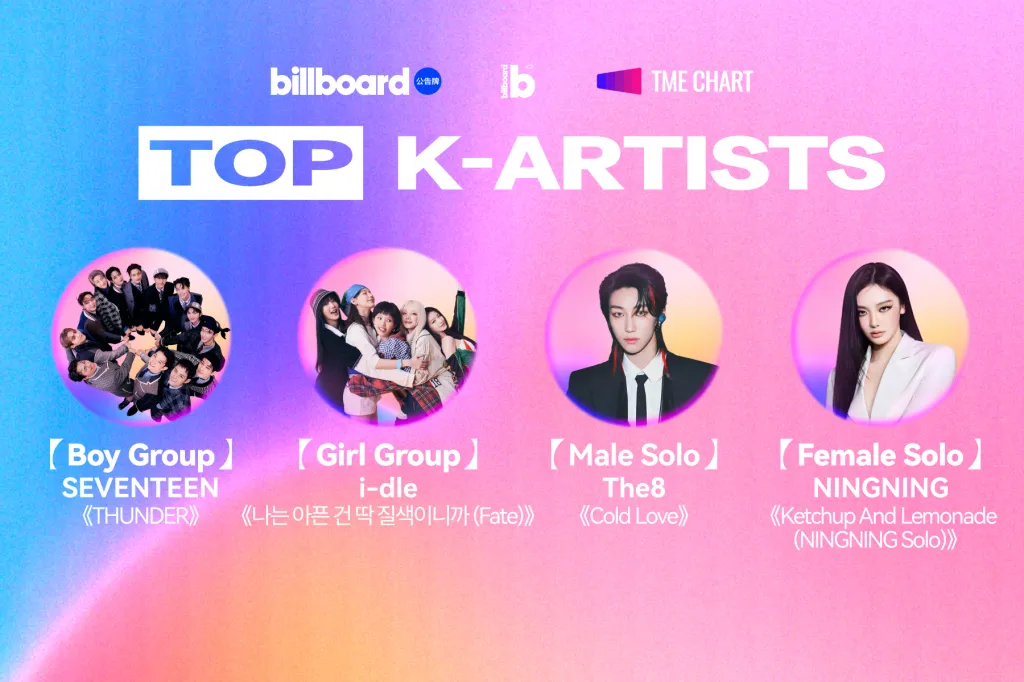
Tencent Music, Billboard China, and Billboard Korea announced the winners of their inaugural cross-market fan voting initiative across four categories. For decision-makers, it signals how music platforms and media brands are bundling chart performance, editorial curation, and fan participation into a scalable format.
Tencent Music, Billboard China, and Billboard Korea just crowned the winners of their inaugural cross-market K-artist fan voting initiative, and the final list is remarkably clear: SEVENTEEN, i-dle, THE8, and NINGNING. The project uses combined results from both the China and Korea voting channels, and that cross-market “one campaign, two audiences” structure is the point. It turns what can be fragmented fandoms into a single scoreboard, where the same categories compete and the results roll up across markets.
Here are the final winners determined by those combined results: Boy Group: SEVENTEEN 《THUNDER》; Girl Group: i-dle 《나는 아픈 건 딱 질색이니까 (Fate)》; Male Solo: THE8 《Cold Love》; Female Solo: NINGNING 《Ketchup And Lemonade (NINGNING Solo)》. The campaign also includes a detailed selection process before fans vote, starting with nominees selected based on performance on the Tencent Music Korean Chart, plus recommendations from Billboard Korea’s editorial team. In other words, fans are not choosing from a blank slate. Editorial teams and chart performance narrow the field, and fan voting decides the winners within it.
This hybrid design matters because it mirrors the way modern music ecosystems try to balance influence. Chart performance is the “signal” that something is resonating, while editorial curation is the “filter” that tries to keep the campaign relevant and credible across a mainstream audience. Fan participation then provides the “reach,” showing which artists can mobilize attention actively, not just passively consume. For executives, this is a familiar tension with a cleaner packaging: if only chart data wins, you may miss dedicated fandom power. If only fans vote, you risk turning the process into pure volume. Combining all three inputs creates a story that is both measurable and emotionally legible to audiences.
The campaign is built around four categories that cover the K-pop surface area where fandoms usually organize themselves: Boy Group, Girl Group, Male Solo, and Female Solo. And the results reveal something subtle about how tastes align across regions, without claiming everything is identical. The source notes that in the Tencent Music Chart and Billboard China voting channel, EXO topped the Boy Group category with “Crown,” while i-dle’s “Fate” led the Girl Group category. In the same China channel, THE8 earned the top spot in Male Solo with “Cold Love,” and NINGNING topped Female Solo with “Ketchup And Lemonade (NINGNING Solo).”
Then the Korea voting channel shows both overlap and divergence. In the Korea channel, BTS’ “Body to Body” topped the Boy Group category, while BLACKPINK’s “JUMP” led the Girl Group vote. Yet, when you combine China and Korea results, the final winners across categories converge for the top two solo categories: the source specifies that voting in both markets produced the same winners in the Male Solo and Female Solo categories. That kind of partial overlap is valuable. It hints that some artists and releases can travel cleanly across borders, while others land differently depending on local fan dynamics.
Zoom out to the collaboration: the inaugural cross-market initiative marks a new collaboration between Billboard China, Billboard Korea, and Tencent Music, using Billboard’s global network to connect music fans across different markets. The structure is straightforward but strategically loaded. It is not just a promotional stunt. It is an operational template that can be repeated, scaled, and refined for future collaborations where cross-market audiences are the product. For Tencent Music and its partners, this is also a way to deepen engagement on platforms that already host chart data, while borrowing Billboard’s editorial credibility to legitimize the campaign’s nominee pool.
For decision-makers at music platforms, media brands, and even adjacent entertainment investors, the second-order implication is about governance and brand safety. This campaign explicitly ties nominations to Tencent Music Korean Chart performance and Billboard Korea editorial recommendations, then uses fan voting for final outcomes across markets. That can help reduce purely algorithmic or purely promotional criticism, because the process is visibly multi-factor. It also suggests how these partnerships may satisfy internal stakeholders with different agendas: commercial teams like engagement, editorial teams like curated accountability, and analytics teams can point to chart-based nominee selection.
The strategic stakes are bigger than four winners. In a world where global audiences are fragmented and social distribution can make results feel noisy, cross-market voting can act like a standardized measurement event. If this format catches on, boards and leadership teams will want to ask hard questions early: how nomination rules are defined, how weighting across markets works, and how to prevent regional dynamics from creating a credibility gap. Today’s result list is the headline, but the real value for peers is the playbook behind it: chart signal plus editorial curation plus fan voting, rolled into one campaign spanning China and Korea.
This story's Key Insights and Take-aways are locked.
Create a free account to unlock Executive Actions for one credit.
Register to UnlockAlways free for Executives Club members. Join the Club
More in Entertainment

Russell Brand's accuser 'bewildered and confused' as he denies 7 sex charges
The criminal case against the comedian is a live test of how media companies manage talent risk when serious allegations go public.

'It's a Magic Trick': Ballet Experts Say Rosalía's SNL Pose Is Impossible
Three ballet experts tell Rolling Stone Rosalía's gravity-defying SNL stillness shouldn't be possible - and why the debate is now part of the show.

Activision CMO: GTA 6 Will Boost Call of Duty, Not Bury It
Activision's top marketer says Rockstar's blockbuster will drive players back to consoles and into Modern Warfare 4, even as the company admits its recent strategy failed.