

The moon's first supercomputer launches this year with AI aboard
Astrolab's FLIP rover will test HPE's Spaceborne Computer-4 at the lunar south pole, a milestone for edge computing, autonomous navigation and the commercial moon economy.
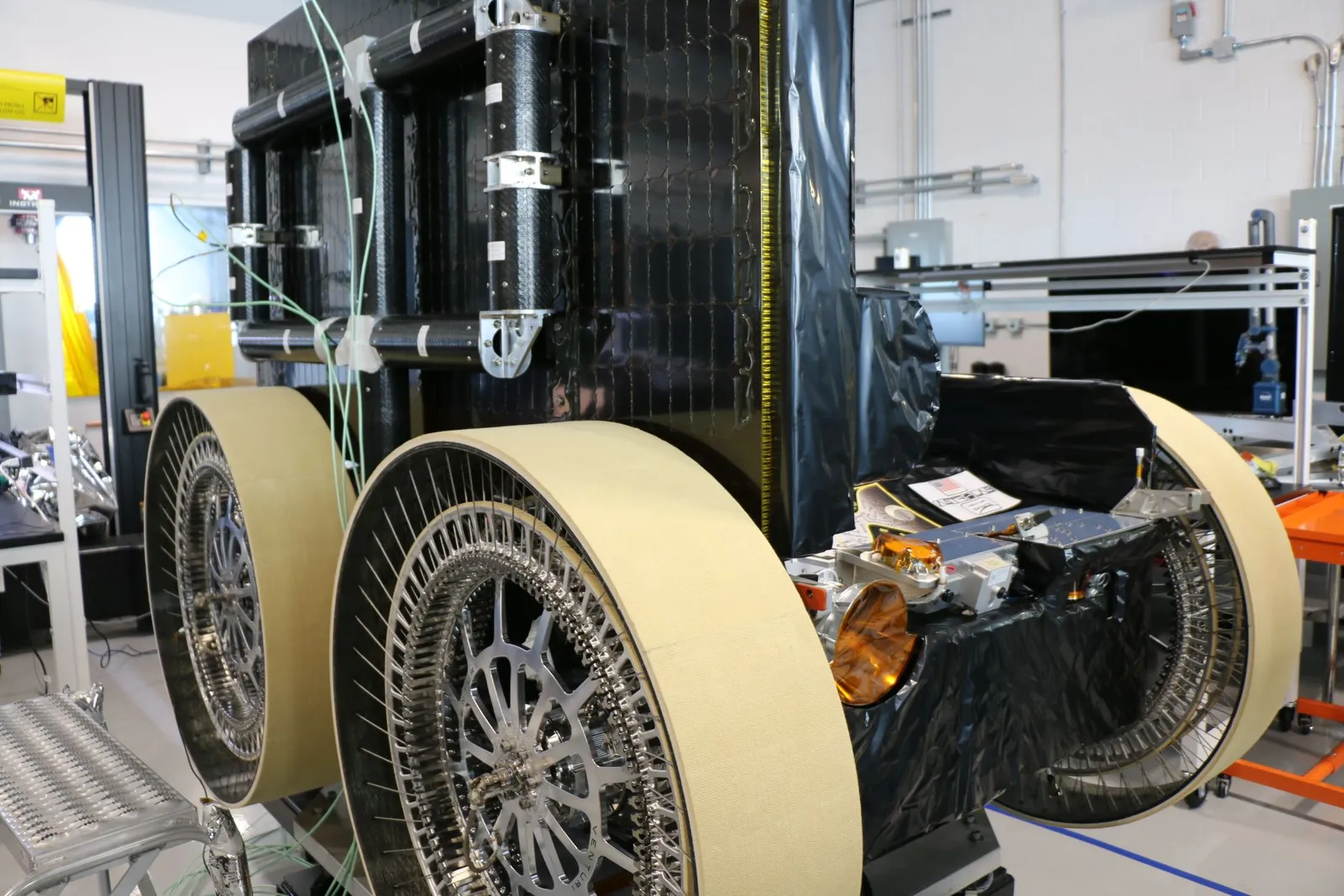
Jaret Matthews, founder and CEO of Astrolab, is sending the FLIP rover to the lunar south pole this year with HPE's Spaceborne Computer-4 aboard, marking the first supercomputer, GPU and AI experiments on the moon. The mission will prove whether advanced computing can survive a year of extreme lunar conditions, a prerequisite for Artemis-era habitation and commercial activity.
The moon's first supercomputer is launching this year, and it is bringing AI with it. Jaret Matthews, founder and CEO of California-based Astrolab, confirmed at an Oct. 14 media event at the company's Hawthorne headquarters that the FLIP rover will carry Hewlett Packard Enterprise's Spaceborne Computer-4 to the lunar south pole as part of Griffin Mission 1. "We're sending the first supercomputer from HPE to the lunar surface later this year, doing the first GPU on the moon [and the] first AI experiments on the moon," Matthews said. "They're breaking new ground, and they're ahead of the curve."
The milestone matters well beyond a bragging-rights first. Astrolab is one of two companies NASA selected to develop a drivable rover for the Artemis program, and the mission is designed to prove that high-performance computing can actually survive the lunar environment. NASA's goal is to land humans back on the moon and, eventually, support habitation and economic activity on and around the lunar surface. Advanced computing that works in that environment is a foundational piece of that plan, and this flight is the first real-world test. For the companies involved, it is also a commercial proof point: hardware that survives the moon is hardware that can be sold to future missions and any industry that needs computing where the grid does not reach.
The hardware itself is built for the job. Spaceborne Computer-4 is lightweight, compact, self-contained and fanless, with a low-power 64-bit CPU paired with a GPU. It attaches to FLIP's cooling system and draws power from a hybrid system of batteries and solar cells on the rover. Memory storage comes from solid state drives supplied by KIOXIA. The computer is encased in heat-conductive aluminum, designed specifically for the conditions of the lunar south pole, where temperatures swing violently and the sun can vanish for days at a time.
The operating conditions are brutal, and Matthews is candid about the difficulty. "NASA's given us a real challenge," he told Space.com. "We have to design for a full year on the lunar surface. So that means surviving multiple lunar nights, upwards of 150 hours of complete darkness where we're not receiving energy or warmth from the sun." The rover will also operate semi-autonomously for long stretches when astronauts are not present, spending many months and traveling hundreds of kilometers across the lunar surface. That combination of darkness, cold and autonomy is exactly what the computer has to survive.
Survival is only half the job. If all goes to plan, the computer will analyze visual data captured during the mission, enable autonomous observations, and handle navigation, mapping and terrain analysis. HPE said in a statement that "an AI services container will demonstrate reliable deployment of scalable AI service applications on the moon," though the exact AI applications remain unspecified. The point of the flight is to prove the technology works in the environment before anyone depends on it for crewed missions. Astronauts on the International Space Station already rely on computers for communications, science experiments and daily tasks, but the moon is a different class of challenge: no GPS, no atmosphere, no quick return to Earth if something fails.
The mission also carries a piece of Mars with it. One experiment running on the spaceborne computer is a localization software package from NASA's Jet Propulsion Laboratory, where Matthews previously worked. The software has been used on Mars, and this will be its first trip to the moon. The challenge it solves is fundamental: neither the moon nor Mars has GPS. "Locating yourself and knowing where you are on the surface [can be difficult]," Matthews said. The system runs a machine learning algorithm that takes a map stored in memory, compares it to the local terrain the rover sees, and matches features to keep the rover on course and away from dangerous craters.
Griffin Mission 1 is the first flight of Astrobotic's robotic Griffin lander, flying for NASA under the agency's Commercial Lunar Payload Services (CLPS) program. FLIP is not the only payload on board. The mission also carries Astrobotic's CubeRover, a small uncrewed rover; LandCam-X, an optical navigation system; and Nanofiche GLPH, a tiny archive of human history described as the Galactic Library to Preserve Humanity. It is a mixed manifest of science, navigation and culture, all riding on a commercial lander.
For executives watching the commercial space economy, the takeaway is about the business model as much as the technology. "The moon presents a challenging environment for advanced computing, and we're pleased to provide HPE with an opportunity to demonstrate its technology on the lunar surface," Matthews said in a statement. "Our FLIP rover is designed to accommodate a variety of payloads, and this mission will demonstrate how commercial lunar mobility platforms can support technology development and scientific research." In other words, Astrolab is selling rides and capability, not just one mission. If FLIP delivers, it becomes a template for how companies monetize lunar infrastructure, and HPE gets a validated product line for the harshest edge-computing market that exists.
This story's Key Insights and Take-aways are locked.
Create a free account to unlock Executive Actions for one credit.
Register to UnlockAlways free for Executives Club members. Join the Club
More in Technology
SpaceX's AI engine just delivered a $4.4 billion profit quarter
The rocket giant's third-quarter net income shows AI demand is now a decisive force in the space economy.
Meta's Muse hits 10M downloads in 40 days, beating AI rivals on retention
Muse's fast start puts it in rare company - and early data shows users stick around longer than ChatGPT or Gemini.

Google's $899 Googlebook laptops are 'woefully underbaked,' review finds
Google's premium ChromeOS-Android hybrid starts at $899, but the first major review says the software can't match the hardware. A risky debut against the MacBook Air and Surface Laptop.