

The robot dog that ran a marathon on one charge just beat human efficiency
South Korea's RAIBO2 quadruped finished 26.2 hilly miles without recharging, and its energy cost now beats the human benchmark.
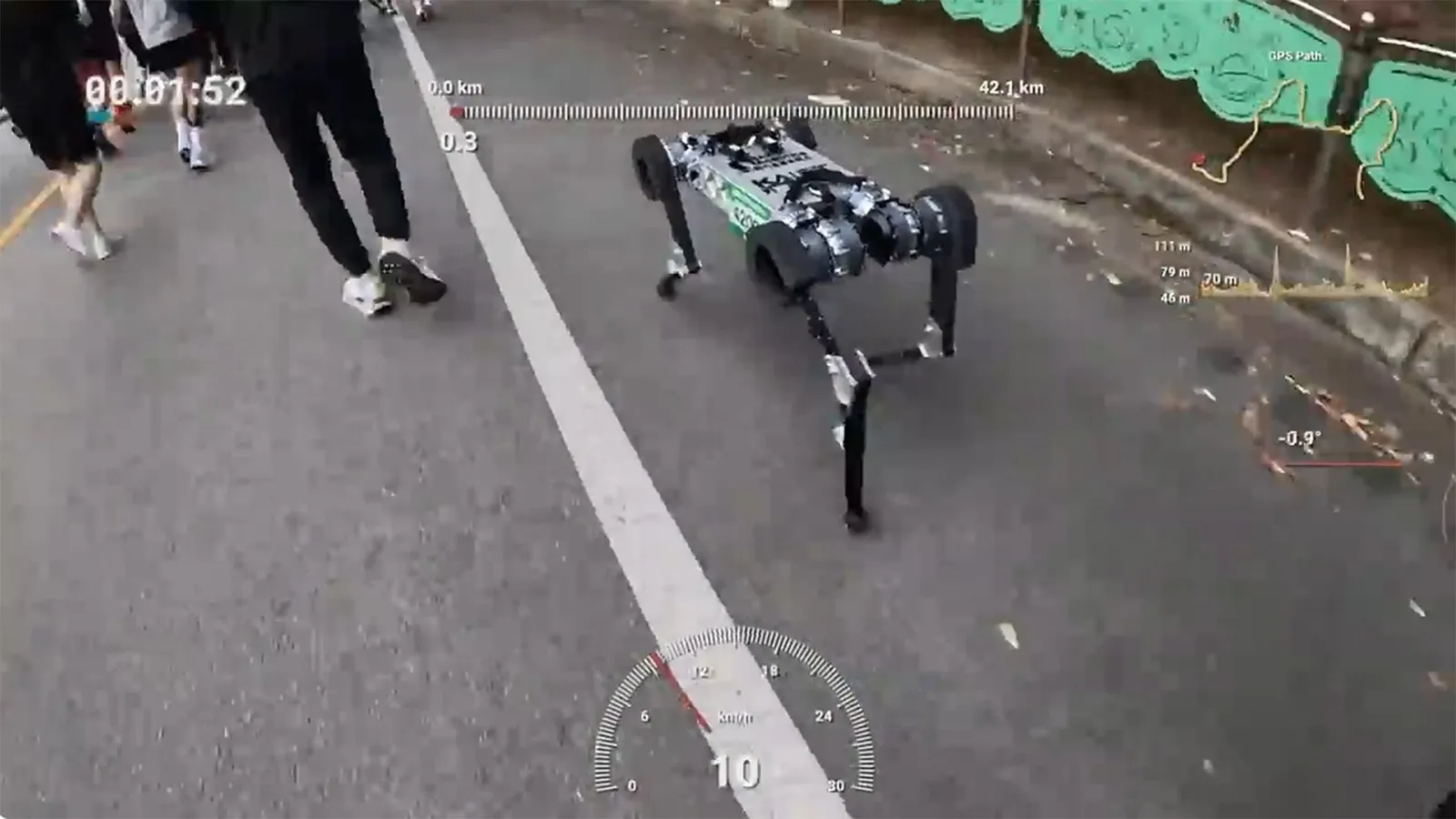
RAIBO2, a quadruped robot developed by South Korean researchers, completed a full marathon on a single battery charge in November 2024, a feat detailed in Nature. The robot's energy efficiency of 0.25 total cost of transport surpasses the human benchmark of 0.37, signaling a leap in endurance for legged machines.
A four-legged robot named RAIBO2 has done what no quadruped has done before: it ran a full 26.2-mile marathon on a single battery charge, and it did so more efficiently than a human runner. The South Korean-built machine finished the Sangju Dried-Persimmon Marathon in just over 4 hours and 19 minutes, navigating a hilly public-road course with two 50-meter elevation climbs and slopes up to 10 degrees. The feat, achieved on Nov. 17, 2024, was published Sept. 23 in the journal Nature, and the headline number is this: RAIBO2's total cost of transport, a measure of energy used per distance, came in at 0.25, beating the human benchmark of 0.37. It is the first quadruped robot to surpass that figure, according to its developers.
That efficiency is the real story, because endurance has long been the Achilles' heel of legged robots. Unlike wheeled machines, quadrupeds burn energy continuously at their joints just to support their own body weight, and they lose kinetic energy every time a foot strikes the ground. That is why most robot dogs can only operate for short bursts before draining their batteries. RAIBO2's marathon was a stress test of both hardware and software, and the team behind it made specific upgrades to get there. They boosted battery capacity by 33%, bringing it to 2,016 watt-hours, and added joint-stiffness control so the robot could soften its legs on impact and push off forcefully when needed. They also streamlined the locomotion policy to limit energy use and relied on lightweight components that transmit kinetic energy with minimal loss.
The result is a machine with a maximum range of 41.6 miles on a single charge on straight paths, more than three times the travel range of existing quadruped robots. The researchers estimate RAIBO2 could have gone about 15.5 miles farther than its marathon distance, meaning the 26.2-mile race was not even the limit. That kind of endurance matters because it opens the door to real-world deployments where wheeled robots simply cannot go. Disaster zones, mountainous terrain, staircases, and rugged trails are all environments where quadrupeds have an advantage, but only if they can carry sensors, cameras, or communications gear without dying halfway through a mission.
The path to this record was not smooth. An earlier marathon attempt on uneven terrain had to be aborted around the 23-mile mark when the battery ran out. The developers attributed that failure in part to frequent pace changes as the robot tried to match nearby runners, which drained energy faster than steady pacing. That lesson shaped the redesign: the team not only increased battery capacity but also refined the control system to handle variable speeds and slopes more gracefully. The robot also benefits from regenerative braking, much like an electric vehicle, capturing kinetic energy on downhill sections to offset some of the cost of climbing.
RAIBO2's training ground was a simulation environment called RaiSim, which includes models of slopes, stairs, and icy roads. That virtual training allowed the team to test and optimize the robot's locomotion policy before ever setting it loose on a real course. The combination of simulation, lightweight mechanics, and a low-loss motor-driving circuit is what pushed the robot past the human efficiency benchmark. For context, a lower total cost of transport means the robot uses less energy to move its body over a given distance, and 0.25 is a significant milestone for legged locomotion.
The implications go beyond robot dog bragging rights. For executives and engineers building autonomous systems, this demonstrates that legged robots can be practical tools, not just lab curiosities. The ability to run for hours on one charge, across uneven terrain, makes quadrupeds viable for search-and-rescue operations, infrastructure inspection, and military logistics in areas where wheeled vehicles are useless. It also signals a shift in where R&D dollars might flow: battery chemistry, lightweight actuation, and energy-aware control software are becoming the competitive battlegrounds in robotics.
For decision-makers watching the robotics space, RAIBO2 is a reminder that the bottleneck is no longer just intelligence or perception, it is endurance. A robot that can think but runs out of power in 20 minutes is a toy. A robot that can outlast a human marathoner is a tool. The researchers say this kind of endurance could broaden the roles for quadruped robots in disaster zones and mountainous areas, where a sufficiently mobile, high-endurance machine could carry cameras, sensors, or communications gear across terrain that would stop a wheeled robot cold. The marathon is over, but the race to deploy these machines in the real world is just getting started.
This story's Key Insights and Take-aways are locked.
Create a free account to unlock Executive Actions for one credit.
Register to UnlockAlways free for Executives Club members. Join the Club
More in Technology

A Chinese rocket deorbited over Minnesota and landed in a farmer's cornfield
Experts tied the fragment to LandSpace's Zhuque-2E, which launched on September 15 and shed debris over the American Midwest after deploying 10 satellites.

JPMorgan Chase deploys first $5B into defense tech and hypersonic missiles
The bank is moving off its balance sheet to back robot factories, hypersonic missiles, and supply chains, signaling a new era of bank-backed military innovation.

Cop fired after sharing Flock login with ICE husband: 983 searches
A Savannah officer's shared credential let an ICE agent run hundreds of plate searches on Hispanic drivers, exposing a surveillance backdoor.