

Tilt’s livestream sellers pull $260,000/month using auctions, AI, and Gen Z hustle
A $50M-plus startup shows how interactive bidding and AI listing tools are reshaping social commerce in the West.
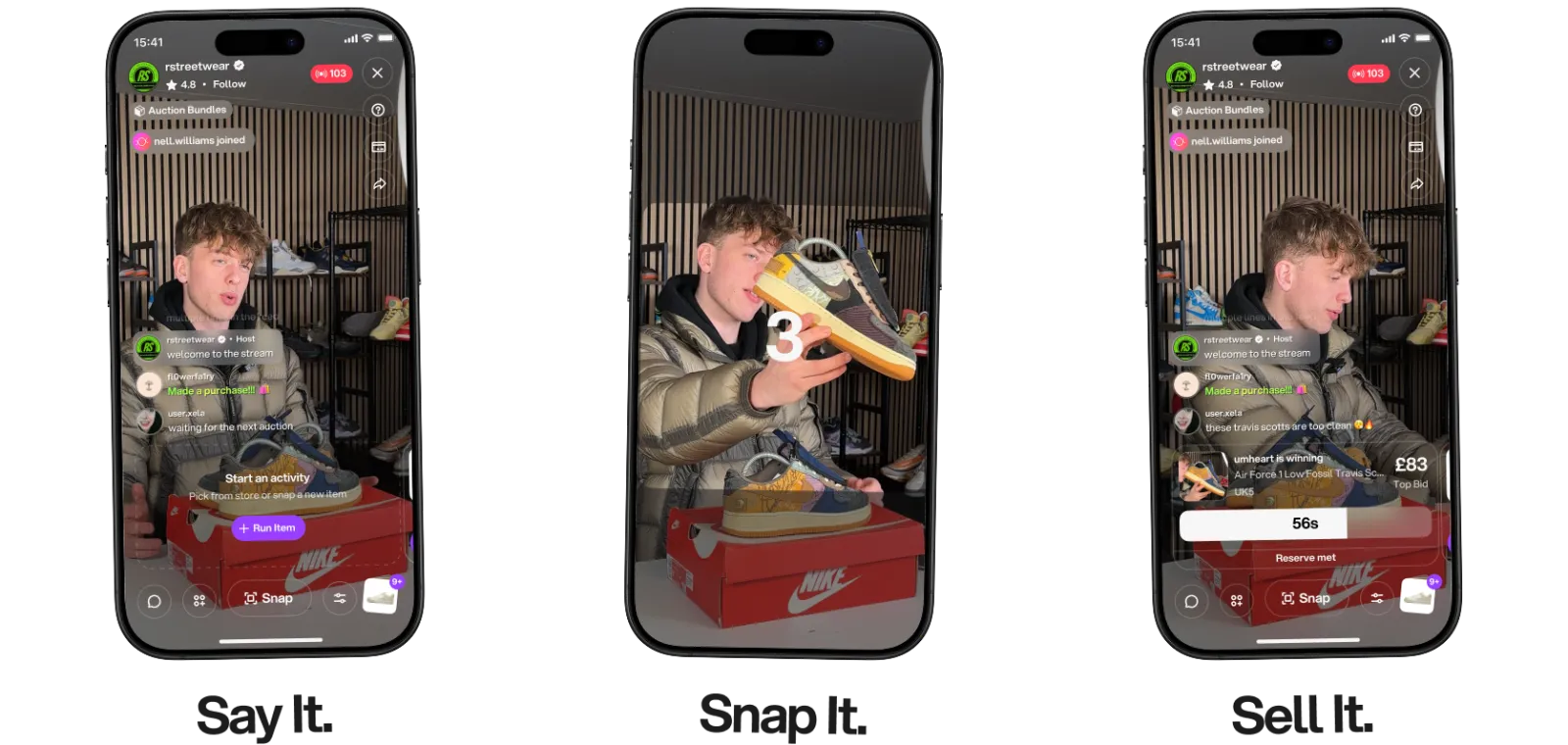
London-based Tilt, cofounders Abhinavan Thanendran and Neil Shah, built a livestream auction marketplace launched in 2023. It cites sellers earning up to roughly $260,000 monthly and has raised roughly $50 million, with an AI pipeline that identifies and lists items from streams for over 1 million buyers.
Tilt is proving that in livestream commerce, the “product page” can be replaced by a live auction and a fast-growing community of sellers. The company says one sneaker seller is generating roughly $260,000 in monthly sales, while other sellers have scaled from single-digit months of selling into six-figure revenue. That kind of performance is the headline because it is not hypothetical. It is coming from a model built to turn entertainment into purchasing, where viewers bid in real time and interact with sellers instead of scrolling static listings.
Cofounders Abhinavan Thanendran and Neil Shah frame the platform as a way for beginners to build a real business quickly. Shah told Fortune that they’ve seen sellers go from “zero to 100,” including a 17-year-old who started in his grandma’s bedroom and scaled to over $100,000 within a few months. Another example: a 22-year-old seller named Maddie, who is deaf and has fibromyalgia, sells niche streetwear brands and surpassed $100,000 in June after initially reaching “upper five figures” in monthly sales, according to the cofounders. Put simply, Tilt is attracting an ecosystem where sellers can iterate fast, and where the platform’s mechanics push them toward consistent demand.
What makes this more than a curiosity about Gen Z is the auction format itself. Tilt describes auctions as the missing engagement ingredient in Western social commerce, which has historically leaned on the less urgent experience of passive shopping. Thanendran told Fortune that while eBay auctions existed, they “weren’t really exciting,” and that buyer engagement during Tilt auctions has been “incredible.” In other words, Tilt is trying to import the thrill of competition into shopping. That matters because it changes the psychology of purchase decisions: urgency is built into the interaction, not bolted on with discounts.
This is also where Tilt’s origin story slots into the broader market timeline. The founders say the initial spark came during the COVID-19 pandemic, when local shops were forced to close. Thanendran described thinking of solutions for shops to keep operating during lockdown, including a livestream system where store owners livestream from inside their shop, show what they have, and let people pick it up. But the idea, he says, evolved into something bigger than storefronts. Tilt launched in 2023 and now hosts livestream auctions across apparel, sneakers, luxury accessories, trading cards, sports memorabilia, watches, beauty products, food and beverages, and clearance merchandise. The platform even includes sellers that specialize in liquidation inventory, moving appliances like microwaves, refrigerators, and air fryers that might otherwise end up in landfills.
Tilt is entering a market that has already moved quickly elsewhere, especially Asia. The company highlights livestream commerce’s explosion across China over the past several years, while Western markets adopted the interactive format more slowly. Tilt’s stated competitor benchmark is Whatnot, a California-based livestream shopping app. The source notes that Whatnot has become one of the largest live shopping marketplaces outside Asia, and it has raised multibillion-dollar valuations as demand for interactive shopping grows. Against that backdrop, Tilt’s differentiation is not just community or content. It’s the AI layer built into the marketplace.
According to Shah, Tilt uses AI to scan, research, and list items from livestreams for its user base of over 1 million buyers to search and bid. The cofounders describe the stack as layered multimodal models designed to understand condition, price, and brand. They say the system correctly identifies products roughly 90% of the time. Importantly for operations, sellers can edit mistakes before an auction begins, and those edits feed back into improving future models. Shah said they validate performance by tracking how many edits are made, then tuning models to get better.
For boards and investors, the practical implication is that this AI pipeline is aimed at solving a real friction point: listing. Shah told Fortune that one of the most surprising things was how much sellers “really hate to list,” which pushed the team to invest heavily in R&D and building models “from the get go.” If listing is painful, sellers churn. If listing is automated, sellers can focus on what they do best in livestream commerce: presenting, answering questions, and driving bids.
Tilt says it has raised roughly $50 million from investors including Balderton Capital, Earlybird, Seedcamp, TQ Ventures, and most recently Vinted Ventures, the investment arm of secondhand marketplace Vinted. Beyond resale, the company argues the medium will expand. Thanendran said the founders believe livestream shopping will not remain confined to collectors or resale communities, and they expect video to become the dominant interface for e-commerce. He told Fortune that whether you are a traditional retailer or a resale marketplace, “the medium is going to change.” For peers in retail, fintech, marketplaces, and creator-driven commerce, the strategic stake is straightforward: interactive auctions plus AI-backed discovery can turn one-off selling into repeatable revenue, and that shifts the competitive game from static inventory to continuous attention.
This story's Key Insights and Take-aways are locked.
Create a free account to unlock Executive Actions for one credit.
Register to UnlockAlways free for Executives Club members. Join the Club
More in Business

Anthropic’s Levant Alpöge cracks the Jacobian conjecture after 87 years
A Harvard valedictorian used Claude to hit a 1939 breakthrough, but the missing “why” is the real problem.

Uber buys Delivery Hero for nearly $15B, vaulting to top food delivery outside China
The deal doubles Uber's dual-services footprint and pushes a ride-and-eats bundling play into 50 more markets.

Epic and Google drop settlement bid, forcing rival Android app stores by July 22
Google told the court it is ready to carry third-party app stores starting Wednesday, July 22.