
Trump signs quantum executive orders and Quantinuum jumps 13% as others surge
Quantum stocks rallied Tuesday while the orders set deadlines for a “scientifically relevant” quantum computer and quantum-resistant encryption.
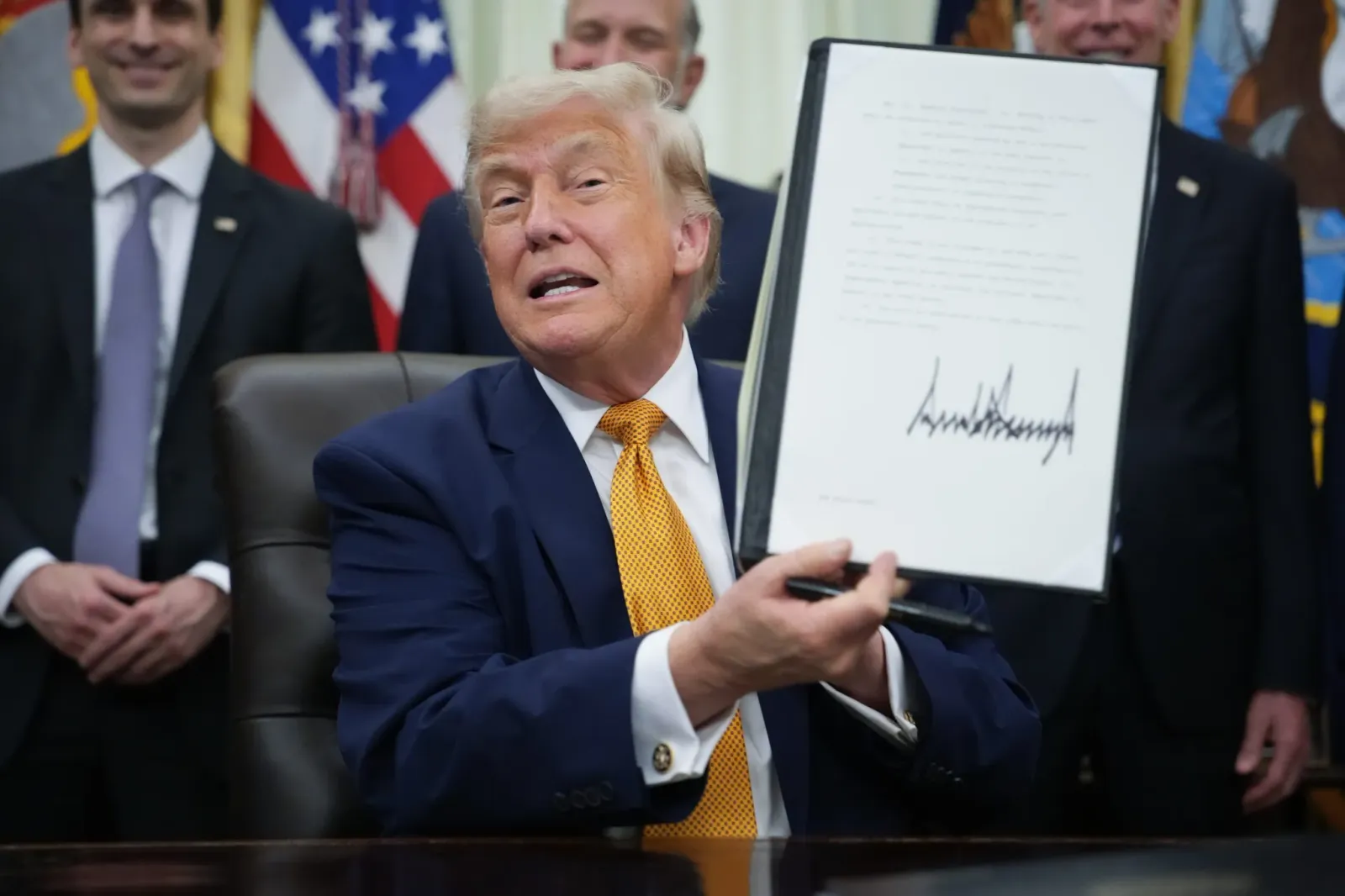
President Trump signed two executive orders backing quantum computing, pulling shares of quantum-focused companies higher on Tuesday, led by Quantinuum. The move creates an immediate market tailwind and a longer regulatory clock for government agencies, defense sensors, and post-quantum cybersecurity upgrades.
Tuesday was a bloodbath for much of tech, but quantum computing carved out a rare bright spot. The Nasdaq fell more than 2% and the S&P 500 slipped more than 1.4% as investor jitters about AI and tech hit risk appetite. Then President Trump signed two executive orders aimed at U.S. dominance in the emerging technology, and quantum stocks reacted like someone turned on the lights.
At the close Tuesday, Quantinuum, formed in 2021 via a merger of Honeywell Quantum Solutions and Cambridge Quantum, led the pack with shares up more than 13%. Two other pure-play quantum companies finished strong: Infleqtion closed up 12%, and D-Wave ended up 2%. IBM, which operates the largest fleet of high-powered quantum systems, gained 5% as well.
What matters for decision-makers is not just the intraday enthusiasm. It is the specificity of what the executive orders require, and the deadlines they introduce, which can change budgeting and procurement cycles across government and large contractors. According to the source, Trump signed the orders alongside leaders of quantum computing-linked companies on Monday at the White House. In remarks at the event, Trump described quantum computing as having “enormous significance for our country's economic growth, scientific research, and cyber security.”
The first executive order is framed around compute and sensors. It establishes the QC-ADDS initiative, directing federal agencies to build the first quantum computer capable of performing meaningful scientific research, to be housed at a Department of Energy facility. The Pentagon is also tasked with deploying at least three next-generation quantum sensor projects by 2028. The described purpose of those sensors is practical and military-adjacent: GPS-independent navigation in conflict zones and the ability to detect underground infrastructure from space.
The second order shifts the focus to cybersecurity, which is where many enterprises are already paying attention to quantum risk. Under the executive order, federal agencies must upgrade their most sensitive systems to quantum-resistant encryption by the early 2030s. Federal contractors face the same requirements. The State Department was directed to push allied governments and critical infrastructure operators toward compatible standards globally, which matters because cybersecurity upgrades only work if ecosystems cooperate.
This is not Trump’s first quantum bet, and that context helps explain why markets moved quickly. In 2018, he signed the National Quantum Initiative Act, which authorized up to $1.2 billion for quantum research. More recently, in May the Trump administration said it would invest an additional $2 billion in nine quantum computing companies in exchange for equity stakes. The beneficiaries named in the source include GlobalFoundries and IBM, set to receive $375 million and $1 billion, respectively, for quantum-associated projects, with the remainder going to smaller quantum companies including D-Wave, Infleqtion, and Quantinuum.
The sector has long had a credibility problem with investors: big promises, uneven proof, and a commercial payoff that some say is still years away. Even after Tuesday’s surge, the source is clear that most pure-play quantum companies have not turned a profit. Quantinuum, Infleqtion, and D-Wave are all pre-profit companies, leaning on government contracts and private investment to fund research and operations. That makes the executive orders potentially consequential, because they can convert “research support” into “adoption pressure” through procurement and compliance.
The backdrop is also technical, and it clarifies why deadlines are meaningful even if commercialization is hard. Classical supercomputers use binary code, 1s and 0s, to run calculations sequentially. Quantum computers rely on qubits, tiny units that can represent both 1 and 0 simultaneously through superposition. They can run calculations in parallel, which can be exponentially faster for certain problems. But qubits are highly sensitive to environmental interference, making them difficult to stabilize. The orders do not magically solve those physics constraints, but they can accelerate the race by aligning government demand with the industry’s milestones.
The source adds that Infleqtion CEO Matthew Kinsella attended Monday’s signing and told Fortune that the new orders now make quantum a “national imperative.” Arvind Krishna, IBM’s CEO, was also present and called the executive orders an “important, timely step forward” in a statement, emphasizing “Sound policy, sustained investment and public-private partnership” as vital for U.S. quantum leadership and technological resilience.
For executives and boards in adjacent areas, the second-order story is that quantum is being treated as an operational transition, not a science project. Federal agencies will be pushed toward quantum-resistant encryption in the early 2030s, and defense-related sensor programs are targeted for deployment by 2028. That combination can pull forward partner selection, vendor qualification, and long-cycle R&D decisions now, even while many quantum pure-plays remain pre-profit. In other words, Tuesday’s stock pop is a headline. The quieter work starts when compliance clocks and procurement plans turn into budget reality.
This story's Key Insights and Take-aways are locked.
Create a free account to unlock Executive Actions for one credit.
Register to UnlockAlways free for Executives Club members. Join the Club
More in Business

SpaceX sells $25B in debt under two weeks after IPO, despite $90B in orders
The satellite and rocket company’s quick $25 billion borrowing move signals how it plans to finance scale after going public.

Accenture’s $4.18bn play fails as AI fears spark a 20% worst-ever stock plunge
On Thursday, Accenture hit its biggest one-day drop on record after forecasting worries that AI could hollow out consulting.

SpaceX stock jumps 3% after it overtakes Amazon’s market cap
CNBC says SpaceX’s shares surge following its IPO Friday, forcing investors to reprice what “space” and “AI” are worth.