
Ukraine protesters demand Zelensky reappoint Defence Minister Mykhailo Fedorov after Wednesday removal
Wartime protests spread as lawmakers prepare to vote on a new government, turning a cabinet shuffle into a political reckoning.
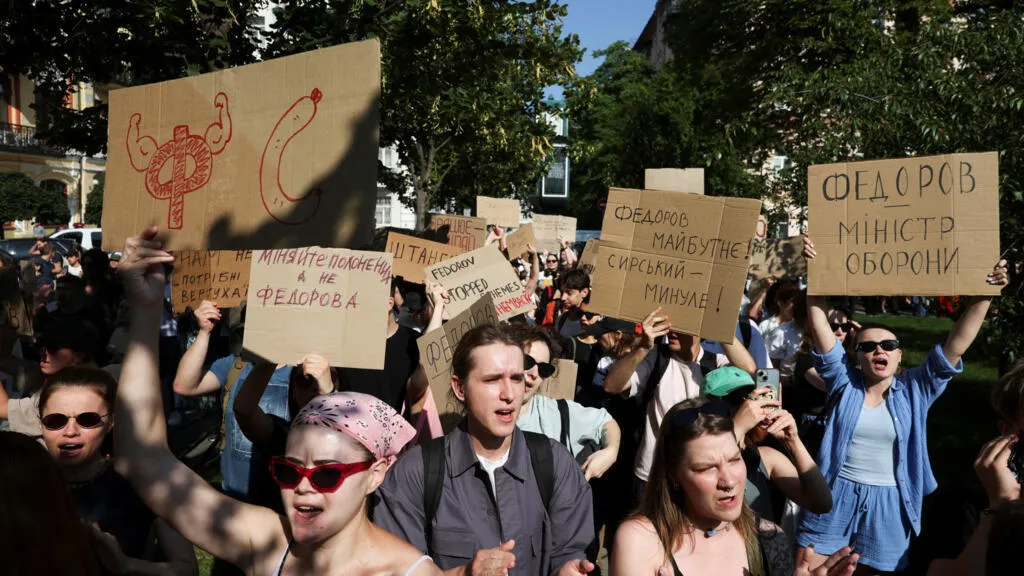
Across Ukraine, protesters erupted on Thursday demanding President Volodymyr Zelensky reappoint Defence Minister Mykhailo Fedorov after he was removed from office on Wednesday. Lawmakers are set to vote on a new government today, making the next leadership decision a near-term test of unity.
Rare wartime protests in Ukraine erupted across the country on Thursday, and they were not abstract. Demonstrators gathered with one clear demand: President Volodymyr Zelensky reappoint the popular Defence Minister Mykhailo Fedorov, removed from office on Wednesday. The timeline matters, too. This is happening with lawmakers scheduled to vote on a new government today, which means the protest pressure is landing right as the political machine is about to decide who runs the next phase.
If you are trying to understand why this is bigger than a personnel dispute, start with the simple fact the protests are anchored to. People are protesting the removal itself, not merely calling for general stability. They want Fedorov back. That raises an immediate question for decision-makers in Ukraine and beyond: what happens to public trust and internal cohesion when wartime leadership changes in visible, fast motion? In wartime, legitimacy is not a “soft” asset. It affects how quickly institutions coordinate, how confidently partners engage, and how reliably the country can execute under pressure.
While the report is focused on the protests and the immediate political timetable, it also sketches the underlying governance dynamic. Zelensky removed Fedorov on Wednesday. Within days, lawmakers are set to vote on a new government today. That kind of rapid cabinet reshaping compresses consultation time and puts scrutiny on the process. Even if the rationale for the removal is not spelled out in the coverage, the public response provides the missing context: there is enough attachment to Fedorov, described as popular in the report, that his removal is triggering street-level pushback.
This is where the second-order implications show up, especially for executives, investors, and anyone advising institutions that depend on consistent governance. In conflict settings, government leadership is often intertwined with budgeting priorities, defense procurement timelines, and the practical flow of coordination across ministries. A sudden change at the defense helm can ripple through contracting pipelines and operational planning. Even without new facts about what will change, the mere prospect of leadership turnover can force organizations to reassess risk, update internal assumptions, and prepare for different decision-making styles.
There is also a boardroom reality to consider. Governments do not behave like public corporations, but they still face a similar strategic question: does leadership stability reduce friction or does leadership change unlock faster or more effective execution? The protests suggest that, at least with some segments of the public, stability under a “popular” defense minister is viewed as the safer choice. That does not automatically answer the governance question, but it raises the cost of misreading public sentiment, especially when demonstrators are willing to take to the streets during wartime.
Zoom out slightly and you see why the protest spread across the country is notable. The report calls them rare wartime protests. That wording is doing work. Wartime typically narrows what people can risk and how easily dissent can organize. If protests still broke out across Ukraine, it signals that the issue is resonating quickly and broadly. For decision-makers, that is a signal to treat legitimacy and messaging as operational variables, not PR afterthoughts.
So what happens next? The report says lawmakers are set to vote on a new government today. In practice, that vote is the pivot point where street pressure meets formal authority. If Zelensky chooses to reappoint Fedorov, the protests would be directly answered by policy action. If not, the contradiction could deepen public tension, creating another round of pressure and uncertainty. Either way, the immediate political outcome will likely influence how quickly other institutions align, how calmly partners interpret the direction of travel, and how confident the public feels about leadership continuity.
For executives in adjacent sectors, the lesson is not about taking sides. It is about watching the coupling between political legitimacy and institutional execution. When a defense minister is removed and protests demand his return, it is a reminder that in wartime, staffing decisions are strategy decisions. The strategic stake is straightforward: the country needs coordination under extreme conditions, and leadership choices can either reinforce trust and cohesion or destabilize it. Today’s government vote will determine which path Ukraine is on next.
This story's Key Insights and Take-aways are locked.
Create a free account to unlock Executive Actions for one credit.
Register to UnlockAlways free for Executives Club members. Join the Club
More in Politics

LA County: DOJ's 20,000 'noncitizen' voter list is 'unreliable,' includes U.S.-born
Preliminary review by Los Angeles County election officials finds errors in the federal list, raising the stakes for voter roll integrity ahead of November.

Trump's $1.5B Pentagon chip investment lands in North Carolina
A $1.5 billion defense infusion for North Carolina chipmaking signals a new era of Pentagon-backed reshoring - here's what it means for the industry.

Nigeria confirms first Ebola case in Abuja, a woman just off a Uganda flight
Health Minister Muhammad Ali Pate says the patient flew in from Uganda, putting Africa's latest outbreak on Nigeria's doorstep.