
Ukraine's 72 km/h medevac robot outruns drones - speed cuts both ways
The MAUL evac bot moves six times faster than DevDroid's strike robot to save the wounded; the catch is less room for operator error and rougher rides for patients.
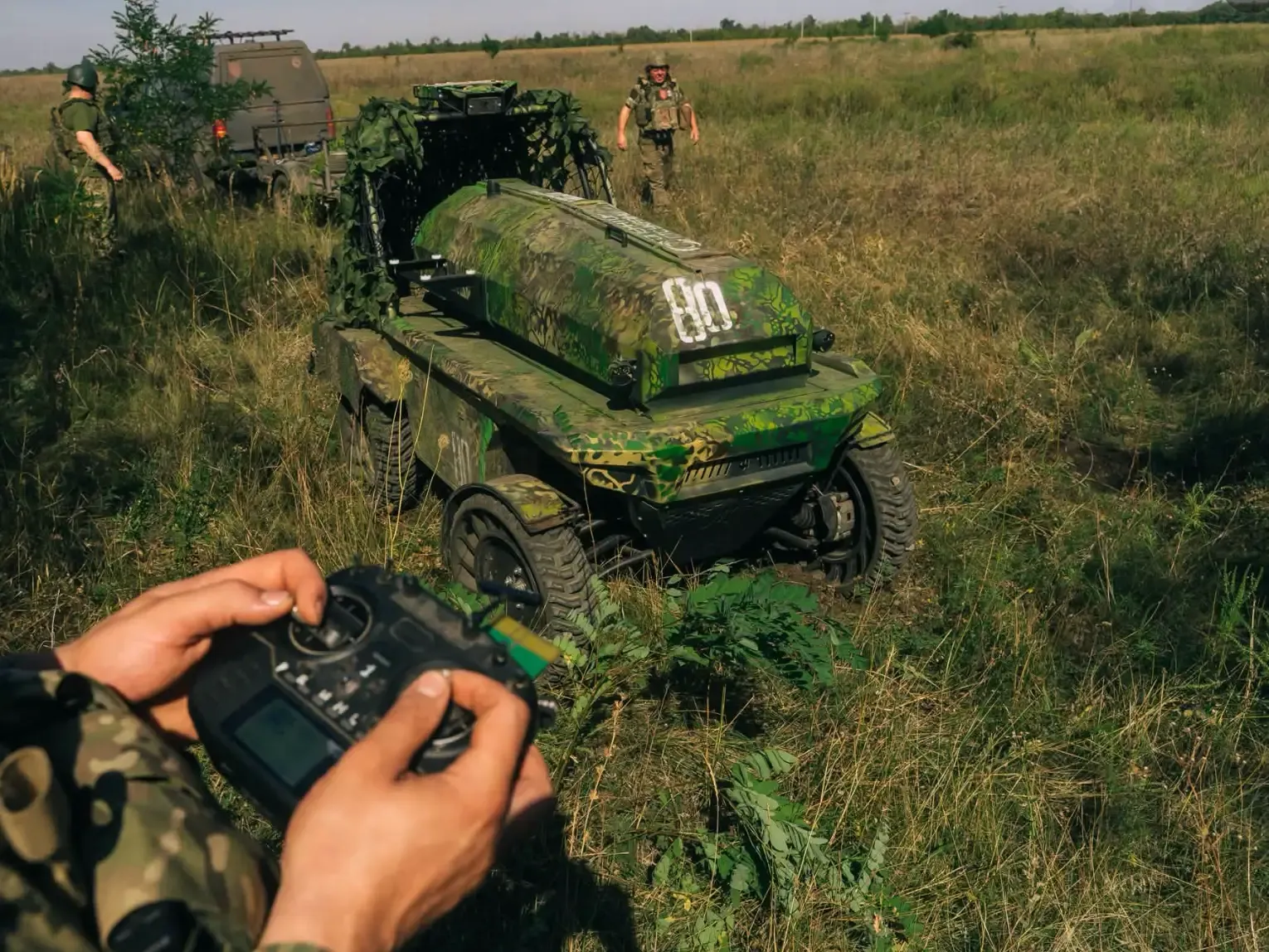
DevDroid's director of R&D, Oleg Fedoryshyn, says the company's MAUL evacuation robot hits a recorded peak speed of 72 km/h, six times faster than its strike drone, to outrun Russian attacks and get wounded soldiers to care faster. For defense contractors and military planners, the trade-off is acute: speed shortens exposure on the most dangerous ground on the front, but it magnifies operator error and jolts patients in ways that can worsen injuries.
The number that now defines the ground war's most dangerous minutes: 72 kilometers per hour. That is the recorded mission peak speed of MAUL, the purpose-built casualty evacuation robot from Ukrainian defense firm DevDroid, and it makes the machine roughly six times faster than the company's Droid TW-12.7 reconnaissance and strike system, which tops out at 12 km/h. The design logic, according to DevDroid's director of R&D, Oleg Fedoryshyn, is blunt: outrun Russian drones, get wounded soldiers to treatment faster, and take away the attacker's easiest kill.
This is not a spec-sheet flex; it is a survival calculation made under fire. The 1st Separate Medical Battalion of Ukraine's ground forces, which helped design MAUL, has repeatedly said that moving as quickly as possible is the key to successful evacuations, and Brave1, the Ukrainian government-backed defense technology incubator, calls speed essential because "one of the main challenges of the modern battlefield is to save the wounded in time." Last November, the battalion described a mission where the robot survived a Russian drone attack purely by outrunning it. For anyone building or buying unmanned systems, the takeaway is immediate: when the sky is saturated with attack drones, the ground answer is a fast, armored box on wheels.
The speed argument is not just Ukraine's; it has the backing of Western combat veterans studying the same problem. Jeffrey Wells, a US Navy veteran who served in Iraq and Afghanistan and now helps train front-line Ukrainian civilians in medicine, told Business Insider that "yes, speed matters." Drones, he said, have made "the last few kilometers to a casualty the most dangerous ground on the front." Every minute a UGV spends crossing that ground is a minute it can be spotted and struck, and "speed shortens exposure, for the vehicle and for the wounded Ukrainian defender on it."
But the same speed that saves lives introduces new risks, and the people closest to the machine are the first to say it. Fedoryshyn warned that at high speeds, a small mistake by the operator can cause a much bigger problem; if there is a lag or a minor error, "you will lose your vehicle." Wells put it just as starkly: faster platforms "leave less room for operator error: a misjudged turn or a lost link at speed is more likely to end in a rollover, and a rollover with a wounded person aboard is a serious problem." That can create even more danger if soldiers then have to go out to help and are targeted by Russian drones. "The operator is often working remotely, under fire, and exhausted, which compounds the risk," Wells added.
MAUL's design tries to engineer around those hazards: an armored capsule protects the injured soldier from attacks, and straps secure them during the ride. Not every evacuation robot in Ukraine has such a capsule, and not every mission pushes the machine to its limits. The 1st Separate Medical Battalion, for example, described an operation involving a robot with a maximum speed of 38 km/h where the average speed was just 18 km/h. The gap between top speed and actual speed matters, because, as Wells said, "a casualty isn't cargo." Speed over broken ground means jolting, and that "can worsen bleeding, fractures, or spinal injuries, especially when nobody is riding alongside to monitor or treat them."
The broader strategic lesson is about the trade-off between generalists and specialists. Ukraine's growing fleet of robots carries gear, lays mines, blows up Russian positions, and now evacuates the wounded, but units rarely have a machine purpose-built for every mission. Fedoryshyn said the reality for soldiers is that "it's not like they have 10 different types of UGVs"; they take the turret off an offensive robot to use it for logistics, and they evacuate casualties with robots never designed for that job "because they haven't any other option." A combat unit might wrap up a logistics mission, discover someone needs evacuation, and send the same robot back out. DevDroid's answer is to increase MAUL production, and its bet is that a dedicated, fast, protected evac robot gives soldiers their best chance of survival.
For executives across defense tech, robotics, and logistics, the MAUL is a live case study in how mission constraints override engineering orthodoxy. DevDroid's other robots are electric battery-powered; MAUL runs on an ATV chassis with a combustion engine precisely because battery-electric couldn't reach the required speed, a choice the battalion commander pushed for, according to Nataliia, an engineer at an uncrewed systems company who told Ukraine's defense ministry in December that "existing solutions with electric engines did not allow us to reach the required speed." The same tension is coming to civilian autonomous fleets, where range, payload, and safety systems compete against the simple demand to move fast.
The bottom line for leaders buying or building unmanned vehicles: speed is a weapon, but it is also a liability multiplier. Wells' framing is the one to steal - the whole chain matters: how fast a vehicle can safely move over terrain, how well it stays connected to its operator, how protected and stable the patient remains, and how quickly it reaches a trained medic. In Ukraine, that chain is being tested every day under fire, and the lesson is already clear: the next generation of ground robots will be judged not by top speed alone, but by how much of that speed can be safely used when everything is going wrong.
This story's Key Insights and Take-aways are locked.
Create a free account to unlock Executive Actions for one credit.
Register to UnlockAlways free for Executives Club members. Join the Club
More in Technology

A Chinese rocket deorbited over Minnesota and landed in a farmer's cornfield
Experts tied the fragment to LandSpace's Zhuque-2E, which launched on September 15 and shed debris over the American Midwest after deploying 10 satellites.

JPMorgan Chase deploys first $5B into defense tech and hypersonic missiles
The bank is moving off its balance sheet to back robot factories, hypersonic missiles, and supply chains, signaling a new era of bank-backed military innovation.

Cop fired after sharing Flock login with ICE husband: 983 searches
A Savannah officer's shared credential let an ICE agent run hundreds of plate searches on Hispanic drivers, exposing a surveillance backdoor.