
US export order shuts off Anthropic Claude Fable 5 and Mythos 5 globally
Enterprises lose top-tier Claude access overnight, with fallback models auto-routing and an uncertain path to restoration.
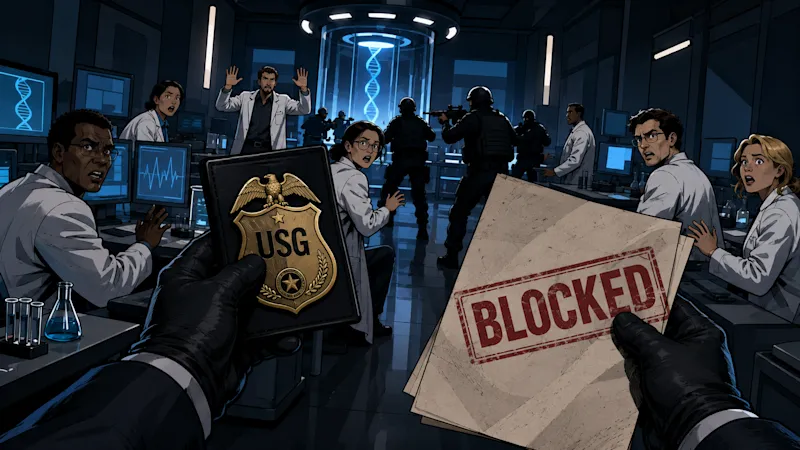
The US government issued an export control directive ordering Anthropic to suspend access to Claude Fable 5 and Claude Mythos 5 for foreign nationals. Anthropic responded by blocking all public access globally, forcing new queries onto older models like Opus 4.8 and ending current sessions in errors.
Last night, a US government export control directive forced Anthropic to suspend access to its top-tier Claude Fable 5 and Claude Mythos 5 models for foreign nationals. Anthropic then blocked all public access to both models globally, meaning not just non-US users, but also enterprise customers and Anthropic employees using them through the public layer.
The immediate operational consequence is blunt. Current Fable 5 and Mythos 5 sessions will end in errors, and new queries will be automatically routed to older, less capable models like Opus 4.8. Anthropic says in a blog post that it believes “this is a misunderstanding” and that it is working to restore access “as soon as possible,” while apologizing to customers. In other words, your model performance plan, toolchain assumptions, and production workflows depending on Fable 5/Mythos 5 just got a hard jolt, not a gentle degradation.
What’s notable is the scope. This is described as an “unprecedented” export control directive, and Anthropic’s response is global blocking, not a narrow regional throttle. The company cites national security authorities without naming them, and it does not clearly connect the order to a specific event. But the timing matters, because just three days before this shutdown, Fable/Mythos 5 were publicly released.
The story around that release includes a viral jailbreak. On June 10, a prolific jailbreaker known as “Pliny the Liberator” posted on X claiming to have bypassed safety guardrails for Fable 5, extracting functional instructions for cyber exploits, explosives, and chemical synthesis pathways. The post specifically references the “birch reduction method” for methamphetamine and describes a multi-agent attack using “Unicode, homoglyphs, Cyrillic,” long-context reference tracking, and a technique of breaking harmful requests into innocuous, out-of-distribution tokens, then reassembling them using a previously jailbroken Opus model.
However, Anthropic does not say that this jailbreak is what precipitated the US government order. Anthropic instead notes that the information provided by the US government has been poorly documented. The company states it received only “verbal evidence” of a potential narrow, non-universal jailbreak and that “one potential jailbreak was shared with the government.” Anthropic also argues the capabilities uncovered are “widely available” in other public models, explicitly naming rival OpenAI’s GPT-5.5. Then it delivers the warning enterprises should actually care about: if regulators treat a non-universal jailbreak as a standard, it could “essentially halt all new model deployments for all frontier model providers.”
Even if your immediate concern is “How do we keep our apps running tomorrow?”, there is a deeper board-level lesson hiding in plain sight: centralized frontier models live at the mercy of government oversight and vendor compliance. The enterprise AI implication is not theoretical. VentureBeat’s article ties this moment to a prior Pentagon precedent, including the abrupt blacklisting of Anthropic by the Department of Defense earlier this year. In March 2026, Secretary of Defense Pete Hegseth labeled Anthropic a “supply chain risk” after the company refused to allow the military to use Claude for mass domestic surveillance and lethal autonomous weapons without safety restrictions. The fallout reportedly led to a sweeping prohibition on Anthropic’s use across defense supply chains, stripping contractors of access overnight.
That matters because it shifts the risk model for CIOs and IT leaders from “Will the model be good?” to “Will the model be there?” Export controls, injunctions, compliance-driven takedowns, and policy changes are not just delays. They can be operational reversals. And since these systems are often integrated into agentic workflows and production applications, recovery is not as simple as swapping a prompt. It can mean rerouting, retesting, revalidating outputs, and rewriting fallback logic across the stack.
So what should enterprises do with this? The article points toward a redundancy strategy, specifically model-agnostic architecture with intelligent routing layers that can dynamically switch from a frontier model like Fable 5 to an open-weights fallback or a secondary provider’s API when outages or regulatory bans hit. The key idea is to treat “availability” as a first-class requirement, not something you hope for.
This is where the “sovereign” fork in the road gets real. The community reaction includes an X post from AI founder Alex Finn calling the shutdown a “wakeup call” and urging developers to run local models on home GPUs, emphasizing that local models cannot be taken away in the same way. The article also notes that Chinese open source provider MiniMax highlighted open weights availability of its new, frontier-class M3 model as a way to contrast decentralization against Claude’s centralized vulnerability. The trade-off for CIOs is straightforward, if not easy: local, open-weights models can improve control and privacy and reduce exposure to export directives, but they may sacrifice the frontier reasoning, agentic capabilities, and massive context windows associated with closed, cloud-based systems.
For executives, the stake is continuity. The US export order and Anthropic’s global block are a reminder that frontier AI is currently entangled with regulatory geography, vendor choices, and compliance timelines. If you build critical workflows around a single closed provider and a single top model, you are building on sand. The resilience move is to design for switching before you need to switch, because the next “misunderstanding” will not wait for your change-management calendar.
This story's Key Insights and Take-aways are locked.
Create a free account to unlock Executive Actions for one credit.
Register to UnlockAlways free for Executives Club members. Join the Club
More in Technology

Insight Partners' Deven Parekh: Why $90B firm won't bet the farm on OpenAI
The VC giant is deliberately staying diversified while rivals pile into OpenAI and Anthropic - and Parekh says he's fine with it.

AI just killed security through obscurity, and the patch backlog is exploding
FBI and Trend Micro researchers confirm AI agents are unearthing decade-old flaws, forcing a record 974-CVE Patch Tuesday and a triage crisis for defenders.

AI staff 'genuinely frightened' for humanity's future, ex-Anthropic researcher warns
A former Anthropic researcher says employees fear AI's trajectory, while the CEO urges a slowdown over 'serious' risks.