

Valve says new Steam Controller reservations won't ship until 2027
Valve upgraded its queue estimates, but the demand crunch means fresh buyers are looking at multi-year wait times.
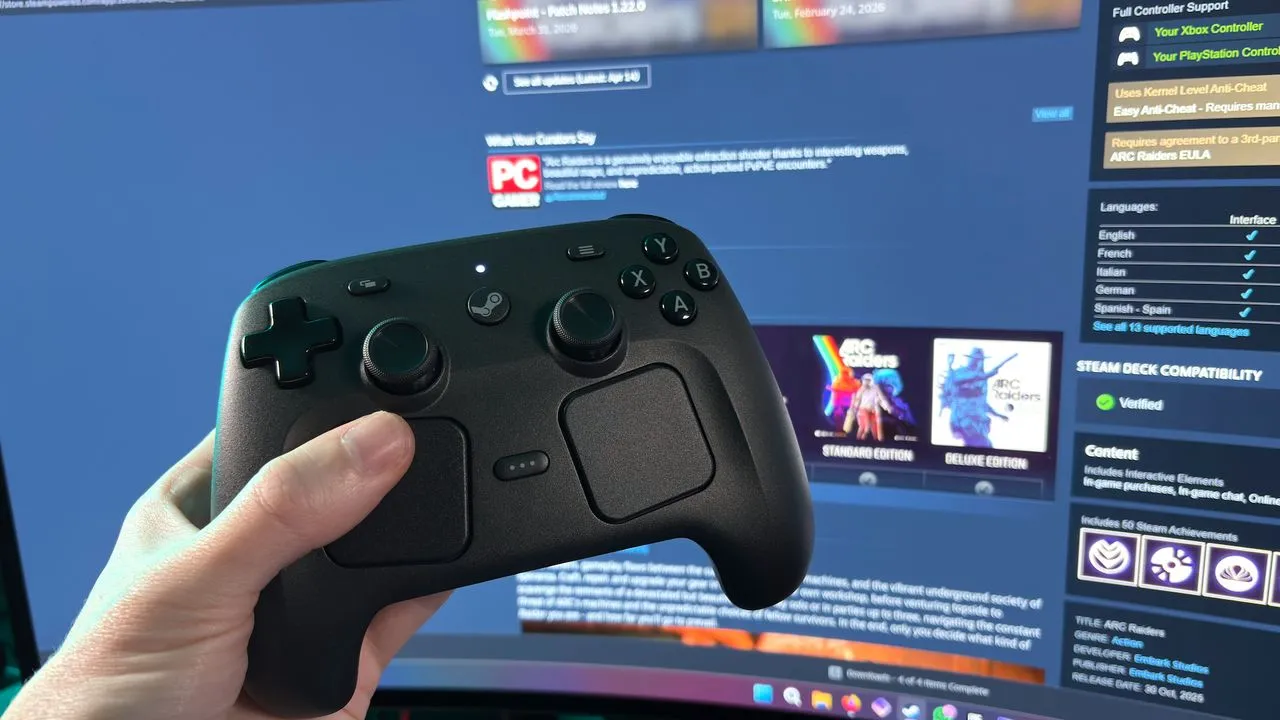
Valve updated its Steam Controller reservation system after initial demand exceeded expectations when the trackpad-equipped controller launched in early May. For decision-makers watching consumer hardware demand and platform behavior, this is a real-time test of how Valve manages scarce supply and expectation risk.
Valve is no longer pretending it can ship Steam Controllers on a normal timeline. In an update, Valve says initial demand for Steam Controller, which launched in early May and sold out quickly, exceeded expectations. Now, based on “current demand” versus how many units Valve says it can make by the end of the year, Valve wants to “manage expectations” on when orders will arrive.
Here is the blunt consequence for anyone not already in the queue: if you are not in the reservation system already, you are likely looking at an estimated order availability in 2027. In the reported tests, a colleague in the United States who joined the queue “today” saw an estimated order availability of 2027, and the same category appeared for the author in Australia. Valve also adjusted the reservation page to show one of three estimated shipping windows: “by September 2026,” “by December 2026,” and “in 2027,” with more specific timing for the “in 2027” bucket to come later.
This matters beyond one product because Valve is effectively using the reservation mechanism as a supply chain communication tool. The company says it has no plans to stop making Steam Controller. But it is also signaling that it cannot catch up soon, at least not for everyone. The system mirrors the kind of reservation flow once used for Steam Deck, where early demand overwhelmed supply and customers became very aware of lead times. In this Steam Controller update, Valve tweaks the queue system again, adding more useful shipping estimations, but the result is still not encouraging for latecomers.
For boards, operators, and anyone running growth experiments inside consumer hardware ecosystems, the incentive structure is the story. When a product sells out immediately, every new reservation creates two competing outcomes. It can lock in customer interest and reduce uncertainty about future demand. But it can also amplify expectation risk, meaning customer frustration when delivery slips. Valve is clearly trying to reduce the second risk by moving from a generic queue concept to explicit windows like “by September 2026” and “by December 2026,” rather than leaving everyone guessing.
There is also a customer behavior angle hiding in plain sight. The source notes that it is possible to reserve your place without placing a deposit. That means registering interest has “no harm” even if a buyer is not committed. Strategically, that changes what reservations represent. They become less like firm purchase orders and more like intent signals. That is good for visibility, but it means Valve should expect that some fraction of reservations will churn as customers decide they do or do not truly need the device. Valve still has to reconcile real inventory production constraints with reservation “interest” that can fluctuate between now and when a ticket is called.
Valve adds a hard operational boundary once you are called: you have 72 hours to make the purchase, or you lose your place in the queue. That rule is the safety valve that keeps a reservation system from becoming an indefinite holding pattern for people who will not buy. In other words, the 72-hour window is how Valve converts queue position into actual demand. If supply stays tight, this kind of timer also helps preserve fairness for those who are willing to commit quickly when inventory finally appears.
Now zoom out to the broader ecosystem. The source frames Steam Machine and Steam Frame as “seemingly imminent,” and points to why similar shortages could show up in other hardware products. Even without inventing details, the underlying pattern is straightforward: as Valve expands from gaming software into more hardware touchpoints, it inherits the same production bottleneck problem as any hardware company, namely that high demand meets limited manufacturing throughput. The second-order effect for executives is that platform-led hardware strategies do not get to skip the fundamentals. Supply constraints, forecasting accuracy, and expectation management become as important as product design.
For decision-makers in adjacent roles, the immediate lesson is not “wait longer” as a consumer complaint. It is the operational reality that expectation management is part of the product when demand outstrips output. Valve is showing a playbook: update the queue, publish clearer delivery windows, and enforce a purchase deadline. The strategic stakes are also real. If customers learn that “initial demand exceeded our expectations” turns into 2027 availability, that can change how future launches are anticipated, how reservations are treated, and how customers plan purchases around hardware cycles. In a market where competing devices and alternate controllers are always one click away, multi-year uncertainty is a risk you manage, not a detail you ignore.
This story's Key Insights and Take-aways are locked.
Create a free account to unlock Executive Actions for one credit.
Register to UnlockAlways free for Executives Club members. Join the Club
More in Entertainment

Russell Brand's accuser 'bewildered and confused' as he denies 7 sex charges
The criminal case against the comedian is a live test of how media companies manage talent risk when serious allegations go public.

'It's a Magic Trick': Ballet Experts Say Rosalía's SNL Pose Is Impossible
Three ballet experts tell Rolling Stone Rosalía's gravity-defying SNL stillness shouldn't be possible - and why the debate is now part of the show.

Activision CMO: GTA 6 Will Boost Call of Duty, Not Bury It
Activision's top marketer says Rockstar's blockbuster will drive players back to consoles and into Modern Warfare 4, even as the company admits its recent strategy failed.