
Villagers build artificial ice pyramids to secure spring water for crops
In India’s Himalayas, communities are turning waste cold into water storage to protect agriculture during dry seasons.
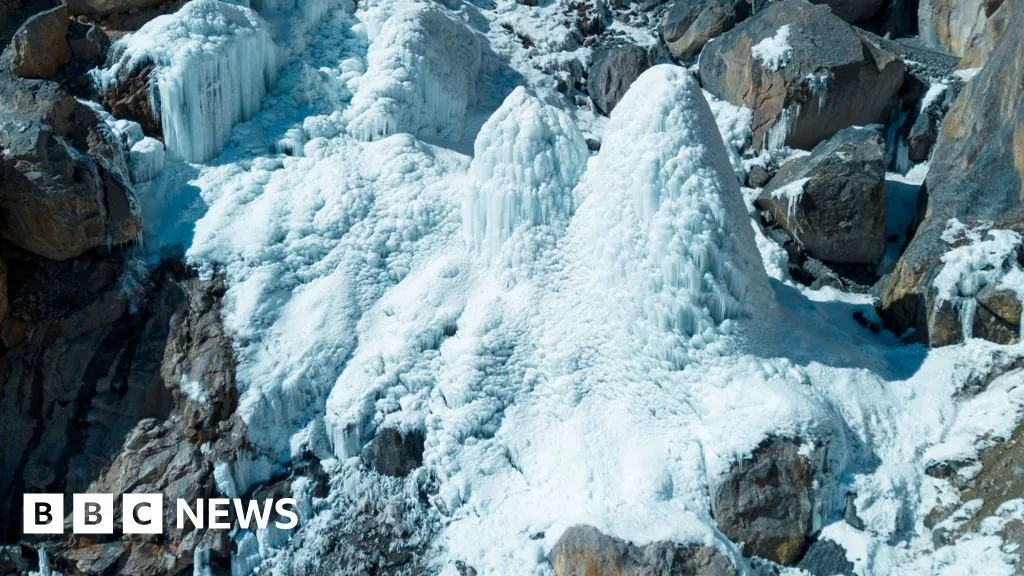
Himalayan villages are creating artificial glaciers made of artificial ice to guarantee water for their crops in the spring. For decision-makers watching climate and water risk, the model shows how local infrastructure can reduce seasonal uncertainty when traditional supplies fail.
In India’s Himalayan region, villages are building artificial glaciers, sometimes described as “artificial ice pyramids,” to guarantee water for crops in the spring. The core problem is simple and brutal: spring is when many crops need reliable water, but conditions are increasingly unpredictable, and natural meltwater can come late, run short, or arrive unevenly.
These villages are not waiting for a long-term climate plan that might or might not land on time. Instead, they are using a practical, local approach to store water as cold and then release it when plants need it most. The result is a spring water supply that is less dependent on how the mountain snow and ice behave that year.
Zoom out for a second, and the story stops being only about one valley. Water security is turning into a board-level issue across agriculture, infrastructure, and energy. Even when companies are not farming themselves, they depend on stable supply chains and predictable operating conditions. When water arrives on the wrong schedule, it does not just hurt yields. It forces costly adaptation, disrupts logistics, and can shift costs from fields to financial statements.
What makes the Himalayan “artificial glaciers” approach strategically interesting is that it is an adaptation measure tied to seasonal timing. Traditional water management often focuses on storage that fills during one part of the year and is drawn down later. Here, the villages are effectively creating a new kind of storage, using artificial ice to buffer the period when demand is high. That means the intervention is not just “more water.” It is “water when it matters,” which is exactly the difference between a plan that looks good on paper and a harvest that actually happens.
There is also an implementation lesson hiding in plain sight. These are mountain villages. That matters because geography dictates what is physically possible. In steep terrain, building large centralized reservoirs can be difficult, expensive, or slow. Smaller, community-driven systems can be faster to deploy and easier to maintain locally, even if they do not scale like mega-projects. For executives and investors, the second-order implication is that climate resilience is not only a question of capital intensity. It is also a question of execution speed, ownership, and who is closest to the problem.
From a regulatory and governance angle, water is usually a sensitive category. Even when a solution is technically feasible, it has to fit within rules around water use, land, environmental impact, and local rights. The BBC framing in this story is focused on the practical outcome, the creation of artificial glaciers to guarantee spring water for crops. That outcome implies that communities are finding ways to operate within their constraints, or at least around them, rather than simply accepting vulnerability as fate. For decision-makers, that highlights a common pattern: in climate stress scenarios, the line between “policy process” and “field action” often compresses. Communities move first; regulators and institutions catch up later.
There is another layer too. When agriculture depends on spring water, variability can amplify risk. In uncertain years, farmers may face reduced yields, lower incomes, and higher pressure to borrow money or buy inputs earlier, which can cascade into broader economic stress. A more reliable spring supply can dampen that volatility. In other words, an artificial glacier is also a risk-management tool. It can protect not only harvests but also planning, budgeting, and the ability to keep working capital stable through the season.
For executives who monitor climate-related risk, supply chain resilience, or ESG performance, this is a reminder that solutions can come from the ground up. The villages in the Himalayas are building artificial glaciers to secure water for crops in the spring, turning local adaptation into something closer to infrastructure. If your organization relies on agricultural regions, water-dependent resources, or predictable seasonal conditions, the strategic takeaway is clear: resilience planning has to account for the timing and reliability of water, not just the existence of water in theory. And it has to make room for community-led engineering when large systems cannot arrive fast enough.
This story's Key Insights and Take-aways are locked.
Create a free account to unlock Executive Actions for one credit.
Register to UnlockAlways free for Executives Club members. Join the Club
More in Technology

Nvidia's $89B data center quarter: the 9 companies cashing in
The AI buildout is minting fortunes beyond GPUs, and memory, cloud, and cooling suppliers are riding the same wave.

Google quietly links your phone number to every Android account on your SIM
Adding a SIM now ties your phone number to all Google accounts - and future accounts inherit it. Here's the security and privacy stakes.

Hijacker AI 'Skynet mode' runs 100,000 attack steps against exposed models
Symantec caught a criminal AI agent that borrows other models, steals data, and mines crypto; the only relief is no confirmed victims yet.