

VW’s profit plunge triggers possible 100,000 job cuts as China sales slump worsens
Volkswagen now expects up to 3% fewer vehicle sales this year after a steep earnings drop and a revised revenue outlook.
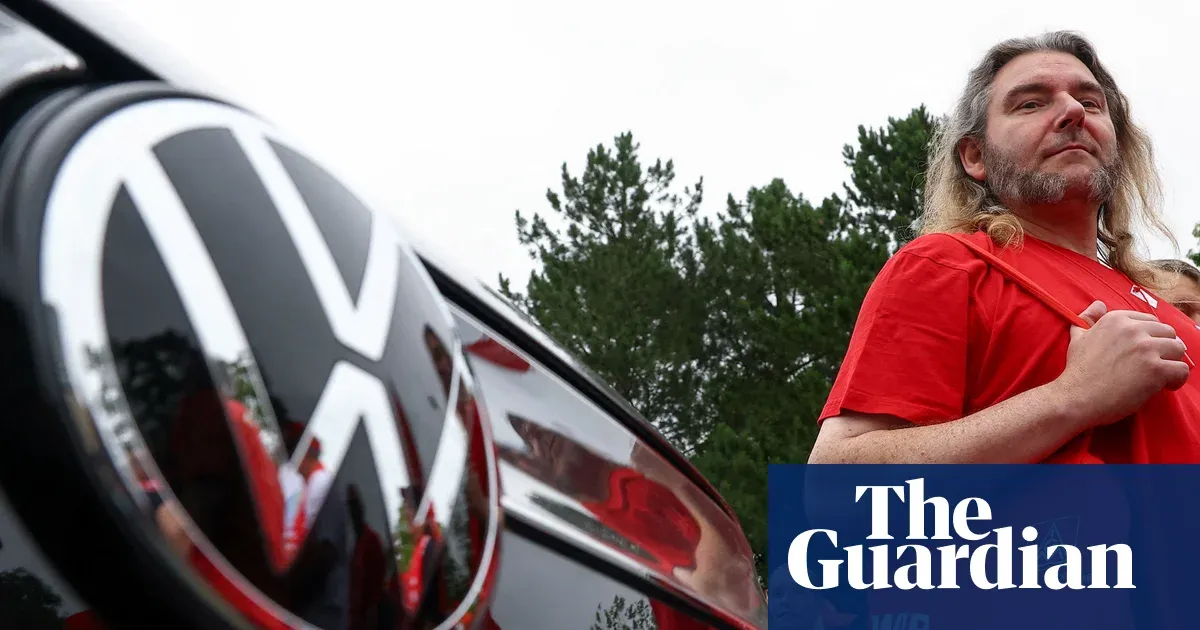
Volkswagen reported a steep fall in profits and cut its revenue forecast, citing a sales slump in China. It now expects to sell up to 3% fewer vehicles this year while pursuing a cost-cutting programme that could eliminate up to 100,000 roles.
Volkswagen is bracing for an earnings hangover from China, and it is preparing to pay for it with jobs. The German carmaker reported a steep fall in profits and cut its revenue forecast, while also saying it expects sales to fall by up to 3% this year. That forecast matters because VW is explicitly walking back a previous expectation of a 3% increase on last year’s €321.9bn (£275.3bn) revenue, and the pivot is tied to a difficult, highly competitive China market.
And the “why” is not subtle. VW’s updated outlook links the revenue and profit pressures to a sales slump in China, then connects that slump to a brutal cost-cutting programme that includes axing up to 100,000 roles. The implication for decision-makers is immediate: this is not a wait-and-see about demand, it is a planned structural response to keep the business from bleeding cash as volumes and pricing pressure continue.
To understand how big this moment is, think about what happens when a global automaker’s largest growth engine stops behaving like one. China is a high-competition market where brand differentiation, pricing discipline, and product timing determine who captures sales and who eats margin. When VW says China sales are slumping and that drives both a steep fall in profits and a reduced revenue forecast, the core issue becomes margin protection under lower volume. That is exactly the kind of pressure that forces management teams to rework cost bases quickly, before the gap between fixed costs and real-world sales gets too wide.
Volkswagen’s internal logic is straightforward even if it is painful: if revenue comes in lower than planned and profit is already falling, the only lever that can move fast enough is cost. Job eliminations are blunt, but they are also one of the few levers that can materially reduce run-rate expenses across a large organization. The source says VW is pushing through a programme that could eliminate up to 100,000 roles, which signals the company intends to change the shape of its cost structure rather than just optimize pockets of spending.
There is also a corporate governance angle here. A company does not cut a profit outlook, revise a revenue forecast, and simultaneously build a mass job-cut programme without strong pressure from the top and the boardroom. In automaking, these decisions usually involve coordinated negotiations across management, labor stakeholders, and supervisory oversight, especially in countries where labor rules and works councils can constrain how quickly layoffs translate into savings. The source does not add those details, but the scale of “up to 100,000 roles” suggests VW is treating the downturn in China as severe enough to accelerate restructuring even when it is operationally complex.
For investors and finance leaders, the updated sales guidance is the clearest datapoint. VW expects sales to fall by up to 3% in the current year, after forecasting a 3% increase previously. Forecast reversals are rarely cosmetic. They usually mean that earlier assumptions about market demand, sales mix, or competitive intensity no longer hold. When that forecast shift pairs with “steep fall in profits,” it points to both weaker topline and deteriorating profitability, the double hit that makes a revised revenue forecast credible and necessary.
For executives at suppliers, lenders, and peers across the auto sector, Volkswagen’s moves are a warning signal. Mass job cuts and aggressive cost programs typically ripple outward: suppliers brace for changes in order volumes and purchasing patterns; logistics and tooling vendors see demand uncertainty; and competitors may adjust pricing and incentives to protect share. Even if those downstream impacts are not spelled out in the source, the second-order effect is well known in the industry: when a global OEM restructures fast, the entire ecosystem starts planning for the new reality.
Strategically, the stake is not only whether VW can stabilize profits, it is whether it can maintain momentum in a market where competition is “highly competitive” as the source puts it. A cost-cutting programme may buy time, but it also risks distraction and capability loss if overdone. The best outcomes come when restructuring aligns with product strategy and market execution. For boards and C-suite leaders, VW’s situation is a stress test of that alignment: can management tighten costs enough to offset the China slump without undermining future competitiveness?
In short, Volkswagen is dealing with a China-driven profit shock and is responding with a forecast downgrade and a job-cut plan that could reach 100,000 roles. For anyone managing large operating models in cyclical industries, this is the playbook in action: when revenue forecasts fall, the organization either reforms the cost base quickly or pays for the gap later. VW is choosing the first option, and the numbers make clear they believe the second option is not acceptable.
This story's Key Insights and Take-aways are locked.
Create a free account to unlock Executive Actions for one credit.
Register to UnlockAlways free for Executives Club members. Join the Club
More in Business

Anthropic’s Levant Alpöge cracks the Jacobian conjecture after 87 years
A Harvard valedictorian used Claude to hit a 1939 breakthrough, but the missing “why” is the real problem.

Uber buys Delivery Hero for nearly $15B, vaulting to top food delivery outside China
The deal doubles Uber's dual-services footprint and pushes a ride-and-eats bundling play into 50 more markets.

Epic and Google drop settlement bid, forcing rival Android app stores by July 22
Google told the court it is ready to carry third-party app stores starting Wednesday, July 22.