
Webb measured WD 1856 b at 126C, proving it survived a dead star’s apocalypse
A gas giant orbiting a white dwarf every 34 hours is far hotter than expected, and Webb pinpoints why.
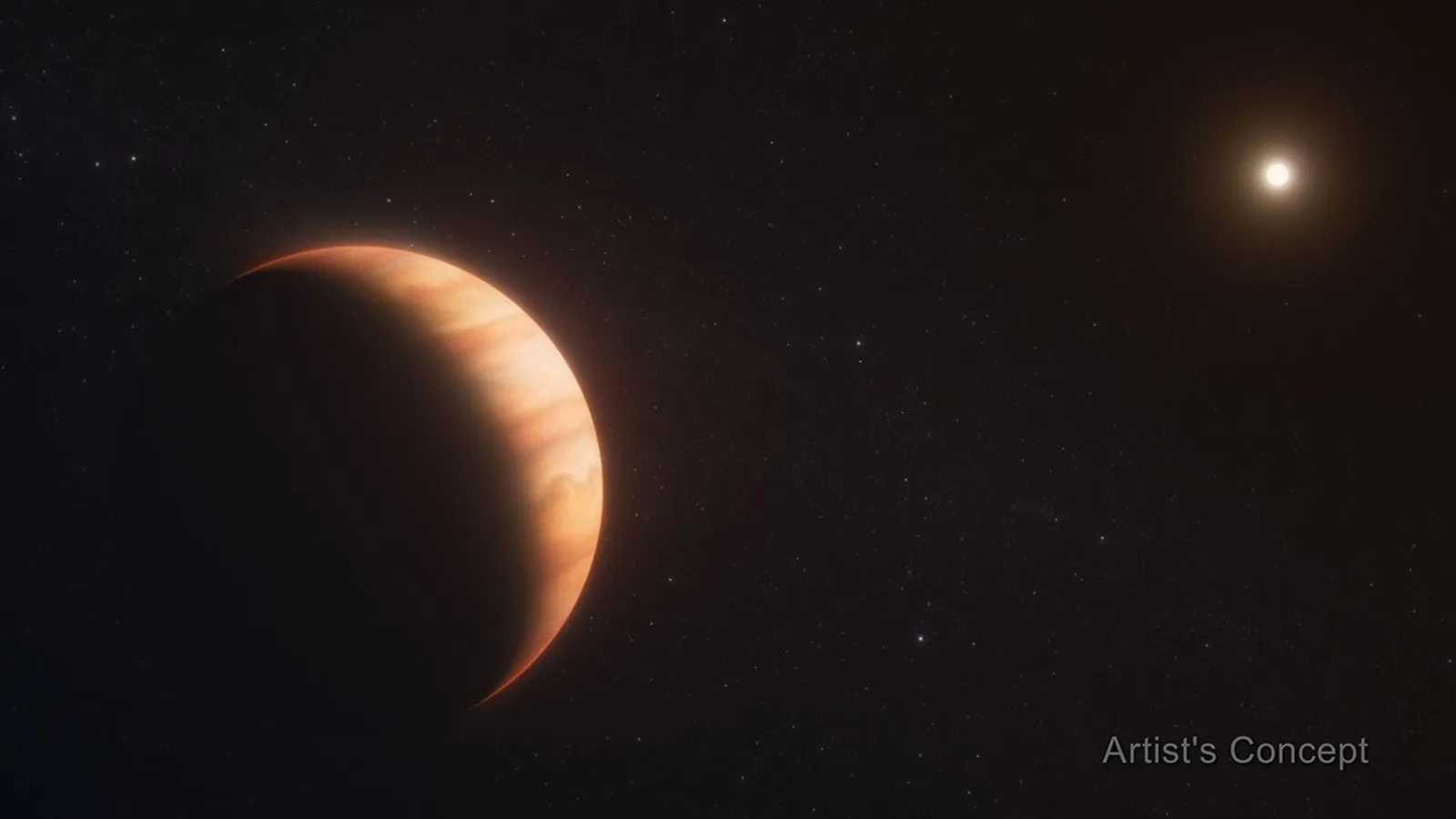
NASA’s James Webb Space Telescope observed the Jupiter-sized exoplanet WD 1856 b transiting its white dwarf host and measured its temperature and atmospheric molecules. The Nature paper, published Wednesday, gives decision-makers a clearer picture of how planets can endure long after a Sun-like star dies.
NASA’s James Webb Space Telescope just did something rare: it looked at a planet surviving the worst possible timing. The target is WD 1856 b, a gas giant that orbits a white dwarf every 34 hours. That tight orbit is only about 50 times closer than Earth is to the Sun, which matters because the host star should have swollen into a red giant and obliterated any nearby planets.
So when Webb measured WD 1856 b’s temperature at about 260 degrees Fahrenheit (126 degrees Celsius), “significantly hotter” than it should be from the white dwarf’s light alone, the result became a clue. The team did not just measure heat. They watched the planet transit the star and used the infrared signature from the planet’s own glow to reverse-engineer its past.
Here’s the setup, and why executives should care even if space is not your day job. Billions of years ago, the star that became WD 1856+534 was a Sun-like star approaching the end of its life. It swelled into a red giant, then ejected its outer layers, leaving behind a hot remnant core called a white dwarf. In normal expectations, a planet at the current distance should have been destroyed during the red giant phase. Yet astronomers found a Jupiter-sized exoplanet circling that remnant core every 34 hours at a separation of less than 2 million miles (3 million kilometers).
To resolve the mystery, an international team of astronomers used Webb to observe the planet as it passed in front of its host star. This transit technique let them measure the planet’s mass and temperature, and it also gave them access to atmospheric chemistry. Webb’s infrared data showed that during transit, infrared light was reduced less than other wavelengths. In plain English: the planet was contributing its own heat in the infrared, not merely reflecting light from the star.
The study pinned down WD 1856 b’s mass at between four and eleven times the mass of Jupiter. For temperature, the researchers found about 260 degrees Fahrenheit (126 degrees Celsius). Then they faced the hard part: where did that extra heat come from? The team concluded there was no source of energy present “to generate that heat today,” so the temperature had to be leftover heat from an earlier era. Using models for how sub-stellar objects cool over time, and combining that with Webb’s measurements, they projected backwards to infer when the planet was heated.
The timing narrowed the competing theories. There are two main explanations laid out in the paper’s discussion, including by co-authors. One theory is that the planet was swallowed by the host star as it was dying, but survived inside. The other is that gravitational interactions with other objects altered the orbit, pulling the planet inward. The white dwarf sits inside a triple star system, so companion stars could have influenced WD 1856 b’s orbit.
What Webb helped decide is which history fits the heat. The researchers concluded the heating most likely happened between 3 and 5.5 billion years after the star became a white dwarf. In that scenario, WD 1856 b started out on a wider orbit that kept it safe during the destructive red giant phase, then migrated inward later. As it moved closer, the strong gravity of the white dwarf would have warmed it considerably, and it has been cooling ever since. Co-author Christopher O’Connor of Northwestern University traced the temperature back in time, tying the “big question” to those two theories and then using Webb’s heat signature to constrain the clock.
The chemistry piece is the second punch. By analyzing starlight filtered through the planet’s atmosphere during transit, Webb detected “telltale signatures of small cloud particles and hydrocarbons,” most likely methane. The NASA release emphasizes that this is the first time an atmosphere has been seen on a planet transiting a dead star. Co-author Victoria Boehm of Cornell University also noted that the team recently observed four more transits with Webb to dig deeper into atmospheric chemistry.
Finally, the broader stakes. The paper is published in Nature, and the target itself was discovered in 2020 using NASA’s TESS (Transiting Exoplanet Survey Satellite) and the retired Spitzer Space Telescope. The white dwarf WD 1856+534 is about 80 light-years from Earth. All of that feeds into a bigger point Webb is making about our cosmic “far future.” In roughly five billion years, the Sun will run out of hydrogen fuel in its core, swell to more than 100 times its current size into a red giant, shed its outer layers, and end as a white dwarf. Mercury, Venus, and possibly Earth will be destroyed, but what happens to distant planets, especially gas giants, is unclear.
This is what turns an astronomy story into an executive-level signal. When scientists can “look forward” at what might happen to outer planets around a remnant of a Sun-like star, they reduce uncertainty about long timescales and complex system behavior. Webb’s transit measurements are, in a sense, a time machine that helps validate models of survival, migration, and atmospheric evolution. For decision-makers, the takeaway is simple: the future is not a theory anymore when you can measure the parameters that force the timeline to make sense.
This story's Key Insights and Take-aways are locked.
Create a free account to unlock Executive Actions for one credit.
Register to UnlockAlways free for Executives Club members. Join the Club
More in Science

Alaska's 1,580-foot tsunami had warning signs. Scientists just found them.
Rapid glacier retreat, heavy rainfall, and thousands of tiny tremors preceded Alaska's 1,580-foot tsunami, a warning for every coastal community in a warming world.

The rare mutation that lets high-risk brains dodge Alzheimer's
Scientists found a natural defense against protein buildup, opening a new path to preventive treatments.

3,000 steps a day may halve Alzheimer's decline, study finds
New research links a modest daily walk to less tau buildup and nearly half the cognitive and functional decline, even for those with early signs.