
White House’s @WhiteHouse X posts Destiny 2 Trump meme as Bungie announces sweeping layoffs
A state-run videogame parody, an unreal power level, and B2 Bomber cosplay collide with Destiny and Marathon job cuts.
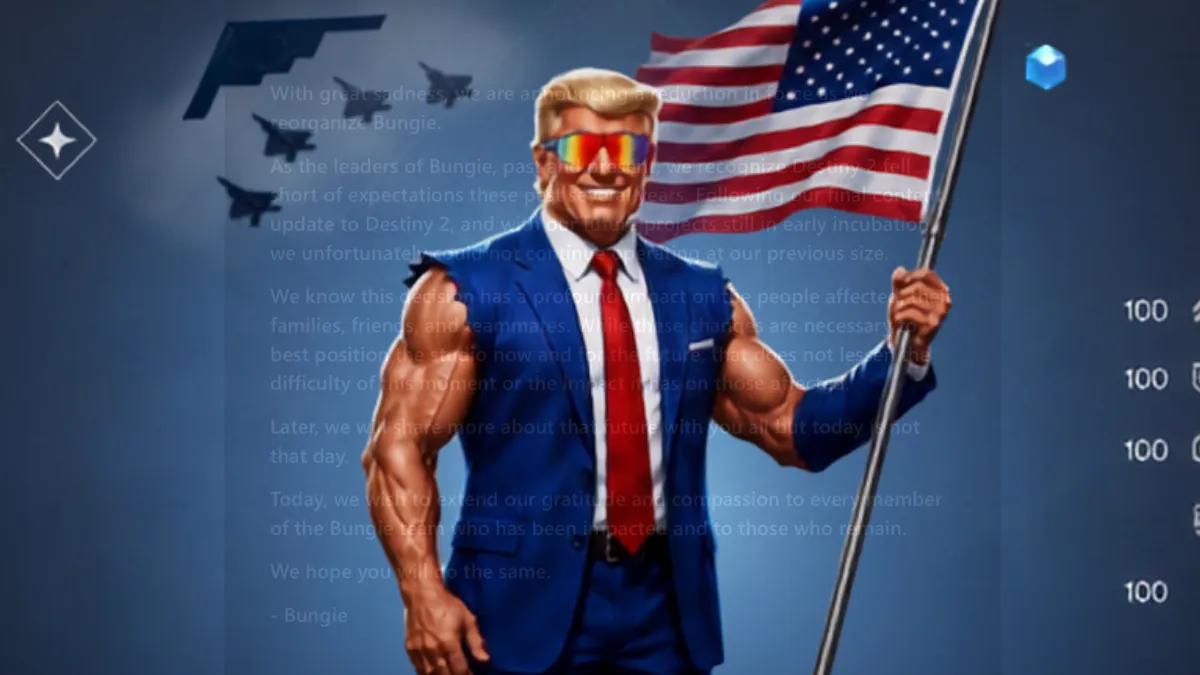
On June 25, 2026, the official White House X account posted an AI-generated Destiny 2 character sheet featuring an unrealistically ripped Donald Trump wielding a Gjallarhorn. The timing lands as Bungie announced sweeping layoffs affecting most of the Destiny team and some Marathon team members.
The official White House X account posted a Destiny 2 meme on June 25, 2026. The image shows an unrealistically ripped Donald Trump holding a Gjallarhorn, under the caption “Eyes up, Guardians,” with a Duke Nukem-esque, fighter-jet-and-Rolls-Royce backdrop.
If that sounds like harmless internet humor, the details say otherwise. Trump in the meme is depicted with a power level of 4700, even though the max in actual Destiny 2 is 550, and he’s paired with a B2 Bomber companion that “costs over $2 billion” per unit. The account also frames that B2 companion in the context of the bomber “most recently deployed in America’s attack on Iran.”
So here’s the real collision: Bungie, the studio behind Destiny 2, announced sweeping layoffs the same day. Sony executive Hermen Hulst said the layoffs would affect “a significant number of employees, including most of the Destiny team and some Marathon team members.” PC Gamer’s framing makes the point bluntly: with that context, the White House meme looks like it is mocking hundreds of now out-of-work developers. Even if it was created earlier than the layoffs, it’s still a weirdly timed piece of state-themed parody when the industry is already in pain.
For executives, the story is not “is the meme funny?” It’s what happens when public messaging, propaganda aesthetics, and corporate downsizing happen in the same news cycle. The White House and its departments have been issuing videogame-themed, AI-generated propaganda for years now, according to PC Gamer. Recent examples include Homeland Security riffing on the cover art for The Legend of Zelda: Wind Waker to celebrate the US Coast Guard, Secretary Brooke Rollins riffing on GTA 6 in a video, and both the Department of Labor and the United States Customs and Border Protection taking a swing at GTA 6 as well.
Those past examples matter because they establish a pattern: the government is using the language and visual grammar of popular games to communicate. It can be attention-grabbing, but it also can slide into something harder to defend, since the content is described as “blunt-edged state propaganda” that would, in PC Gamer’s words, have Edward Bernays rolling in his grave. The underlying business question for leaders is: when you rely on meme logic, you compress nuance. A character sheet becomes policy theater. A power level becomes a flex. A companion unit becomes a justification wrapped in a skin.
That’s why the current context is so combustible. PC Gamer notes that earlier this year, the White House issued videogame-themed AI propaganda to promote its attack on Iran. The B2 Bomber and its over-$2 billion “cost per unit” are not generic fantasy props. In the meme, they are attached to real military operations and real spending, then packaged as a game mechanic alongside a radically inflated power stat.
Meanwhile, Bungie is doing what so many studios are doing right now: restructuring under economic pressure. PC Gamer calls Destiny 2’s moment a “bittersweet renaissance,” which is basically the industry’s emotional roller coaster in one phrase. Studios can be revitalizing a live game while simultaneously cutting headcount elsewhere. For boards and investors, that combination is the key signal: performance and staffing are not always aligned, and marketing or public relations narratives can clash with internal realities.
There’s also the governance angle. When state accounts use AI-generated imagery and game framing, they are effectively borrowing established entertainment tropes, then applying them to governance topics. That creates a second-order effect in the corporate world: it raises the baseline for what audiences expect from institutions. If the government can do cosplay, meme culture can start to demand constant novelty from private brands too, especially when audiences feel politically “in the story.”
In the short term, Bungie employees and the broader developer community get collateral attention. In the medium term, peers in gaming, entertainment, and even adjacent sectors face a reputational environment where layoffs and propaganda timing can become a narrative trigger. The White House meme is also, according to PC Gamer, especially poorly timed given the layoffs announcement. Whether it was prepared in advance or rushed, executives should treat this as a playbook reminder: timing is part of the message, and modern attention cycles punish any mismatch between public tone and private harm.
This story's Key Insights and Take-aways are locked.
Create a free account to unlock Executive Actions for one credit.
Register to UnlockAlways free for Executives Club members. Join the Club
More in Business

Bungie cuts most Destiny 2 staff as Sony says Marathon still matters
Herman Hulst confirms layoffs affecting most Destiny and some Marathon teams after Bungie admits Destiny fell short.

SK Hynix jumps 11% after seeking up to $29.4B in Nasdaq listing
The chip giant filed for a Nasdaq listing plan that could raise $29.4 billion, instantly reshaping investor expectations.
Micron revenue hits nearly $42B as AI memory lifts gross margins above 81%
Fiscal Q3 results crush estimates, prove AI memory is rewriting Micron's margins, and change the momentum math for the whole chip stack.