
Wind-powered underwater data centre begins 24MW operations off Shanghai, aiming to cut strain
China’s Shanghai Lingang project uses wind undersea to address AI-era power and water pressures with a 24-megawatt test.
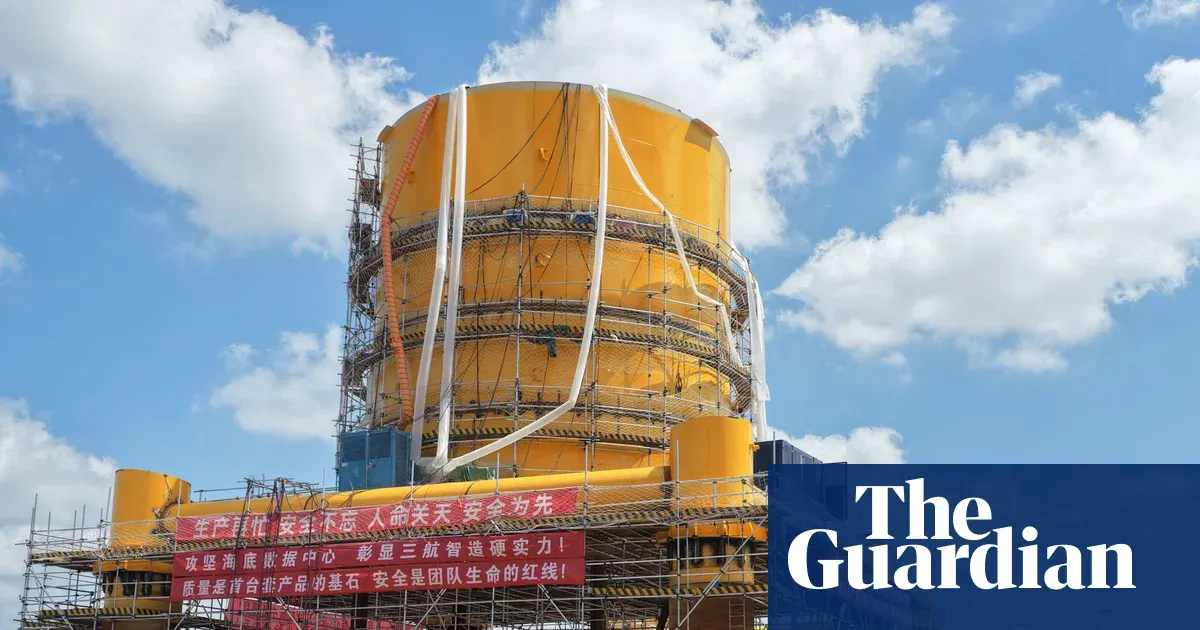
HiCloud Technology and China Communications Construction, a state-owned company, launched the Shanghai Lingang undersea datacentre demonstration project off the coast of Shanghai. It began operating after a May launch, delivering 24 megawatts with claims of using less power and water than land-based equivalents.
The world’s first wind-powered underwater datacentre has started operating off the coast of Shanghai, and it is already staking a very specific claim: it uses less power and water than an equivalent land-based facility. The demonstration project, called Shanghai Lingang, launched in May and now moves from construction theater to real-world operation, with a capacity of 24 megawatts.
This matters because China’s AI boom is not just a compute story. It is an infrastructure story, and the constraints are physical. Power availability and water usage are increasingly part of the business case for data centres, particularly when demand for training and serving AI models accelerates. By putting a datacentre underwater and pairing it with wind power, Shanghai Lingang is trying to turn two bottlenecks into engineering variables, and the “first operating” milestone makes it more than a concept slide.
Shanghai Lingang is a joint effort between HiCloud Technology and China Communications Construction, a state-owned company. That pairing is notable in how these projects typically get made. Data-centre rollouts depend on both technology providers and large construction or infrastructure players that can coordinate permitting, civil works, and grid or site integration. The source also frames the launch as part of China pressing forward with solutions to energy challenges created by the country’s artificial intelligence boom. In other words, this is not a vanity prototype. It is positioned as a response to pressure that is already being felt in the system.
The project’s timing, launched in May and now in operation, hints at a broader rhythm in the data-centre world. Facilities can be described in megawatts long before they run any workloads, but operators care about performance and operating cost, not just nameplate capacity. When a demonstration project begins operating, it becomes eligible for evaluation against the key metrics that boards and CFOs obsess over: actual energy draw, cooling and water consumption, reliability, and how smoothly it integrates with the local environment and power network. The source’s line that the underwater approach uses less power and water than land-based equivalents is the headline number, but the next question for decision-makers is whether the “less” holds up under sustained demand.
Regulation and permitting tend to show up indirectly in stories like this, but they matter directly for strategic planning. In many markets, data-centre expansion has collided with environmental requirements, water availability rules, and grid constraints. Even when permitting is granted, the cost of compliance can shape timelines and margins. By designing a datacentre around different physical assumptions, the Shanghai Lingang team is effectively exploring whether alternative siting and energy sourcing can reduce the friction that land-based expansion faces. If the operational phase confirms the source’s claim of lower power and water use, it could influence how future expansions are justified, particularly in areas where coastal development and resource scarcity intersect.
There is also a capital allocation angle. Undersea infrastructure is not the cheapest or simplest way to build a datacentre. So for executives, the real question becomes economics over the full lifecycle, not just the first cost. A 24-megawatt demonstration suggests intent to scale enough to measure meaningful outcomes, but not so much that it commits an entire region’s compute roadmap. That balance is often what boards want from “firsts”: enough signal to inform investment decisions, without betting the company on unproven performance. The fact that this effort is already operating off Shanghai increases the odds that it will generate data that can be used for internal business cases rather than outside marketing.
The second-order implication for peers is that wind-powered, underwater compute could reframe the competitive narrative around “where power goes.” Instead of treating power procurement and cooling as unavoidable overhead, this project treats them as design targets. That could ripple across supplier strategies, procurement criteria, and how developers bid for new capacity. If underwater datacentres can deliver comparable compute while reducing power and water requirements, it gives operators a new lever to negotiate with grid operators, manage sustainability reporting, and protect uptime during periods of tight resource availability.
Ultimately, Shanghai Lingang’s switch from launch to operating status off the Shanghai coast turns a bold claim into an observable experiment. For decision-makers watching the AI infrastructure buildup, it is a reminder that the next bottleneck is rarely the servers themselves. It is the ability to feed them reliably with energy and cooling, at acceptable cost and environmental impact. Whether this 24-megawatt test becomes a roadmap or a lesson, it is already participating in the most consequential contest in data centres right now: building capacity that can scale without breaking the grid or the local water balance.
This story's Key Insights and Take-aways are locked.
Create a free account to unlock Executive Actions for one credit.
Register to UnlockAlways free for Executives Club members. Join the Club
More in Technology

OpenAI says 10,000 agents cracked a 90-year math problem in 88 hours
The company's claim is audacious, but one mathematician is pushing back. Here's what it means for AI-driven discovery.

Meta still serves child sexual abuse ads on Instagram in India - BBC report
A new report following the BBC Eye investigation says the ads are still there - what it signals for every platform with a self-serve ad engine.

White House yanks 'Build the Wall' game after Tetris Company copyright warning
The administration's arcade game vanished in hours - and the takedown playbook every brand can learn from.