

World's fastest AI drone outflies human champs at 63 mph with one camera
Delft's MonoRace won the 2025 Abu Dhabi Autonomous Racing League and beat three former world champions without GPS, a map, or motion capture.
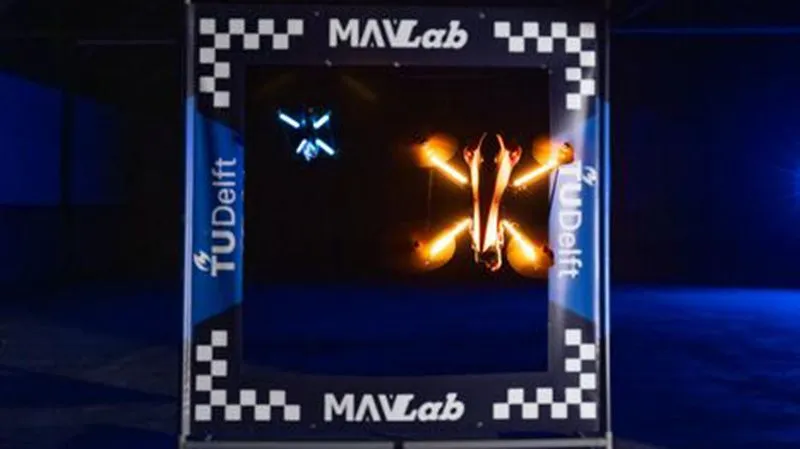
Researchers at Delft University of Technology's Micro Air Vehicles Lab built MonoRace, an AI system that won the 2025 Abu Dhabi Autonomous Racing League and beat three former human world champions at 63 mph. The result demonstrates that lean, single-camera neural control can out-race humans and could reshape drone training and energy-efficient robotics.
An AI drone has outflown the best human pilots. MonoRace, developed at Delft University of Technology's Micro Air Vehicles Lab in the Netherlands, won the 2025 Abu Dhabi Autonomous Racing League with a two-lap, 11-gate run in 16.56 seconds and a top speed of about 63 mph (102 km/h). The result, published Oct. 14 in the journal Science Robotics, beat every rival autonomous team and posted faster times than three former human world-champion drone pilots.
What makes the win more than a fast lap is the hardware. MonoRace carried no GPS, no external motion-capture system, no stereo cameras and no preloaded map. It used a single forward-facing camera, an inertial measurement unit, and a tiny onboard computer small enough to fit a 966-gram quadcopter measuring roughly 30 x 28 x 10 centimeters. The neural network sends commands to the four propellers 500 times per second. In other words, the drone sees, decides and acts with the computing power of a microcontroller-class chip.
The system's name reflects its core design: "mono" means monocular vision. The network was trained with reinforcement learning, a method where an agent repeatedly attempts a task and adjusts based on success or failure. Co-author Guido de Croon, a professor at Delft University of Technology, told Live Science: "The reinforcement learning ran in simulation, because it needs lots of trial and error - like millions of tries." He added: "It actually learns to fly from scratch." Early training focused on basics like avoiding crashes and reaching the first gate, then the system advanced to flying farther and faster. The researchers varied dimensions such as weight, voltage, drag, sensor noise and propeller condition so the model could handle real-world imperfections. "That ensures that the trained network can control different drones," de Croon said.
The learning pipeline separates perception from control. A convolutional neural network segments the white racing gates, detects gate corners and estimates the drone's position and motion. That estimated state is fed to the control network, which generates motor commands. Because training happened in a stripped-down, pure physics simulator, the system never needed to render visuals while learning. "Simulating vision was not done during training, as the control neural network receives an estimated state as input," de Croon explained. That distinction matters for anyone building real-world AI: simulation for control, real camera for perception.
The practical payoff could be a training tool for human pilots. De Croon compared MonoRace to powerful chess programs that have inspired human players, adding that its broader significance lies in physical AI, especially how a robot can perceive, decide and act at high speeds despite limited sensing and computing power. Because the control network runs on a microcontroller-class chip, sophisticated control does not require a large computer.
That opens a second-order opportunity in energy efficiency. De Croon noted that a similarly sized network could optimize for minimal energy use rather than minimum lap time. Since most machines rely on small processors and conventional controllers, energy-optimal neural control could eventually reduce power consumption in everyday robotics. For executives in drones, autonomous vehicles, logistics and edge hardware, MonoRace is a proof point that a lean sensor suite plus a well-trained neural network can outperform heavier, more instrumented systems.
The design also points toward autonomy that does not depend on external infrastructure. The drone needed no GPS, no motion-capture beacons and no preloaded map, which matters for any environment where those tools are unavailable or unreliable. The researchers did not claim a commercial timeline, but the capability is a tangible step in a broader shift toward machines that learn to navigate with minimal sensing.
For decision-makers, the lesson is not just that AI beat humans at a race. It is that a 966-gram drone with a single camera out-ran former world champions because the algorithm, not the sensor stack, did the heavy lifting. That should make anyone building or funding autonomous systems ask whether they are adding hardware to solve problems that software could solve more cheaply. MonoRace shows the gap between perception and action can be closed fast, and the winning approach may be the simplest one.
This story's Key Insights and Take-aways are locked.
Create a free account to unlock Executive Actions for one credit.
Register to UnlockAlways free for Executives Club members. Join the Club
More in Technology

Google's $899 Googlebook laptops are 'woefully underbaked,' review finds
Google's premium ChromeOS-Android hybrid starts at $899, but the first major review says the software can't match the hardware. A risky debut against the MacBook Air and Surface Laptop.

doubleAI's Maxwell rewrites code while it runs, claims 38x speedups
The Tel Aviv startup's code execution model formally verifies optimizations, turning AI into an agent for the hardware itself.
Saudi military official paid to fly OpenAI bugging suspect's family out, prosecutors say
A court filing says a Saudi military official funded the family's exit and Riyadh offered bail, putting foreign-influence risk squarely on AI boards.