

Zurich quietly became the AI R&D hub for Apple, Google, OpenAI and more
The “secret sauce” is density plus stability: why so many frontier AI builders cluster around Greater Zurich Area.
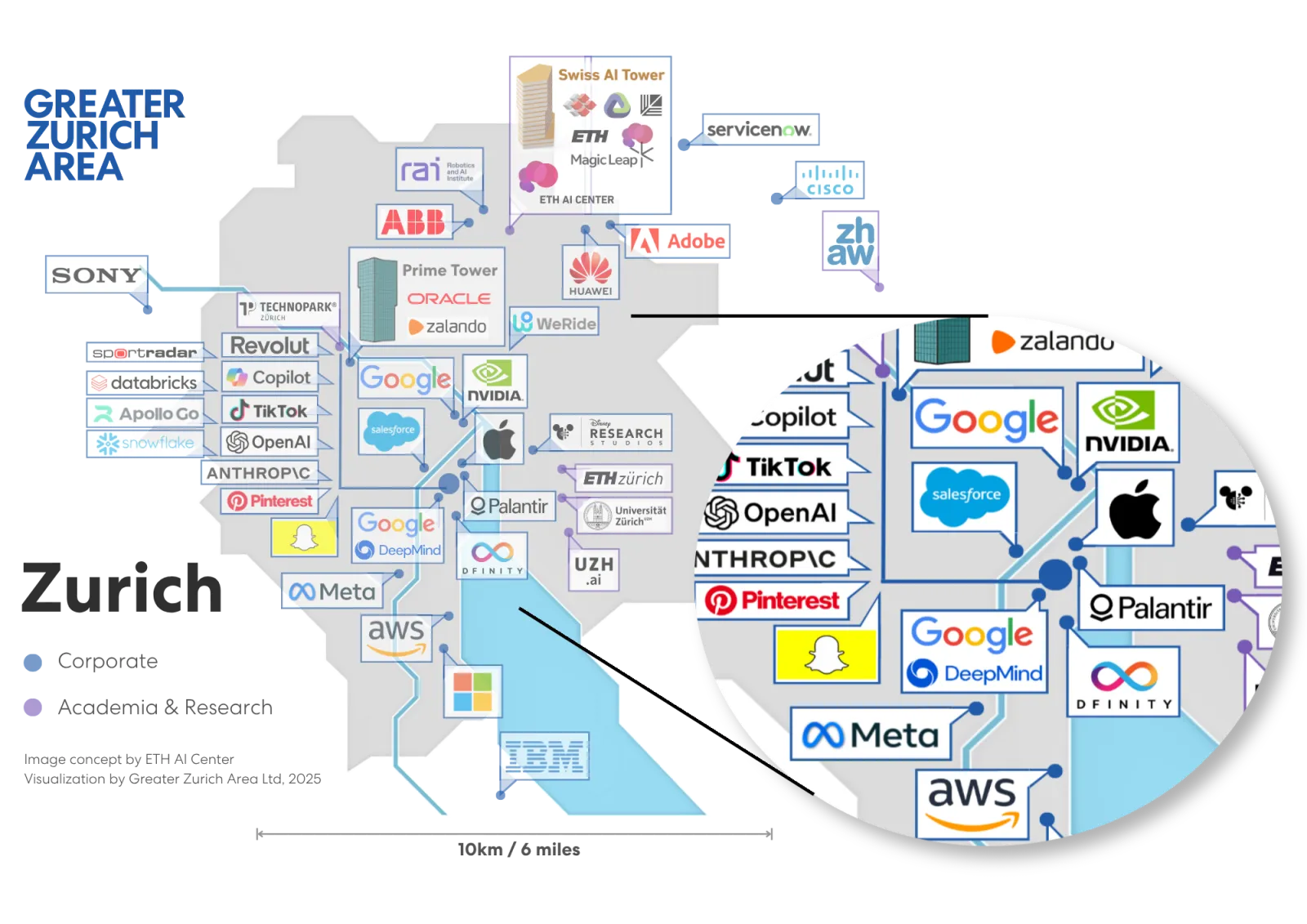
Over the past two decades, a surprising share of major tech R&D has expanded beyond Silicon Valley into and around Zurich, Switzerland, including Apple, Anthropic, Disney Research, Google, Meta, Microsoft, NVIDIA, and OpenAI. For decision-makers, the consequence is clear: Switzerland’s model concentrates talent, research, regulation, and commercialization in a way that changes where AI teams can scale efficiently.
Apple. Anthropic. Disney Research. Google. Meta. Microsoft. NVIDIA. OpenAI. These are not small names, and yet many of them have chosen to build R&D operations in and around Zurich, Switzerland. Fewer places outside Silicon Valley can claim that kind of roster. Even rarer: Zurich is where that concentration happens inside a city of just over 400,000 people, roughly half the size of San Francisco.
The headline fact is why this matters: Zurich has evolved into one of the world’s most concentrated centers for AI research, talent, and commercialization, in certain areas at a higher density than Silicon Valley. The “why” is not mysterious if you look at how the ecosystem is engineered, from political stability and intellectual property protection to transport links and a deep-tech-leaning capital market. And it did not start as a random talent grab. What began with Google’s decision to build its largest R&D hub outside the United States has, over time, become a magnet for other global AI builders.
Start with the geographic and institutional setup. The Greater Zurich Area spans the cantons of Glarus, Graubünden, Schaffhausen, Schwyz, Solothurn, Tessin, Uri, Zug, and Zürich, plus the region of Winterthur and the city of Zurich. It sits at the center of Europe, giving companies access to major markets. It is also described as politically stable, with regulatory predictability and strong intellectual property protection. On the practical side, Zurich Airport connects the region directly with key business hubs across Europe, North America, and Asia, making it an efficient base for international operations. When you are building AI systems that need long feedback loops between research, compliance, and productization, predictability becomes a competitive advantage.
Switzerland’s innovation performance reinforces that advantage. The country has ranked first in the Global Innovation Index for more than a decade, leads the world in patents per capita, and invests over 3.3% of GDP in research and development. Earlier this year, google.org pledged a $1 million grant to the Swiss National AI Institute, a joint effort to advance AI research for the public good. The funding climate also tilts toward deep tech. According to the Swiss Deep Tech Report 2026, Switzerland’s venture ecosystem puts over 60% of Swiss venture capital into deep tech, the highest share globally by a large margin and nearly twice the share of major economies like Germany, France, and the UK. At $1,470 invested per capita, Switzerland commits more to deep tech per capita than any other country in Europe.
Then there is the economics, which is where this story gets interesting for executives. Switzerland can be expensive for talent and operations, and the talent pool is small by global standards. Scaling a team quickly is harder in Zurich than in London, Paris, or Amsterdam. Early-stage companies that need to hire fast and burn lean face a real trade-off. But for companies building specialized AI capabilities, the equation shifts. The objective is not to assemble the largest team; it is to assemble the right team. Switzerland’s economy is built around high-value, knowledge-intensive work, with productivity among the highest in the world. Companies concentrate on specialized expertise rather than large workforces.
In other words: Zurich is not trying to outpace Silicon Valley on volume. It is optimizing for specialization, plus the hard-to-copy inputs that matter for advanced AI. Those include direct access to leading universities and research institutions, regulatory stability, and a quality of life that helps attract and retain skilled international talent. That helps explain the next layer: the ecosystem’s density. Greater Zurich concentrates many ingredients required to build and deploy AI systems, with world-leading AI companies, research institutions, investors, and startups operating in close proximity. Google engineers teaching at ETH Zurich is one example. ETH graduates joining companies such as Anthropic is another. Researchers launch startups, while former employees of global technology firms go on to found new ventures. In a region of this size, collaboration happens less through formal introductions and more through proximity. Talent flows freely, but it rarely leaves the ecosystem.
The ecosystem also signals maturity through its ability to convene. Events such as the Zurich AI Festival will bring together more than 6,500 guests from September 28 to October 3. With more than 35 confirmed events across AI and the arts, AI literacy, health, technology, and policy, it is positioned as a platform for cross-sector exchange. Flagship events include the AI + X Summit, AI + Environment, and the AI + Policy Summit, bringing together internationally recognized leaders, researchers, policymakers, venture capitalists, and entrepreneurs. That matters because AI is not just a lab problem; it is a deployment problem, and deployment is where policy, industry needs, and user trust collide.
At the center of Switzerland’s AI capabilities are institutions such as ETH Zurich, the University of Zurich, École Polytechnique Fédérale de Lausanne (EPFL), Scuola Universitaria Professionale della Svizzera Italiana (SUPSI), and Zürcher Hochschule für Angewandte Wissenschaften (ZHAW). ETH Zurich ranks among Europe’s leading universities for deep tech commercialization, generating more than 40 spin-offs and startups in 2025 alone, helping create some of the continent’s most valuable technology companies. The Stanford AI Index 2026 reinforces the scale of that talent supply: Switzerland ranks first globally for AI researchers and inventors per capita, with 110.5 per 100,000 inhabitants, ahead of Singapore (109.5), Sweden (80.6), and the United States (64.8). The IMD World Talent Ranking ranked Switzerland number 1 for the 10th consecutive year, leading globally in investment, development, and talent appeal. Add the movement between universities, startups, and established technology firms, and you get strong knowledge flows across organizations.
Density is increasingly attracting companies from outside the region too. Before Exa.ai formally announced its Zurich office, it received a strong pipeline of candidate applications. Will Bryk, the company’s CEO and co-founder, said: “To assemble the greatest search team in the world, you've got to meet people where they are,” and “many are in Greater Zurich.” Former Google Switzerland employees alone have founded approximately 210 companies and created around 2,600 jobs over the past two decades. For a country of around nine million inhabitants, that multiplier effect is significant, because large firms contribute not only through direct employment but through new companies and transferred expertise.
Finally, for executives comparing Switzerland to Silicon Valley, the key point is complementarity. Silicon Valley remains unmatched in scale, venture capital, and frontier model development. But for global technology companies, an R&D presence in Switzerland has become a strategic complement, letting them access specialized talent, stay close to leading research, and build capabilities that shape the next generation of products and services. This is especially relevant where AI meets the physical world. Switzerland offers direct access to leading universities, industrial partners, and sectors such as healthcare, finance, manufacturing, and robotics, where reliability, compliance, and precision are often as important as raw model performance. Geography, in this case, is strategy. If you are deciding where to build the next generation of AI, the question is no longer simply “where is the biggest ecosystem,” but “where is the distance between research, talent, capital, and deployment actually minimized.”
This story's Key Insights and Take-aways are locked.
Create a free account to unlock Executive Actions for one credit.
Register to UnlockAlways free for Executives Club members. Join the Club
More in Technology

Nvidia's $89B data center quarter: the 9 companies cashing in
The AI buildout is minting fortunes beyond GPUs, and memory, cloud, and cooling suppliers are riding the same wave.

A YouTuber dissected the iPhone Duo and thinks he found crackgate's cause
CuriousHagi's teardown of Apple's foldable reveals a gear-like hinge that may explain why screens crack in the same spot within hours.

Google quietly links your phone number to every Android account on your SIM
Adding a SIM now ties your phone number to all Google accounts - and future accounts inherit it. Here's the security and privacy stakes.