

A $10 glasses program could unlock $27B annual output gains for apparel workers
Trial data in the British Journal of Ophthalmology says every $1 spent can return $3.37 in productivity.
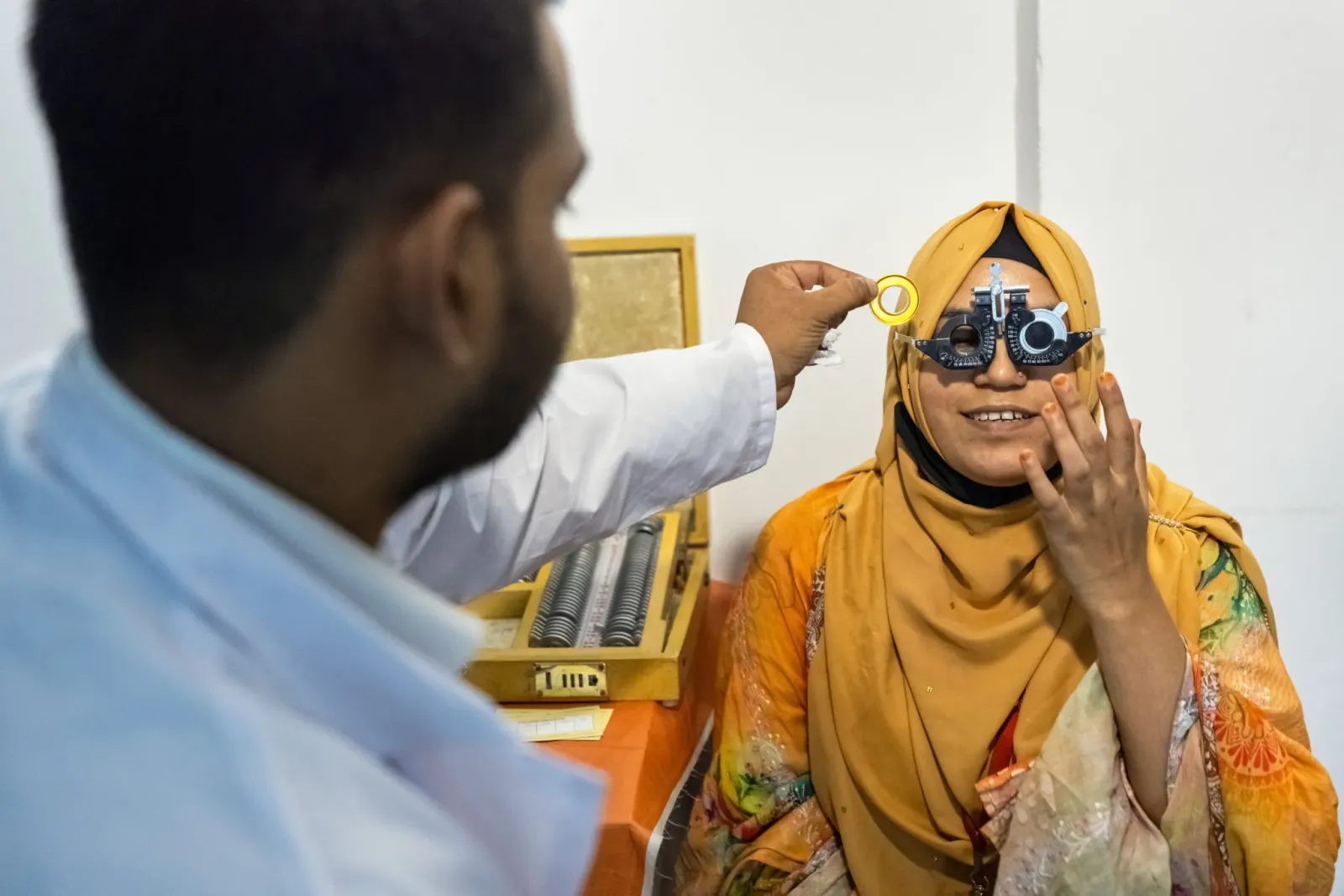
VisionSpring CEO Ella Gudwin says factory-based vision screenings delivered immediate gains, including in a randomized controlled trial. The results imply apparel operators could scale an overlooked workplace need into major annual output gains.
In apparel manufacturing, the biggest productivity bottleneck might not be machines or management. It could be blurry vision. A randomized controlled research trial co-authored by VisionSpring and published in April in the British Journal of Ophthalmology found that sewing machine operators who received reading glasses increased productivity by 6% while making fewer errors. The economic punchline is even sharper: every $1 spent on vision screening and glasses generated $3.37 in productivity gains over 12 weeks, and the study estimated expanding similar programs across the global textile and garment industry could generate the equivalent of $27 billion in additional annual output.
That matters now because garment workers often lose time to tasks that do not look like “operations” issues until you measure them. For Ruma Aktar, a sewing machine operator at a garment factory in Bangladesh, a pair of reading glasses changed day-to-day output. Aktar said her glasses helped her thread needles faster, and also relieved headaches and eye strain. “Before I got the glasses, it took me a long time to thread the needle. Now I can thread it in just a short time. I make far fewer alterations than before.” In a setting where each worker is expected to produce thousands of garments a day, shaving seconds off fine-motor steps, and reducing mistakes that trigger rework, can move real volume.
Bangladesh is a particularly useful lens for this story because of scale and incentives. The country has the world’s second-largest garment industry after China. The garment sector contributes about 11% of gross domestic product and employs around 4 million workers. That means even modest efficiency improvements can ripple into labor scheduling, defect rates, and the ability to meet quality and production targets. VisionSpring, a global nonprofit social enterprise supplying affordable glasses to people in poorer countries, estimates roughly one in three Bangladeshi garment workers need glasses but do not have them. Through a partnership with the Bangladesh Garment Manufacturers and Exporters Association, which represents factory owners, VisionSpring has supplied glasses that cost less than ten dollars per pair to some workers.
VisionSpring’s CEO, Ella Gudwin, said the benefits were immediate: workers were better able to meet quality and production targets. She also pointed to a practical mechanism executives should care about. Better vision reduces mistakes such as skipped stitches, uneven hems, and misplaced buttons, which in turn cuts the need for rework. Rework is the hidden tax on manufacturing. It consumes labor time, disrupts workflow, and can lead to cascading delays when later steps depend on earlier approvals. When you reduce the number of defects caused by vision limitations, you do not just improve “productivity” in a vague way. You lower scrap and correction work, and you keep line throughput steadier.
This is not only theory. Masco Group, a Bangladeshi garment company, screened about 5,000 workers, and around 30% received glasses. Fahima Akhter, a director at Masco Group, said managers initially did not realize how many workers had vision problems because they rarely complained. That detail is telling for boards and executives. If problems are not raised because workers assume nothing can change, defect rates can persist while leadership looks in other directions, like training, staffing, or machinery. Akhter said her company plans to extend the program to its remaining workforce of more than 20,000 employees. She also framed the decision in investment terms, saying, “We don’t consider it a cost. It is an investment. If the workers are working with better vision, their productivity and workplace safety will improve, and eventually this will translate into better productivity and profit for the company.”
From an incentives perspective, VisionSpring’s Gudwin argues vision correction has been overlooked because eyeglasses were often seen as a luxury rather than an essential workplace tool. She said many factory workers develop age-related short-sightedness in their late 30s and early 40s, but delay treatment because they assume glasses are expensive. Bringing eye screenings directly into factories removes those barriers. For executives, the operational angle is the distribution model: if the problem is visibility at work, then the solution has to be delivered where the work happens, not only through external healthcare access.
Second-order implications for decision-makers show up in how this interacts with quality systems and scaling. The research trial measured outcomes over 12 weeks and found both productivity gains and fewer errors, which suggests this is not a one-week novelty. The study’s estimate that scaling across the global textile and garment industry could generate the equivalent of $27 billion in additional annual output points to an industry-wide utilization gap: one in three Bangladeshi garment workers needing glasses but not having them is a capacity constraint disguised as a health access issue. In other words, a program that improves vision can also improve the reliability of output, the speed of tasks like threading needles, and the rate of corrections tied to preventable mistakes.
If you run apparel operations, the strategic takeaway is uncomfortable in a good way. The fastest way to add output might not be an expensive automation purchase. It could be a workplace benefit that directly improves the precision work operators do every day. And for investors and boards watching margins, this reframes the “low cost, high impact” narrative in a way that connects to measurable manufacturing outcomes: a $10 pair of glasses, a 6% productivity lift in the trial, fewer errors, and a modeled $3.37 return per $1 spent over 12 weeks, with an industry-wide upside estimate of $27 billion in additional annual output.
This story's Key Insights and Take-aways are locked.
Create a free account to unlock Executive Actions for one credit.
Register to UnlockAlways free for Executives Club members. Join the Club
More in Business

Uber buys Delivery Hero for nearly $15B, vaulting to top food delivery outside China
The deal doubles Uber's dual-services footprint and pushes a ride-and-eats bundling play into 50 more markets.

Epic and Google drop settlement bid, forcing rival Android app stores by July 22
Google told the court it is ready to carry third-party app stores starting Wednesday, July 22.

SK Hynix opens at $170, raises $26.5B, and tops foreign IPO records
In Friday's Wall Street debut, SK Hynix turns AI RAM demand into a $26.5B fundraising moment that rewrites comps.