

A proton shuttle flips triplet energy transfer, boosting performance in quantum-dot systems
A brief proton shift coordinates electron movement, then returns, dramatically improving triplet energy transfer for next-gen devices.
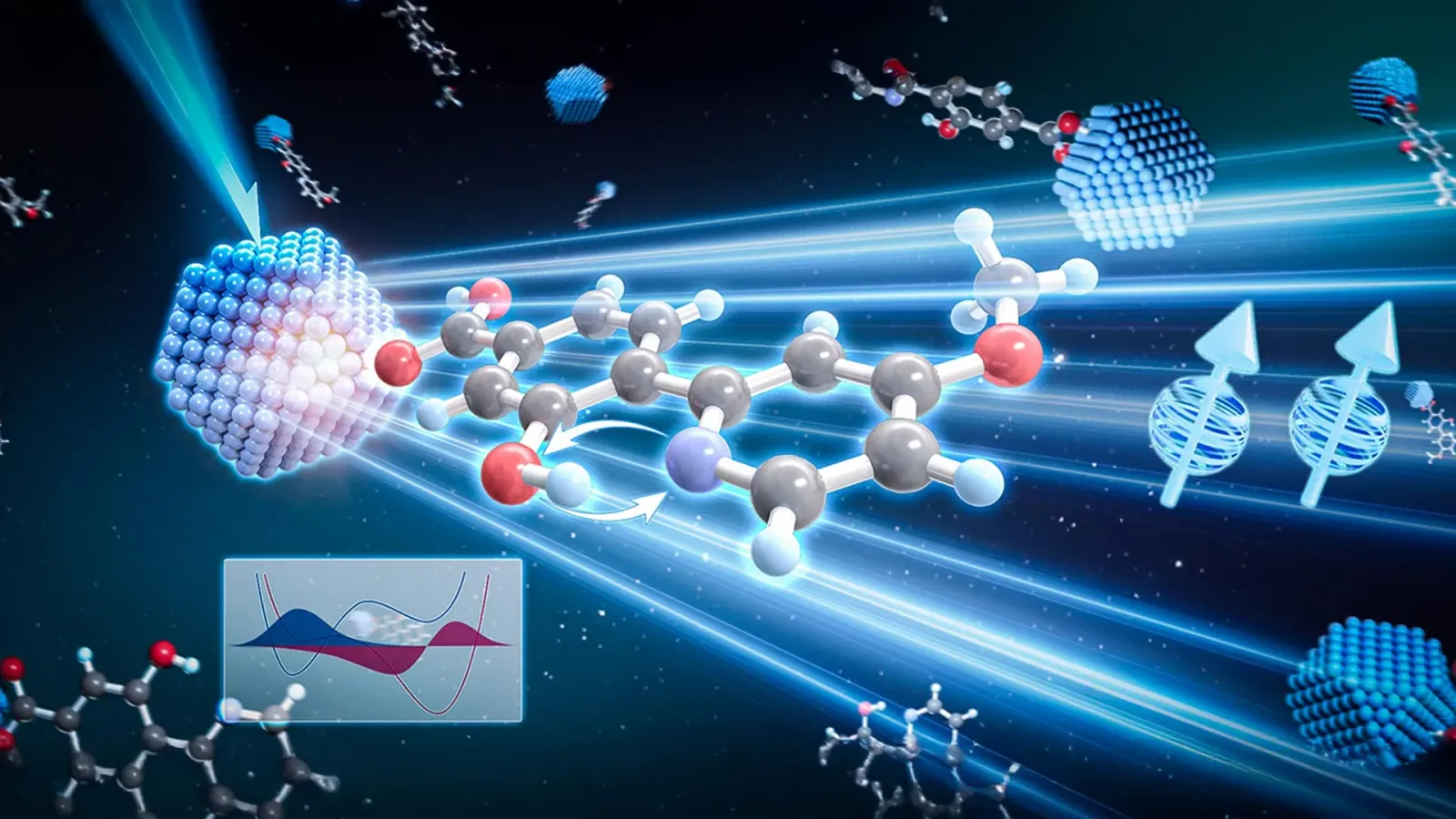
Researchers report a proton-assisted quantum mechanism that dramatically boosts how triplet energy transfers between quantum dots and nearby molecules. For decision-makers, it suggests a tunable lever for improving solar cells, lasers, and catalytic reactions without rewriting the whole platform.
Triplet energy transfer is the quiet workhorse behind a lot of photonics and chemistry, but it can be stubborn: the energy often takes inefficient paths, which caps brightness, conversion efficiency, and reaction rates. Now researchers have uncovered a strange, but plausibly useful, proton-assisted mechanism that dramatically improves this transfer between quantum dots and nearby molecules.
Here is the core of what they found: a proton briefly shifts position, helps coordinate electron movement, and then returns to where it started. In other words, the proton acts like a temporary shuttle or coordinator. It does not get consumed or permanently moved away. That “borrow-and-return” behavior is what makes this mechanism feel fundamentally different from ordinary ways of speeding things up, and it is also what makes it interesting as a potential tuning knob.
Why should executives care about a proton in the first place? Because energy transfer efficiency is not a niche physics detail. In quantum-dot based approaches, energy has to move from one region to another in a way that preserves the right quantum states. Triplet states matter because they can be involved in light-emitting processes, charge or exciton pathways, and energy-driven chemistry. When transfer is weak, the system needs more input energy to produce the same outcome, whether that outcome is photons in a laser, electrical output in a solar cell, or activation steps in catalysis. When transfer improves, you can often get the same effect with less overhead, or you can push performance further before hitting the next bottleneck.
This research also lands in an industrial moment when “tuning” matters more than ever. The field is crowded with competing architectures for solar cells, lasers, and catalytic reactions, and companies are increasingly judged on how precisely they can control properties at the nanoscale: emission wavelengths, reaction selectivity, stability, and efficiency under real operating conditions. A mechanism that is explicitly described as quantum-driven and proton-assisted offers a different kind of handle. Instead of only changing materials, device geometry, or external conditions, you are looking at altering how energy is handed off at the molecular interface.
The practical promise hinted by the researchers is broad: the proton-guided shuttle “could offer a powerful new way to tune solar cells, lasers, and catalytic reactions.” That matters because each of those markets has its own version of the same problem. Solar cells need efficient conversion, lasers need controlled emission with high output and low losses, and catalytic systems need energy pathways that reliably drive reactions rather than wasting it as heat. A single underlying mechanism that improves triplet energy transfer could, in principle, be adapted across these domains, especially where quantum dots are used to interface light with molecular or chemical activity.
Now zoom out to the governance and regulatory context that often shapes whether such breakthroughs turn into products. In heavily regulated sectors like energy and chemical manufacturing, the pathway from lab mechanism to deployment usually requires long timelines, reproducibility, and evidence that performance gains persist outside ideal conditions. Even when no direct regulatory approval is required for a new lab method, commercialization still faces technical compliance requirements, safety validation, and lifecycle considerations. A proton-assisted approach could face typical scaling questions: does the mechanism depend on specific environmental conditions, and can manufacturing reliably reproduce the quantum-dot and molecule arrangements needed for the proton-assisted coordination? The source does not provide those details, so the responsible way to think about it is as an enabling discovery, not a guaranteed product recipe.
Second-order implications for boards and investors follow from that uncertainty. A mechanism described as “dramatically improves” transfer is the kind of signal that attracts attention, but the investment question becomes: is this improvement robust across device variants, and does it introduce new material dependencies that complicate supply chains or reliability? The fact that the proton returns to its starting position may help with conceptual stability, because it implies a catalytic-like role for the proton in the coordination process rather than a one-way consumption. Still, the real proof will be in repeatable device-level performance under realistic conditions.
For peers in adjacent roles, the strategic takeaway is simple. If energy transfer can be tuned by a quantum-driven shuttle mechanism, then the next generation of photonics and catalytic systems may prioritize interface engineering that enables coordinated electron movement, not just bulk material selection. That could reshape what teams choose to optimize: less emphasis on brute-force inputs, more emphasis on orchestrating the handoff of triplet energy at the nanoscale. In a world where improvements have to translate into measurable efficiency, brightness, or conversion yield, this proton-mediated coordination is a promising new lever worth watching closely.
This story's Key Insights and Take-aways are locked.
Create a free account to unlock Executive Actions for one credit.
Register to UnlockAlways free for Executives Club members. Join the Club
More in Science

Alaska's 1,580-foot tsunami had warning signs. Scientists just found them.
Rapid glacier retreat, heavy rainfall, and thousands of tiny tremors preceded Alaska's 1,580-foot tsunami, a warning for every coastal community in a warming world.
The rare mutation that lets high-risk brains dodge Alzheimer's
Scientists found a natural defense against protein buildup, opening a new path to preventive treatments.

3,000 steps a day may halve Alzheimer's decline, study finds
New research links a modest daily walk to less tau buildup and nearly half the cognitive and functional decline, even for those with early signs.