

A robot just ran 100m in 9.39s, beating Bolt. Roboticists shrug
Beijing's X-Humanoid smashed the human 100m record at the World Humanoid Robot Games, but experts say the real benchmark is folding laundry.
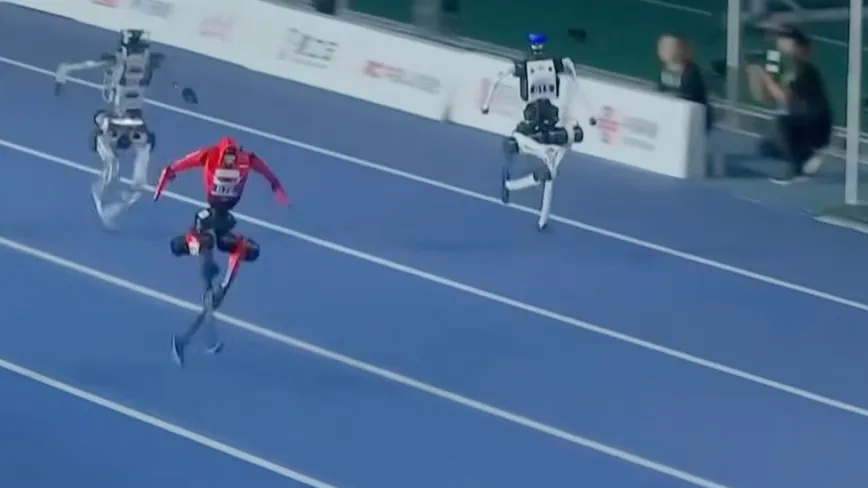
Beijing's X-Humanoid built a humanoid robot that ran 100 meters in 9.39 seconds, beating Usain Bolt's 9.58-second record at the World Humanoid Robot Games. Roboticists caution that this speed feat on a known course is far less impressive than dexterous tasks like folding laundry, signaling where the industry's true value lies.
A humanoid robot built by Beijing's X-Humanoid just ran 100 meters in 9.39 seconds at the World Humanoid Robot Games, shattering Usain Bolt's 9.58-second world record. The machine crossed the finish line nearly two-tenths of a second ahead of the fastest human ever timed, a margin that in sprinting terms is a full stride. But the reaction from roboticists? A collective shrug, and for good reason: speed on a flat, known course is one of the easiest things for a machine to master, while the mundane act of folding laundry remains a frontier that still trips up the world's most advanced robots.
The gap between what the X-Humanoid robot achieved and what roboticists actually care about is the real story here. Sprinting is a controlled, repeatable task: the track is fixed, the conditions are predictable, and the robot can be optimized for a single motion pattern. Folding laundry, by contrast, requires perceiving a deformable object, adapting to its shape, and executing fine motor control in real time. That is why the robotics community greeted the 9.39-second run with something closer to indifference than awe. The record is a headline-grabber, but it does not move the needle on the challenges that matter for real-world deployment.
For executives watching the robotics space, the lesson is not about track times. It is about where the industry's actual value is being created. The X-Humanoid sprint is a demonstration of control systems and hardware integration, but the commercial applications that will reshape logistics, manufacturing, and healthcare are the ones that solve dexterity, adaptability, and safety in unstructured environments. A robot that can fold laundry, load a dishwasher, or assist a nurse in a hospital room is worth far more than one that can outrun a human on a straight line.
The World Humanoid Robot Games, where this record was set, are part of a broader push by Beijing to position itself as a leader in humanoid robotics. China has been pouring resources into the sector, with local governments funding research and development, and companies like X-Humanoid emerging as players. The event itself is designed to showcase progress, but it also highlights the gap between spectacle and substance. A 9.39-second sprint is impressive engineering, but it does not address the fundamental question of whether humanoid robots can perform economically valuable tasks at scale.
That question is central to the investment thesis for humanoid robotics. Venture capital and corporate R&D budgets are flowing into companies that promise to deploy humanoid robots in warehouses, factories, and homes. But the economics only work if the robots can handle the messy, variable tasks that humans do every day. The X-Humanoid record is a reminder that the industry is still early, and that the metrics that capture public imagination are not always the ones that capture commercial value.
For decision-makers, the takeaway is to look past the headlines. When evaluating robotics companies, the benchmarks that matter are not speed records but reliability, cost per task, and the ability to handle edge cases. A robot that can run 100 meters in 9.39 seconds is a marvel of engineering, but a robot that can fold a towel without tearing it is a product. The former wins applause; the latter wins contracts.
The strategic stakes for peers in the robotics and automation space are clear: do not confuse publicity stunts with progress. The X-Humanoid sprint is a useful marketing moment, but it does not change the competitive landscape. The companies that will lead the next wave of automation are those that solve the hard problems of perception and manipulation, not those that set track records. As the industry matures, the gap between spectacle and substance will narrow, but for now, the smart money is on the unglamorous work of making robots useful in the real world.
In the end, the 9.39-second run is a fun fact, but it is not a signal. The signal is that humanoid robotics is still in its infancy, and the milestones that matter are the ones that happen in kitchens, warehouses, and hospitals, not on a track. For executives, the takeaway is to invest in the capabilities that will drive adoption, not the ones that will drive headlines.
This story's Key Insights and Take-aways are locked.
Create a free account to unlock Executive Actions for one credit.
Register to UnlockAlways free for Executives Club members. Join the Club
More in Technology

doubleAI's Maxwell rewrites code while it runs, claims 38x speedups
The Tel Aviv startup's code execution model formally verifies optimizations, turning AI into an agent for the hardware itself.
Saudi military official paid to fly OpenAI bugging suspect's family out, prosecutors say
A court filing says a Saudi military official funded the family's exit and Riyadh offered bail, putting foreign-influence risk squarely on AI boards.

AI researcher's 26,000-word claim: Neural nets aren't tangled after all
Nick Cammarata's Goodfire post has the AI world split - if he's right, monitoring frontier models just got a lot easier.