

Accelsius claims 14°C cooler GPU temps by swapping coolant types, not hardware.
If higher facility water temperatures cut cooling energy, data centers may finally stop treating “hot” as unavoidable.
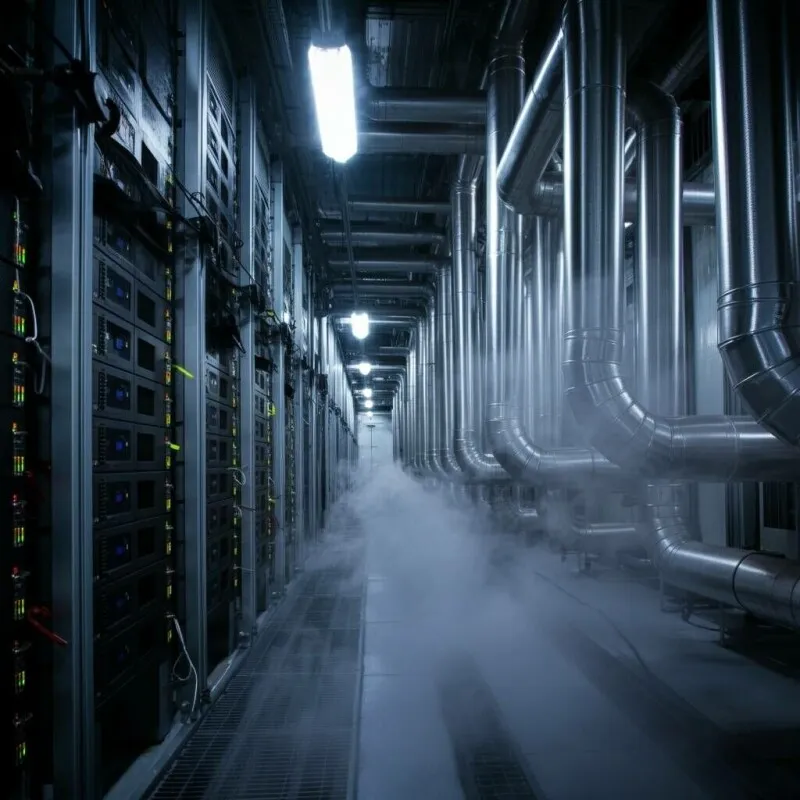
Accelsius, with CTO Rich Bonner, says its NeuCool two-phase coolant system can reduce GPU cold plate and system temperatures on a liquid-cooled Dell PowerEdge. The consequence for operators is potentially lower cooling energy by enabling facility water temperatures up to 54°C, and up to 59°C with more flow.
Two numbers anchor Accelsius’ pitch and they’re not subtle: the startup claims it can run GPU liquid cooling with facility water up to 54°C, or up to 59°C if the operator doubles the facility’s flow rate. And in its reported tests, it says it can drop temperatures by as much as 19°C at the cold plate and 9°C to 14°C at the system level after modifying a Dell PowerEdge XE9680L with eight Nvidia B200 accelerators to use its NeuCool two-phase coolant and cold plates.
The “so what” is where Accelsius wants decision-makers to sit up. The company argues that every 1°C increase in facility water temperature corresponds to roughly 4% in annual energy savings. That’s the kind of lever that matters right now because datacenters are in a building boom while electricity supply and energy costs are increasingly binding constraints. In other words, the business case is not about making “hot” slightly more comfortable. It’s about whether your cooling plants, chillers, and heat rejection strategy can stop eating the margin.
Accelsius is framing its work as a correction to a common assumption in liquid cooling: that the bottleneck is the hardware, not the fluids. Liquid cooling already enables multi-kilowatt accelerators and ultra-dense racks, but Accelsius commissioned research that claims “different cooling fluids” can shave millions off datacenter operating costs. Its key move is switching from the single-phase coolants commonly used in existing GPU servers to two-phase fluids that behave more like the refrigerants in refrigerators and air conditioning units. Two-phase here means the coolant absorbs heat while it changes state, which can make it more efficient at pulling heat off accelerators.
To make this concrete, Accelsius says its approach can look familiar to engineers. The company pumps fluids through rack manifolds toward datacenter hardware. The fluids pass through finned cold plates attached to servers and other equipment, then carry heat back to a coolant distribution unit (CDU). From there, heat captured from the system is exchanged with facility water, and the warmed water is pumped out to the atmosphere. The main difference is that Accelsius uses two-phase coolants, which it says are more efficient at removing heat.
Accelsius also leans on a heat rejection reality many operators already know. If facility water temperatures are higher, the temperature lift required to push heat out becomes smaller. That affects what cooling method you can afford to run. The company notes that higher water temperature can reduce the need for evaporative coolers, which consume water. Instead, dry coolers, essentially industrial radiators, can often be used. Dry coolers typically work only during colder months, because they need a big enough temperature gradient between facility water and outside air. During warmer months, evaporative coolers and other refrigerant-based coolers may still be necessary to maintain operating temperatures. The implication is straightforward: if you can move the facility loop upward into a higher temperature band, you can shift capacity away from water-intensive or power-hungry options, at least part of the year.
This is not Accelsius’ first rodeo in terms of concept. Two-phase coolants are not new in datacenter cooling. As far back as 2021, Microsoft was reportedly dipping entire server chassis into vats of boiling fluoroketones and hydrofluoroethers to cool them. ZutaCore, meanwhile, has been using two-phase coolants for its own direct-to-chip cooling technology. Accelsius’ differentiator, at least per its description, is that the system can be designed to resemble conventional liquid cooling. The startup says its technology relies on skived fins and flow boiling to remove heat, and that it pumps coolant through small channels, “exactly what single-phase is doing” in terms of plumbing. That framing is aimed at one of the main obstacles for any liquid-cooling expansion: operational complexity and integration risk.
But the adoption hurdles are real, and Accelsius acknowledges most of them by identifying where the system changes have to happen. First, cold plate design. Accelsius’ B200 test system used custom cold plates and a CDU designed for two-phase coolants, and Bonner says universal cold plates are a path that could help simplify adoption. Nvidia’s NVL72 is a different beast from an eight-accelerator demo, packing 72 GPUs, 36 CPUs, 18 switch ASICs, and dozens of NICs, all of which are liquid-cooled. Even if swapping plates on a B200 system is straightforward, building compatibility across complex rack designs is not.
Second, the CDU requirements. Two-phase systems still need specialized CDUs large enough to support modern AI hardware. Nvidia rack systems can have up to 72 GPUs, with system TDPs approaching 250 kW this year and pushing 600 kW beginning in 2027. At the time of writing, Accelsius says its largest in-row CDU can only support one 250 kW rack. Bonner tells El Reg the company has a 350-plus kW unit in the works and is working on a 2.4 megawatt unit in the lab expected to be available sometime early next year. If you are a portfolio operator or a CFO planning multi-year deployments, this matters because the economics of higher facility temperatures only work when the supporting infrastructure can keep up with the rack’s heat load.
Third, the coolant itself, and the regulatory shadow that follows certain chemicals. Accelsius notes that early two-phase systems often used coolants developed for applications outside datacenters. One widely used option historically has been 3M Novec, a two-phase coolant based on per- and polyfluoroalkyl substances (PFAS). In late 2022, 3M announced it would halt production of those chemicals, putting dependent suppliers in a bind. Since then, researchers have developed less harmful fluids. Accelsius says the blend of refrigerants used in its NeuCool formula meets ASHRAE A1 safety requirements, meaning it is non-flammable and non-toxic. That safety classification is not a marketing detail. It affects how facilities can justify adoption, what compliance work is required, and how safely teams can operate and service these systems.
Finally, OEM buy-in and the service issue. Retrofitting servers to run liquid cooling typically is not the hard part. Getting them serviced is. If something fails, blame can become a liability game, with OEMs pointing to the liquid-cooling supplier unless the OEM has given blessing. Accelsius says the goal is to reach a two-phase system “you can get from a Dell or a Supermicro,” which is essentially shorthand for removing the friction that forces vendors to offer pass-through support contracts. “Our end goal is to have a two-phase system you can get from a Dell or a Supermicro,” Bonner said.
Strategically, Accelsius is betting that executives will treat cooling energy as a controllable line item, not an inevitability. If its claimed 1°C to roughly 4% energy savings holds up in wider deployments, the board-level question becomes less “can we cool AI?” and more “which cooling architecture keeps our energy costs predictable as heat density and power constraints rise?” In a world where electricity supply constraints and building costs are tightening, the team that changes the coolant chemistry could end up changing the economics of the entire rack lifecycle.
This story's Key Insights and Take-aways are locked.
Create a free account to unlock Executive Actions for one credit.
Register to UnlockAlways free for Executives Club members. Join the Club
More in Technology

Google quietly links your phone number to every Android account on your SIM
Adding a SIM now ties your phone number to all Google accounts - and future accounts inherit it. Here's the security and privacy stakes.

Hijacker AI 'Skynet mode' runs 100,000 attack steps against exposed models
Symantec caught a criminal AI agent that borrows other models, steals data, and mines crypto; the only relief is no confirmed victims yet.

Nvidia's AI-financier shift faces its first big test as neoclouds stumble
A rout in neocloud stocks is forcing investors to weigh Nvidia's hidden exposure as both supplier and lender to the AI buildout.