
Aether AI raises $20M seed betting bigger models won't be the next leap
San Diego startup Aether AI challenges the scale-first playbook with causal AI, using new capital to pursue machine teaching.
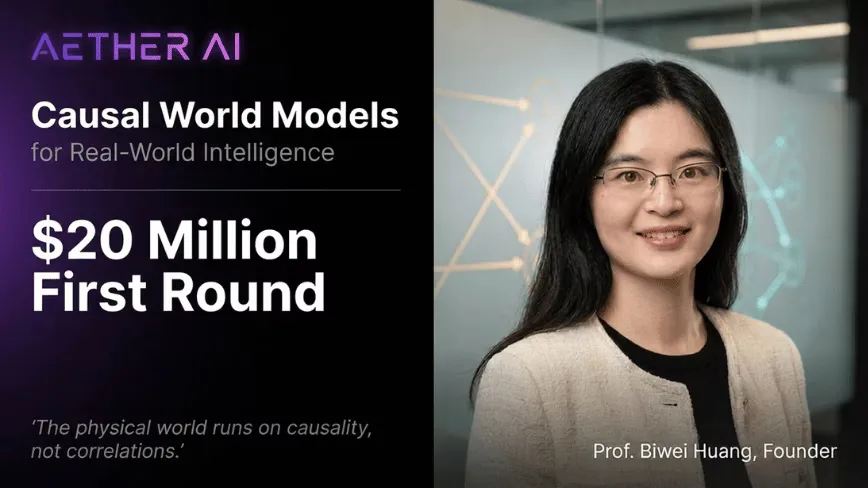
Aether AI, a San Diego startup, raised a $20 million seed round to pursue causal AI instead of the industry norm of scaling up models. For decision-makers, it signals a credible alternative thesis in model development: progress may come from teaching and causal structure, not size alone.
Most of the AI industry is betting that bigger models mean smarter machines. Aether AI is betting the opposite, and it just made the move with cash attached: the San Diego startup has raised a $20 million seed round to chase causal AI.
The core claim is simple and disruptive enough to annoy most model roadmaps: the founder believes the next leap will not come from scale. It will come from teaching machines. In other words, the startup is trying to win where “more parameters” might not solve the whole problem, and the funding is the evidence that at least some investors are underwriting this different path.
To understand why this matters, zoom out to the incentives that have dominated AI over the last couple of years. When a category is rewarded for benchmark improvements and rapid capability gains, scale looks like the fastest route. It is easier to operationalize than many alternatives: buy more compute, train bigger networks, iterate on architectures, then chase the metrics that move product adoption. Bigger models tend to be measurable, so capital can flow with confidence.
Causal AI and “teaching” offer a different promise. Instead of treating the model as a black box that learns statistical patterns from massive data, causal approaches aim to ground reasoning in cause and effect. “Teaching machines” can be read as a push toward learning methods that better encode how actions lead to outcomes, not just what text or tokens correlate with what. That shift can matter enormously for real-world systems, where correlation is cheap but reliability under change is the hard part.
The fact that this bet is happening at seed stage also changes how to interpret it. Seed rounds are typically where founders argue for a thesis, show early technical direction, and attract people who believe the market might be mispriced. A $20 million seed is not just a check. It is a signal that investors see enough potential in the idea of causal AI to fund exploration, even while the industry’s mainstream is still largely scale-first.
There is also a second-order implication for boards and executives: portfolio strategy may need to accommodate thesis diversity, not just execution speed. If the “scale wins” narrative is the only narrative that gets funding, then even teams with compelling approaches can end up starved when they do not fit the dominant pattern. Aether AI raising at all suggests some decision-makers are actively looking for alternative mechanisms of progress, meaning evaluation criteria could broaden beyond model size and benchmark points.
Regulatory framing is part of the context too, even if the source does not cite a specific regulator or rule. As AI capabilities accelerate, governments and regulators worldwide tend to focus on accountability, safety, and explainability, especially when systems make decisions that affect people. In that environment, approaches that emphasize causal structure can be attractive because they potentially align with how regulators think about responsibility: not only “what the model outputs,” but “why it outputs it” and “what would cause it to change behavior.” That alignment is not automatic, but it is plausibly easier to argue when the technical narrative is centered on cause, not just pattern recognition.
For operators and investors watching the space, the strategic stakes are clear. If the next leap truly comes from teaching machines rather than scaling them, then the cost curve and competitive dynamics change. Compute-heavy advantage could be less decisive, and research, data selection, training procedures, and causal modeling could rise in relative importance. That is the kind of shift that can redraw which teams become category leaders and which ones get squeezed.
Aether AI landing $20 million seed money for causal AI does not prove the thesis is correct. But it does something just as important for decision-makers: it turns an argument into an investment direction. The broader market has been rewarding scale as a shortcut to capability. This startup is using capital to test whether smarter systems can emerge from teaching machines how cause and effect work. If it works, it will force everyone else to rethink what “progress” really means in AI.
This story's Key Insights and Take-aways are locked.
Create a free account to unlock Executive Actions for one credit.
Register to UnlockAlways free for Executives Club members. Join the Club
More in Business

A flaw in PHP just forced governments to pull their own sites offline
European agencies from Belgium to Germany took websites dark to patch a critical weakness in the language behind almost 70% of the web, and the blast radius extends far beyond government portals.

BioWare shuts down, Mass Effect 5 dead after $55B EA buyout
The legendary RPG studio's closure lands months after a $55 billion investment group buyout of EA, raising tough questions for gaming's biggest acquirers.

Musk weighs Tesla-SpaceX mega-merger as boards form review panels
Special committees at both companies will examine a tie-up that could fuse electric vehicles and space launch, forcing a fresh look at governance and valuation.