

AI finds 7 new quasar lens candidates in DESI data, published July 22
The seven gravitational lens systems could let astronomers study growing supermassive black holes without being blinded by quasars.
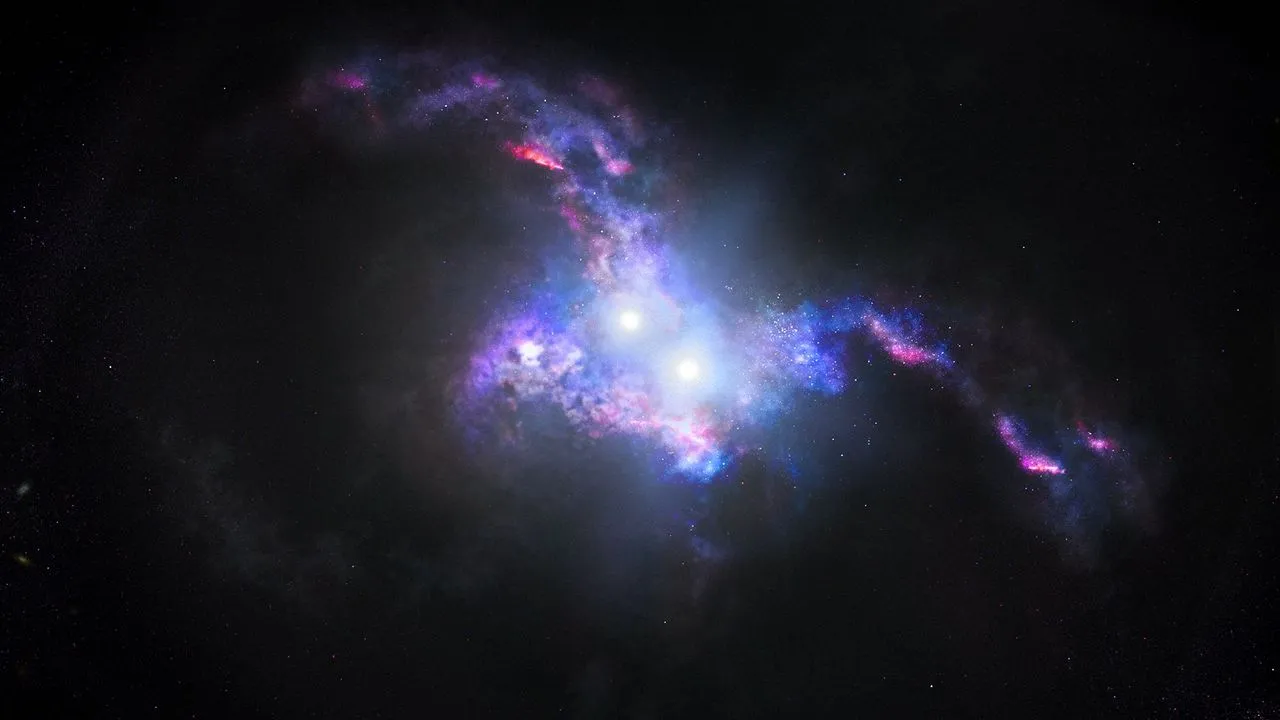
Everett McArthur, lead author of the study, and a research team used AI on DESI data to identify seven quasar gravitational lens candidates. For decision-makers, it signals how massive survey datasets can be turned into rare, high-value insights with less manual search.
Artificial intelligence just surfaced seven rare quasars that behave like natural gravitational lenses. Using data from the Dark Energy Spectroscopic Instrument (DESI), astronomers identified seven promising candidates where the gravity of a foreground mass bends and magnifies light from a more distant source. The work, published July 22 in The Astrophysical Journal, is not a cataloging exercise. It is a new pathway to studying how actively growing supermassive black holes evolve, at a time when modern observatories are generating datasets too large to search by hand.
The immediate reason these seven objects matter is straightforward: quasars are extremely bright centers of galaxies powered by actively feeding supermassive black holes. As those black holes pull in gas and dust, they release so much energy that quasars can outshine their entire host galaxies, making it hard to study the galaxy itself. Gravitational lensing offers a workaround. In lens systems, the quasar and the distant galaxy whose light is being magnified are both available to researchers, giving a unique opportunity to observe both components rather than only the glare.
This is why the “finding” itself is the story. The team began with a catalog of roughly 800,000 quasars identified by DESI. They then used a machine-learning model to search for subtle signatures of gravitational lensing in that huge set. Here is the constraint that shapes everything about the method: because so few quasars acting as gravitational lenses are known, researchers had little real-world data to train the AI model. Training an AI on a scarce label set is like trying to learn a language without ever hearing enough sentences. So the researchers generated simulated examples of these cosmic alignments first, letting the algorithm learn what lensing should look like before it ever “saw” the DESI catalog.
Once trained, the AI narrowed the search to about 200 candidates. Those were then reviewed manually by the research team. That combination matters for readers thinking in terms of operations and process, not just astronomy. Full automation would have been risky because the signal is rare and the dataset is huge. Full manual search would have been impossible at this scale. The output, after AI filtering plus human review, was seven new quasar lens candidates. The discoveries roughly double the number of known systems found through similar survey searches, according to the statement.
For context, DESI is mapping millions of galaxies and quasars, creating an enormous archive that would be nearly impossible to search by hand. The second-order implication for anyone watching the evolution of data-driven science is that “big data” alone does not produce breakthroughs. The breakthroughs come when you pair it with smart search strategies that acknowledge constraints in training data and then reduce the candidate set to something humans can validate. In other words, this is an applied lesson in how to turn survey-scale discovery pipelines into actionable targets.
The work also highlights why gravitational lensing is such a valuable observational tool. In a cosmic deep field, lensing can appear as “glowing spots” in some cases while producing “lines” in others, depending on how light is deflected. For quasars, those lensing signatures can encode information that would otherwise be washed out by the quasar’s own brightness. If follow-up observations confirm these new candidates, researchers would be able to investigate how supermassive black holes shaped the galaxies around them, leveraging the lensing magnification to see structure that would be difficult or impossible to extract from direct observation.
There is, of course, the next step beyond candidate identification. Follow-up observations will be needed to confirm the newly identified quasar lenses and to study their properties in greater detail. But even at the “candidate” stage, the paper positions the results as a proof of concept: AI can uncover rare cosmic phenomena hidden within enormous sky-survey datasets, and these rare phenomena can unlock questions about black hole and galaxy evolution.
For peers in adjacent fields, the strategic takeaway is simple and not restricted to astronomy. When you are sitting on a dataset the size of a planet, the bottleneck is usually not collection. It is retrieval, triage, and validation of rare events. This July 22 study shows one workable pattern: simulate to train when real labels are scarce, use AI to shrink the search space dramatically, then apply manual review before committing telescope time. For executives and research leaders, that translates into a familiar governance question: how do you scale insight without losing confidence in what you are claiming? This is one credible answer, written in the language of gravity and light.
This story's Key Insights and Take-aways are locked.
Create a free account to unlock Executive Actions for one credit.
Register to UnlockAlways free for Executives Club members. Join the Club
More in Science

Alaska's 1,580-foot tsunami had warning signs. Scientists just found them.
Rapid glacier retreat, heavy rainfall, and thousands of tiny tremors preceded Alaska's 1,580-foot tsunami, a warning for every coastal community in a warming world.

The rare mutation that lets high-risk brains dodge Alzheimer's
Scientists found a natural defense against protein buildup, opening a new path to preventive treatments.

3,000 steps a day may halve Alzheimer's decline, study finds
New research links a modest daily walk to less tau buildup and nearly half the cognitive and functional decline, even for those with early signs.