
Amazon’s $35 DIY Bluetooth speaker kit goes glue-free and still blasts music
A battery-powered, snap-together kit turns STEM curiosity into an actual portable speaker with Bluetooth 5.0 and 20 LED lights.
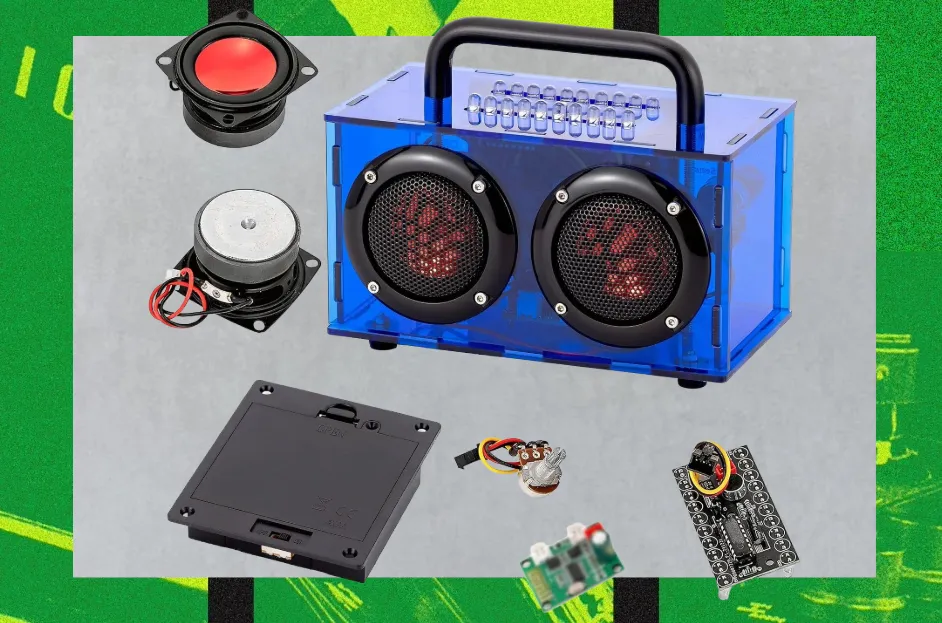
Amazon is selling a $35.99 Bluetooth speaker DIY kit that lets users build a brick-size wireless speaker with pre-fixed wiring and no gluing or soldering. For decision-makers, it is a reminder that product experiences, not just specs, are becoming the battleground for consumer audio adoption.
Sure, Bluetooth speakers are everywhere. But an Amazon DIY kit that costs $35.99 and lets you build a working, portable wireless speaker is a different kind of pitch. It is not just another gadget you buy and unbox. This one is built to be assembled, taught, and played, combining STEM learning, sound engineering concepts, and hands-on assembly into a speaker that can actually play music.
Here is the headline truth in plain terms: the kit is designed so there is no gluing or soldering required. Instead, the wiring is pre-fixed to individual boards, and those boards snap together. You are still going to need batteries, because batteries are not included, but the core build friction is taken out. The finished speaker is described as approximately 6 x 3.2 inches, or 6 x 4.9 inches with the handle up, and it is meant to be lightweight enough to take along to “play dates and parks alike,” not just sit on a shelf like a science project that never got finished.
Why does this matter beyond the cute “build it yourself” angle? Because in audio, customers can buy features like Bluetooth version upgrades and LED effects, but they cannot easily buy the sense that the device was earned. This kit leans into that payoff. It is housed inside an acrylic shell, the sound comes from two cones, and it includes built-in handle plus 20 LED lights that pulse to your music. That LED detail is not just decoration. It gives immediate feedback that the system is working, which is exactly what you want in a kit where the user experience has to survive assembly mistakes, wiring confusion, and the inevitable first-time build nerves.
Connectivity is also not treated as an afterthought. The kit connects to a phone or laptop via Bluetooth 5.0. And reviewers say the sound is surprisingly loud for the speaker’s size. For executives watching consumer devices, the point is not whether this kit will compete with high-end audio hardware. It is that “small, DIY, surprisingly loud” is a recognizable formula for lowering adoption friction. Consumers are often choosing between “buy now and hope it works” and “I could figure it out later.” This product collapses that distance by packaging the technical unknowns into pre-fixed components and snap-together assembly.
The kit comes in four colorways, including a black version and a translucent blue version that lets you see the working components inside. That design choice does two things at once. It makes the speaker look like more than a black box, and it also reinforces the learning element. If you are building for kids, a clear window into internal components makes the learning tangible. The source notes that the kit is designed to promote STEM learning with kids, but it also calls out that it can be a great gift for music fans of all ages. In other words, the positioning is intentionally broad, which matters because education-themed products often struggle when they cannot expand beyond classrooms and parent shopping.
What about credibility? The set has a 4.8-star rating out of five from reviewers, according to the source. Ratings are not engineering validation, but they do act like a market signal for execution quality. If the snap-together wiring truly works, if the acrylic shell holds up, and if the Bluetooth pairing behaves, users will say so quickly. They will also return the kit quickly, but the existence of that high rating suggests the build is not merely “fun in theory.”
Billboard also points to a second DIY audio option on Amazon: a kit that combines a working FM radio and a mini Bluetooth speaker made out of wood. That kit is $16.99 and includes an antenna. The speaker delivers three watts of sound. Power can come from three AA batteries, not included, or via a USB cable charge. The completed design resembles a cat’s face with pop-up ears, and Amazon says it is ideal for children ages 8-12. Reviewers, however, suggest it may be better suited to slightly older ages due to component complexities.
So what is the second-order takeaway for decision-makers? The DIY audio category is not only selling sound. It is selling an experience that bundles education, sensory feedback, and assembly simplicity into a product users can complete. That experience is a distribution advantage because it turns the device into an event: build it together, test it immediately, and then use it as a portable speaker with Bluetooth 5.0 and visible LED activity. When you are competing for consumer attention against a flood of off-the-shelf Bluetooth speakers, an “assemble it, and it lights up” story can outperform feature lists, especially at a price point like $35.99 where customers are willing to experiment.
For boards and operators, the real strategic stakes are simple: if consumers start expecting interactive, lower-friction build experiences, then future product roadmaps in consumer tech and audio need to account for the entire lifecycle, not just manufacturing. That includes how components are presented, how assembly is supported, what power users must provide (batteries not included), and whether the product delivers instant proof it works. The market is not waiting for the next spec race. It is rewarding products that make “working” feel inevitable, even when the user is the builder.
This story's Key Insights and Take-aways are locked.
Create a free account to unlock Executive Actions for one credit.
Register to UnlockAlways free for Executives Club members. Join the Club
More in Entertainment

12TB Steam 'teraleak' goes beyond Valve: GTA 3, Mafia 2 prototypes exposed
A 12-terabyte dump of Steam data reveals prototypes and builds of third-party classics like GTA 3 and Mafia 2, plus unreleased Valve content, rewriting game history.

LinkedIn's romance problem: 1 in 4 workers say dating on it is fair game
A new survey shows a quarter of U.S. employees treat the professional network as fair game for romance, even as LinkedIn bans it and removes hundreds of thousands of offending posts.

Enhypen's first No. 1 album breaks K-pop's Billboard 200 streak
The K-pop group's 98,000-unit debut tops the chart while Dolly Parton's catalog reentry shows how death reshapes streaming.